

FTSE Slides Into the Close as Gold Miners Drag and Rate Worries Return
London turned decisively lower into Thursday’s close, with the FTSE 100 down around 0.6% and trading near the low of the day as weakness in precious metal miners, renewed rate anxiety and caution around commodity-driven inflation overwhelmed earlier support from energy shares. The move marked a clear deterioration from the morning session, when the index had been little changed, and energy gains were helping cushion the market. By late trade, however, the tone had shifted. Investors were no longer simply rotating between stronger oil names and weaker gold miners; instead, they were cutting risk more broadly as central-bank concerns and geopolitical energy risks came back into focus. The blue-chip index’s late slide also took some of the shine off Wednesday’s CPI-driven rally, when the FTSE reached 10,747.00, its highest level since March 2026. Softer UK inflation had briefly encouraged hopes that the Bank of England could stay patient, but Thursday’s price action showed that investors remain nervous about whether renewed Middle East tensions could reverse that disinflation trend.
Energy shares were one of the few supports. Oil prices rose after Yemen’s Houthis said they had struck two Saudi oil tankers, raising concerns that disruption to global oil supply could spread beyond the Strait of Hormuz. The news added another source of geopolitical risk to an already tense Middle East backdrop and helped lift crude prices. That supported the FTSE’s energy complex, but the gains were not enough to hold the broader market up. Higher oil is a double-edged sword for London: it helps the earnings outlook for Shell (SHEL), BP (BP) and other energy-linked names, but it also revives inflation concerns, increases costs for businesses and threatens consumer spending power. By the close, investors appeared more focused on the macro damage from higher energy prices than on the index support from oil majors.
Precious metal miners were the main drag. The sector fell sharply, down about 2.5%, as gold prices weakened. The pressure came from renewed concerns that persistent inflation could force the U.S. Federal Reserve to raise interest rates later this year. Higher rate expectations tend to weigh on gold because it offers no yield, and that translated into selling across London’s precious metal mining names. The weakness in gold miners was especially important because miners had helped lead the FTSE higher earlier in the week. Thursday’s reversal therefore looked less like a pause and more like a rotation away from one of the market’s recent leadership groups. With energy higher but precious metals lower, the commodity complex sent a mixed and uncomfortable signal: geopolitical risk is supporting oil, while rate risk is undermining gold.
The European Central Bank added to the cautious mood. The ECB left interest rates unchanged, as widely expected, following last month’s 25 basis point increase, which took the deposit facility rate to 2.25%. But President Christine Lagarde’s tone kept another September rate rise firmly on the table. That mattered for UK equities because it reinforced the message that central banks are not yet ready to declare victory over inflation. The ECB’s hawks remain concerned that headline inflation is still above target and could rise again if Middle East tensions keep global energy prices elevated. Oil prices have moved back toward the levels embedded in the ECB’s June baseline projections, which assumed that further tightening would be needed to return inflation to target over the medium term. For investors, that was a reminder that the recent inflation relief may not be durable.
The Bank of England appears to be in a somewhat more comfortable position, but Thursday’s market reaction showed that comfort has limits. UK CPI has now surprised to the downside for three consecutive reports, helped by a deceleration in food prices. June headline inflation eased to 2.6% from 2.8%, below consensus and well below the BoE’s projected path. That gives the MPC room to hold rates at 3.75% for now. But the communication challenge remains difficult. Underlying inflation is still too high, energy costs are edging back toward their highs, and the pass-through into household bills tends to lag. Natural gas and refined products are particularly important risks. With demand still showing resilience and the labour market steadier than feared, the BoE cannot ignore the possibility that producer-level cost pressures could rebuild.
Corporate earnings added to the stock-specific volatility. EasyJet rose 5.5% after reporting a 70% decline in third-quarter profit, as the result still came in ahead of analysts’ expectations. The airline said the Iran war had contributed to volatile fuel prices and made travellers more cautious, but investors focused on the better-than-feared earnings and the possibility of clearer conditions during the peak summer travel period. Howden Joinery also gained, rising 1.6% after maintaining its annual outlook and saying it had hedged fuel costs through the end of the year. In a market worried about energy volatility, that cost protection mattered. Companies able to show fuel hedging, pricing discipline or margin resilience are being treated more favourably than those exposed to sudden input-cost swings. Jupiter Fund Management fell 2.6% despite reporting a 67% increase in first-half pre-tax profit. The decline suggested investors were focused less on the headline profit number and more on forward-looking concerns such as flows, fee pressure, margins or the sustainability of earnings. Asset managers remain highly sensitive to market confidence, and Thursday’s broader risk-off tone did not help.
Domestic policy remained in focus after Prime Minister Andy Burnham announced that business rates for pubs, clubs and live music venues would be reduced by 20% from April. The measure, his third in three days aimed at supporting households and businesses, was targeted at some of the economy’s most pressured consumer-facing sectors. It also followed renewed evidence of strain in hospitality, including Wetherspoon’s profit warning earlier in the week. For markets, however, the fiscal question remains central. Business-rate relief may help vulnerable firms, but investors will continue to ask how the policy is funded and whether it fits inside a credible broader fiscal framework. June borrowing was slightly better than expected, giving Burnham a less difficult starting point than feared, but the margin for error remains narrow. Gilt yields remain the market’s main scoreboard for confidence in the new government’s approach.
Finish Line: The FTSE 100 weakened into the close, down around 0.6% and near the low of the day, as losses in precious metal miners and renewed rate concerns outweighed support from higher oil prices. Energy shares gained after Houthi attacks on Saudi tankers lifted crude, but the broader market focused on the inflationary consequences of another energy shock. Gold miners fell about 2.5% as higher-rate fears pressured bullion. The ECB held rates but kept a September hike alive, reinforcing concerns that central banks may not be finished if energy prices keep rising. For the UK, three downside CPI surprises still support a BoE hold at 3.75%, but rising energy costs and producer pressures mean the policy backdrop remains unsettled. Burnham’s business-rate cut offers targeted relief, yet investors are increasingly focused on whether the new government can support households and firms without weakening fiscal credibility.
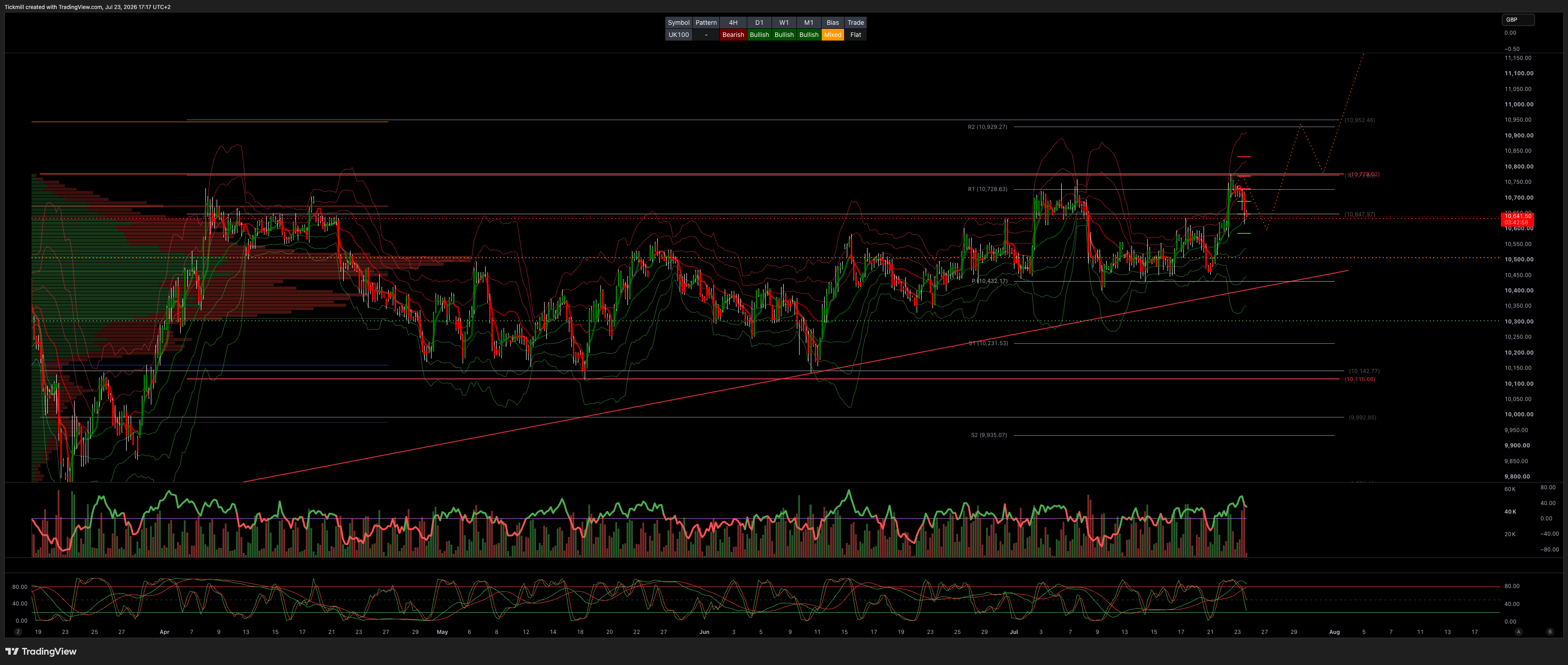
TECHNICAL & TRADE VIEW – FTSE100
Daily VWAP Bullish
Weekly VWAP Bullish
Above 10500 Target 11000
Below 10400 Target 9500


Comments
Log in or sign up to join the conversation.