


Global equities fell Tuesday as renewed concerns around the AI complex hit sentiment and pushed investors toward safer assets. The MSCI Asia Pacific Index dropped 1.7%, on track for its lowest close since August, while US and European equity futures also declined after a Wall Street selloff drove the Nasdaq 100 to its weakest level this month.
The pressure was most acute in Asia’s technology space. South Korea’s Kospi slumped 6.5%, with SK Hynix and Samsung both down around 8%, as investors worried about rising Chinese competition and crowded AI positioning. Similar weakness spread across Japanese and Taiwanese tech names. The move highlights a growing market sensitivity: AI remains the dominant equity theme, but valuations are now vulnerable to any sign of margin pressure, competition or slower monetisation. Tencent’s planned bond offering, potentially raising around $5bn to fund expanding AI investment, added to the debate. The broader question is whether AI capex is being financed by cash-flow-rich winners or increasingly through larger debt issuance. Investors are still willing to fund AI infrastructure, but the hurdle rate is rising as rates remain high and earnings visibility becomes more important.As equities sold off and oil eased, government bonds caught a bid. Treasury yields fell across the curve, with the US 10-year yield down 4 bps to 5.26%. Australian and New Zealand bonds also rallied. The move suggests the market is leaning back toward a defensive growth-risk interpretation, at least for now, rather than treating the latest equity weakness as a purely sector-specific correction.
Brent crude slipped 1% to around $105.60/bbl. The decline offered some relief, but oil remains high enough to keep inflation risks alive. For central banks, lower daily oil prices are helpful only if they persist. With Middle East tensions still elevated and supply risks unresolved, energy remains a key upside risk to this week’s inflation data and to the broader policy outlook. In FX, the Dollar gauge dipped, snapping a four-day winning streak. India’s Rupee extended Monday’s gains after the central bank introduced additional measures to support the currency in response to higher oil prices and foreign capital outflows. The move underlines the pressure facing oil-importing emerging markets when crude is elevated, global yields are high and risk appetite weakens.
The main macro event remains Wednesday’s US CPI report. Consensus expects headline inflation to reaccelerate to 0.6% m/m and 3.6% y/y from 3.4%, largely due to oil-related transport costs. Core CPI is expected to edge up to 2.5% y/y from 2.4%. A hotter print would complicate the Fed’s ability to lean into patience after softer payrolls and cooler PCE revisions.The distinction between headline and core will be crucial. The Fed can look through an energy-driven rise if inflation expectations remain stable and underlying services pressures are contained. But if oil pass-through appears broader, into transport, goods or logistics, markets may need to rebuild some probability of further tightening. That makes this week’s CPI, PPI and import/export price data central to the October policy debate.
Fed speakers remain important in the final week before the blackout. Markets will listen for whether officials view recent bond-market tightening and softer labour data as sufficient reason to pause, or whether renewed energy inflation keeps a tightening bias in place. The equity selloff gives the Fed another financial-conditions variable to consider, but inflation remains the gating factor.
In Europe, French fiscal risk is returning to focus. The National Assembly begins debating tax measures in the 2027 budget, while the IMF’s latest World Economic Outlook may sharpen attention on fiscal sustainability. France’s challenge is that the political process remains fraught, and even the current budget path only brings the deficit down to around 5% of GDP, still a high level for a large Eurozone sovereign. The key market question is whether French spread widening could eventually trigger ECB intervention via the Transmission Protection Instrument. For now, the bar looks high. There is a strong case that wider French spreads reflect fundamentals: elevated deficits, political uncertainty and weak fiscal credibility. That is different from disorderly or unwarranted market conditions detached from underlying economics.
However, spillover risk is rising. The Italy-Bund spread has long been closely tied to broader risk sentiment, but more recently French spread stress appears to be dragging Italian spreads wider too. That matters because Italy’s fiscal path looks less concerning than France’s, with the IMF previously forecasting Italy’s deficit at roughly half the size of France’s next year. If French stress increasingly contaminates markets where fundamentals are more stable, ECB intervention risk will move higher on the agenda. For now, the ECB is more likely to rely on communication than action. But the evolution of contagion will matter. A French-specific repricing is one thing; a broader fragmentation shock is another. Markets will watch whether OAT weakness remains contained or becomes a driver of wider peripheral pressure.
In the UK, rates markets have repriced sharply, reflecting a meaningful degree of MPC convergence toward a more hawkish Fed path. The question is whether that pricing is consistent with the domestic macro backdrop. The MPC faces a less favourable trade-off than the Fed, given weaker household resilience, higher sensitivity to mortgage costs and a likely disinflationary impulse from energy base effects. Hikes priced beyond November therefore look harder to justify. Policy lags, rising unemployment risks and weakening consumption argue against mechanically importing the Fed’s tightening path. The UK economy may have shown near-term resilience, but unsecured credit stress, fiscal drag and higher winter energy costs leave households exposed.
The inconsistency is visible across markets. Gilts imply a meaningful policy response to the Fed, but inflation markets, the RPI-CPI wedge and parts of the GBP swaption surface still price outcomes that sit uneasily alongside that path. In short, UK markets are not telling one coherent story. Sterling will be critical. A resilient Pound would give the MPC more scope to resist following the Fed and preserve optionality after a likely November hike. Further GBP weakness, however, could force a more hawkish response, even though the evidence that higher UK rates provide durable currency support remains limited. That tension creates potential dislocations as markets resolve whether the UK follows the Fed or reasserts its domestic growth constraints.
China also remains in focus after the recent EU-China trade agreement. The 16-point deal covering trade, investment, export controls and intellectual property suggests both sides want to avoid an uncontrolled trade conflict. But prospective EU safeguards on imports, including hybrid vehicles, mean friction is being managed rather than eliminated. For global equities, that matters because AI, autos, semiconductors and industrial policy are increasingly linked.
Macro to Micro, markets are moving from AI euphoria to AI scrutiny. Asian tech weakness, falling US futures and a bid for bonds show that investors are reassessing stretched positioning and valuation risk. Oil has eased but remains high, gold remains supported, and Wednesday’s US CPI is the key macro test. In Europe, French fiscal contagion risk is back on the radar, while UK rates pricing looks increasingly stretched versus domestic fundamentals. For traders, the focus is Nasdaq breadth, Korean tech, Brent, US CPI, French spreads, Sterling and whether bond strength reflects healthy disinflation hopes or rising growth anxiety.
Overnight Headlines
Trump Does Not Believe China And Russia Are Helping Iran 'At All'
Saudi: Houthi Ballistic Missile Intercepted Over Riyadh, Khamis Mushait
Supertankers Turn From Gulf Oil Transfer Hub Amid Iran’s Attacks
Kyiv: Russia Hits Energy Targets Despite Trump Ceasefire Announcement
Mortgage Shock Sends US Pending Home Sales To Near 12-Year Low
Hammack Backs Restrictive Policy, Says Better If It Comes 'Relatively Quickly'
Germany, Italy Request ‘Emergency Brake’ Power To Stop New EU Laws
Bank Of France Estimate French Third-Quarter Growth At 0.1%
Italy Exit From EU Budget Procedure At Risk Due To Deficit Increase
UK Shoppers Stay Cautious As Fuel Costs Bite, Surveys Show
Burnham To Push For New Post-Brexit Deals At EU Summit
Japan’s Producer Prices Cools, Indicating Room for BOJ to Wait
Wall Street Revives the Case For Scrapping The US 20-Year Bond
LVMH Sales at Key Unit Tumble on Weaker Demand in China
Nvidia's China AI-Chip Share Falls As Huawei Closes Gap, Report Finds
Meta Says Its New AI Models On Par with OpenAI, Anthropic
Microsoft Prepares To Put Gigawatts Of Its Chips In Data Centers
Applied Materials Will Double Sales, Not Headcount, Thanks To AI
FX Options Expiries For 10am New York Cut
(1BLN+ represents larger expiries and is more magnetic when trading within the daily ATR.)
EUR/USD: 1.1290 (EU1.61b), 1.2750 (EU1.22b), 1.1300 (EU963.7m)
USD/JPY: 158.00 ($683.8m), 154.00 ($650m), 156.50 ($560.3m)
AUD/USD: 0.6950 (AUD850m), 0.6935 (AUD431m), 0.7050 (AUD324.3m)
USD/CAD: 1.3842 ($436.7m), 1.3840 ($426.3m), 1.3850 ($331m)
USD/BRL: 5.1225 ($612.8m), 5.5500 ($578.4m), 5.1355 ($448.3m)
USD/MXN: 17.27 ($364.3m), 16.81 ($325m)
NZD/USD: 0.5860 (NZD461.6m), 0.5760 (NZD386.6m), 0.5775 (NZD382.5m)
CFTC Positions as of 9/10/26
Equity fund speculators increase S&P 500 CME net short position by 41,003 contracts to 396,700
Equity fund managers raise S&P 500 CME net long position by 3,101 contracts to 904,356
Speculators increase CBOT US 5-year Treasury futures net short position by 167,830 contracts to 1,163,531
Speculators trim CBOT US 10-year Treasury futures net short position by 4,134 contracts to 896,481
Speculators increase CBOT US 2-year Treasury futures net short position by 60,880 contracts to 852,904
Speculators trim CBOT US UltraBond Treasury futures net short position by 50,097 contracts to 276,339
Speculators trim CBOT US Treasury bonds futures net short position by 67,063 contracts to 119,812
Bitcoin net long position is 2,540 contracts
Swiss franc posts net short position of -23,740 contracts
British pound net short position is -97,611 contracts
Euro net short position is -99,332 contracts
Japanese yen net long position is 62,325 contracts
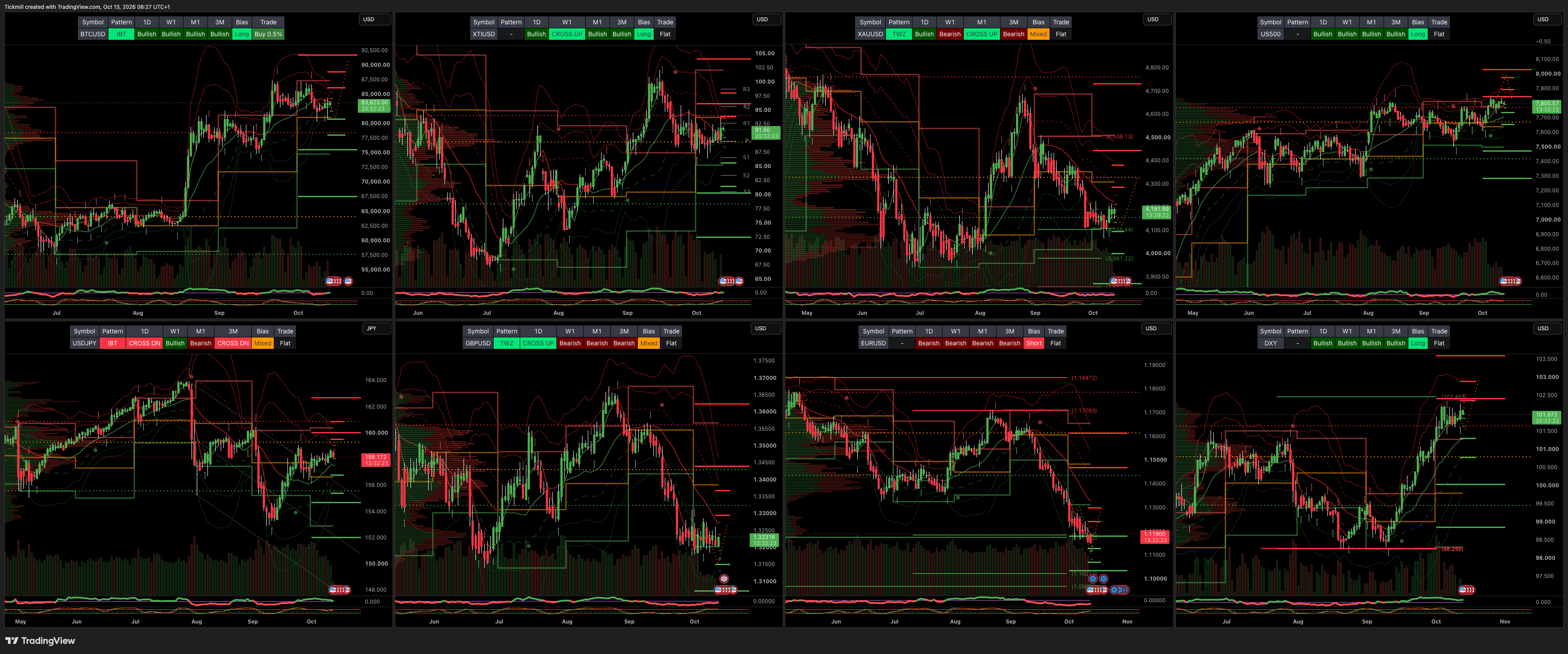
Technical & Trade Views



Comments
Log in or sign up to join the conversation.