

Defensives Lift London as Mann Pushes Back Against Rate-Cut Hopes
London moved higher on Thursday, supported by defensive healthcare, beverage and grocery stocks, even as investors absorbed more hawkish commentary from Bank of England policymaker Catherine Mann, rising gilt yields and a fresh batch of signals showing that UK businesses and borrowers are still under pressure. The FTSE 100 found support from its defensive core rather than from a broad cyclical rally. Healthcare led the advance, with the healthcare sub-index rising 1.4%. AstraZeneca (AZN) gained 1.4% after agreeing a deal worth up to $1.77 billion with China’s CSPC Pharmaceutical Group to develop kidney disease treatments. The deal reinforced AstraZeneca’s role as one of the FTSE’s key quality growth anchors, especially on days when investors prefer earnings visibility over macro sensitivity. Consumer staples also performed well. Tesco, Coca-Cola HBC (CCH) and J Sainsbury rose between 1.8% and 2.6%, helping steady the index while commodity and rate-sensitive areas remained more mixed. The leadership profile was defensive: healthcare, beverages, and food retail attracted demand as investors looked for resilient cash flows amid geopolitical and central-bank uncertainty.
The more important macro signal came from Catherine Mann. Her comments at the Natixis conference were notably hawkish and contrasted with Andrew Bailey’s more cautious tone earlier in the week. Mann said she has placed more weight on inflation persistence since the Iran war and that her view has shifted away from considering a rate reduction toward a longer hold, with a potential need to lean against inflation risk. That matters because markets have been trying to decide whether the Bank of England is moving toward cuts, a prolonged pause, or another hike. Mann made clear that, for her, the balance of risks has moved away from easing. She said tightening the Bank Rate could have made sense in June, although market rates had already tightened considerably in nominal terms. In other words, she did not vote for a hike, but she did not sound comfortable with inflation risks either. Her phrase “activist hold” is the key. Mann described the June decision as an activist hold, meaning the Bank can keep policy restrictive without necessarily raising rates immediately. But she also warned that if future data are unfavourable to inflation, an activist move may be needed to bring inflation expectations and outcomes back to target. The forward-looking watchlist from Mann was clear: energy prices, profit-margin behaviour and 2027 wage negotiations. Those are the channels through which the Iran conflict could become more than a temporary price shock. If firms rebuild margins, if energy volatility feeds into broader pricing, or if wage bargaining embeds higher inflation expectations, the BoE may need to stay tighter for longer. That message landed as gilts weakened. The UK 10-year yield rose about 5bp to 4.81% ahead of the U.S. jobs release, while the UK sold £3.25 billion of 2037 gilts at an average yield of 4.934%, with a bid-to-cover ratio of 3.31 times. The auction demand was healthy, but the yield level underlined the price of financing in the current environment. For equities, especially domestically exposed and rate-sensitive names, elevated gilt yields remain a major valuation headwind.
The Bank of England’s Q2 Bank Liabilities Survey and Credit Conditions Survey added to the sense that monetary transmission is still working through the system. Investors were watching for signs of tighter funding conditions, changes in lender risk appetite and whether households and businesses are finding credit harder to access. Together with this week’s weaker mortgage approvals and flat Nationwide house-price data, the surveys reinforce the idea that the economy is softening even before any clear easing cycle begins. Business sentiment also deteriorated. The Institute of Chartered Accountants in England and Wales said its Quarterly Business Confidence Monitor fell to its lowest level since the fourth quarter of 2022 in the three months to June, with the Iran war pushing up costs and worsening corporate mood. That is an important detail for the earnings outlook: if higher energy and input costs squeeze margins while demand softens, companies may struggle to protect profits even without a recession.
Geopolitics remained unsettled but slightly less alarming for oil supply. Iran and the U.S. concluded indirect talks in Doha on Wednesday without a clear breakthrough toward a lasting peace agreement. Even so, oil prices slipped as supply concerns around the Strait of Hormuz eased. Bloomberg reported that Saudi supertankers exited Hormuz in the kingdom’s biggest oil flow since the Iran war truce, adding to the perception that immediate shipping disruption risks have eased. That combination is awkward for the FTSE. Lower oil helps inflation and consumers, but it can weigh on the index’s energy-heavy earnings base. It also complicates the BoE picture: a lower oil price is disinflationary, but Mann’s concern is that the war may have already shifted expectations, margins and wage-setting behaviour. Politics also stayed in focus. Andy Burnham was due to hold a two-hour meeting with union general secretaries, a reminder that labour-market policy and public-sector pay will be central to the next phase of the UK political transition. Investors are likely to watch whether Burnham can balance union demands with fiscal credibility, especially as gilt yields remain elevated. At the same time, Burnham’s team is reportedly looking to revamp the UK’s AI strategy. That could matter for medium-term sentiment toward UK productivity, technology investment and industrial policy. AI has already been a driver of global equity optimism, and a credible UK strategy could help attract private capital. But for now, markets will separate long-term productivity promises from near-term fiscal and inflation risks.
For equities, Mann’s message was mixed but slightly restrictive. A softer economy reduces the case for aggressive BoE tightening, but persistent inflation reduces the case for cuts. That is not an easy backdrop for risk assets. Defensive equities can rally in a higher-rate environment if earnings are stable, but rate-sensitive sectors remain vulnerable. In individual stocks, Currys fell 3.7% after warning that a global memory-chip shortage could push up prices for smartphones, laptops and other electronics later this year. The update highlighted a new supply-chain risk just as consumer electronics demand remains sensitive to household budgets and financing conditions. Genel Energy rose 4.6% after the Kurdistan-focused oil and gas producer agreed to acquire Britain’s Capricorn Energy in a $360 million all-cash deal. The transaction added to the ongoing theme of corporate activity in UK-listed assets, with depressed valuations continuing to attract buyers.
The most bullish strategic call came from JPMorgan (JPM), which raised its 2026 year-end FTSE 100 target to 11,000 from 10,300. That upgrade fits the recent market narrative: despite weak domestic sentiment, political uncertainty and elevated gilt yields, the FTSE’s global earnings base, defensive composition, cheap valuation and lower technology concentration remain attractive for diversification. Still, the path to 11,000 is unlikely to be straight. The index needs a combination of stable gilts, contained Middle East risks, resilient earnings and no major inflation re-acceleration. Mann’s comments are a reminder that if inflation expectations move the wrong way, the BoE will not rush to support risk assets.
Finish Line: The FTSE 100 climbed as AstraZeneca, healthcare, beverages and grocery names carried the index higher, while JPMorgan’s upgraded 11,000 target added to the longer-term bull case. But Catherine Mann’s hawkish remarks pushed back against rate-cut hopes, framing June as an “activist hold” and warning that inflation persistence may require the Bank to lean harder against price risks. Rising gilt yields, weaker business morale, credit-condition concerns and Burnham’s looming union talks kept the rally cautious. London’s advance was defensive, not reckless: investors bought resilience while keeping one eye oil flows through Hormuz, Iran diplomacy and the BoE’s increasingly divided reaction function.
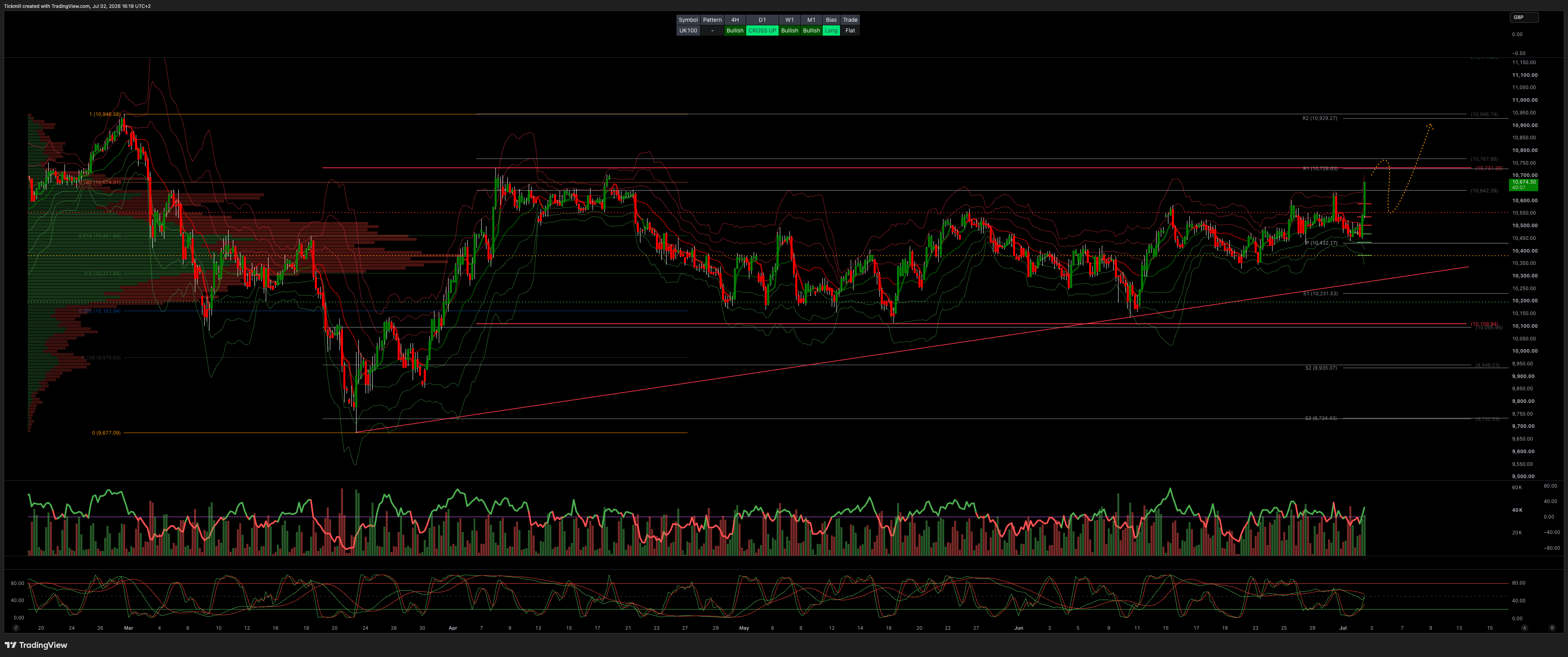
TECHNICAL & TRADE VIEW – FTSE100
Daily VWAP Bullish
Weekly VWAP Bullish
Above 10300 Target 11000
Below 10100 Target 9469

Comments
Log in or sign up to join the conversation.