

Peace Premium Powers London Pop
London finished the week with a proper risk-on burst. The FTSE 100 jumped 1.1% to 10,414.02 by late morning, while the FTSE 250 rallied 1.5%, putting both indices on course for weekly gains. The catalyst was geopolitical: President Trump said a peace agreement with Iran could be signed soon, raising hopes that the three-month conflict — and the shocking blockade of the Strait of Hormuz — may be nearing an end. That headline flipped the market script. The same Middle East escalation that had supported oil, defence and inflation hedges earlier in the week suddenly became a disinflationary tailwind. Crude prices dropped more than 4%, and the UK equity market rotated hard into the beneficiaries of lower energy costs and easier financial conditions.
Energy was the only major loser. The sector fell 3.6% as oil sold off, with investors quickly marking down the geopolitical risk premium that had been embedded in crude. If a deal is confirmed, the market will start pricing not just lower spot oil but also a reduced inflation impulse into the second half of the year. The winners were clear. Housebuilders led the charge, with Vistry up 6.6%, while Bellway and Persimmon gained around 4% each. The move makes sense: lower oil, softer inflation risk and reduced geopolitical stress all help the rate-sensitive housing complex. The sector remains exposed to mortgage affordability and weak transaction volumes, but Friday’s tape showed investors are still willing to buy builders aggressively when macro risk eases. Travel and leisure also caught a strong bid, rising 3.6%. Airlines were obvious beneficiaries of the oil move, with British Airways owner IAG and Wizz Air among the strongest names. For carriers, lower fuel prices are a direct margin tailwind, and a less hostile geopolitical backdrop also helps sentiment around summer travel demand.
The rally came despite a softer UK growth print. GDP fell 0.1% month-on-month in April, the first monthly contraction since August 2025 and in line with expectations. Services output was the weak link, down 0.2%, while production was flat and construction edged higher. On the surface, that looks like a poor start to Q2. But the detail is less alarming than the headline. April looks more like payback after a strong end to Q1 than the start of a clean downturn. GDP was still up 0.7% on a three-month basis, and the arithmetic means that even if May and June simply hold at April’s level, Q2 would still post around 0.2% quarterly growth. That would be slightly above the Bank of England’s April projection. So the activity message is not “recession now". It is more subtle: growth is fading from Q1’s 0.6% pace, but not collapsing. The economy is losing momentum, though probably not fast enough to force the Bank of England into an immediate dovish pivot.
The more important issue for Threadneedle Street remains inflation. The Bank of England’s quarterly survey showed long-term public inflation expectations rising to a record high, a development policymakers will not ignore. That matters more for the June decision than one soft monthly GDP print. If households and firms start to believe inflation will remain higher for longer, the MPC’s tolerance for weak growth falls. The base case remains that the MPC holds Bank Rate at 3.75% in June. But the vote split could turn more hawkish. April’s decision was 8–1 in favour of no change, with Huw Pill voting for a hike. This time, Megan Greene may join him in backing a 25bp increase, given her recent emphasis on acting early to stop inflation persistence from becoming embedded. A 7–2 hold would not change policy, but it would change the signal: the hawkish tail is still alive. For the rest of the Committee, patience still wins. There are no new forecasts at this meeting, and the July Monetary Policy Report offers a cleaner opportunity to reassess growth, inflation and labour-market conditions. The case for holding is helped by signs of employment weakness, including another drop in “employment activities” in the April GDP detail. That does not scream labour-market reacceleration.
Next week matters. The UK calendar is stacked: CPI on Wednesday, the labour-market update on Thursday, then GfK consumer confidence, public borrowing and retail sales on Friday. Headline inflation is likely to move back toward 3.0%, with core also nudging higher. That would keep the hawks engaged. But if wage growth cools and payroll weakness persists, the case for a broader MPC shift toward hikes becomes harder to sell. Politics is the other risk. The Makerfield by-election lands on Thursday, with results likely before Friday’s open. If Andy Burnham wins comfortably and returns to Westminster, markets will immediately frame it through the lens of pressure on Starmer and the possibility of a less stable fiscal strategy. Gilts are already carrying a political and fiscal risk premium; a messy result could keep that premium sticky.
Finish Line: London rallied on peace hopes, not domestic growth. The FTSE 100 and FTSE 250 both pushed higher as investors bought housebuilders, airlines and consumer cyclicals while dumping energy. April GDP was soft, but not disastrous; the bigger BoE problem is still inflation expectations and next week’s CPI/labour-market mix. For now, the market is trading the peace premium: lower oil, lower inflation risk and a bid for rate-sensitive equities. But with UK politics, CPI and payrolls all due next week, the relief rally still has plenty to prove.
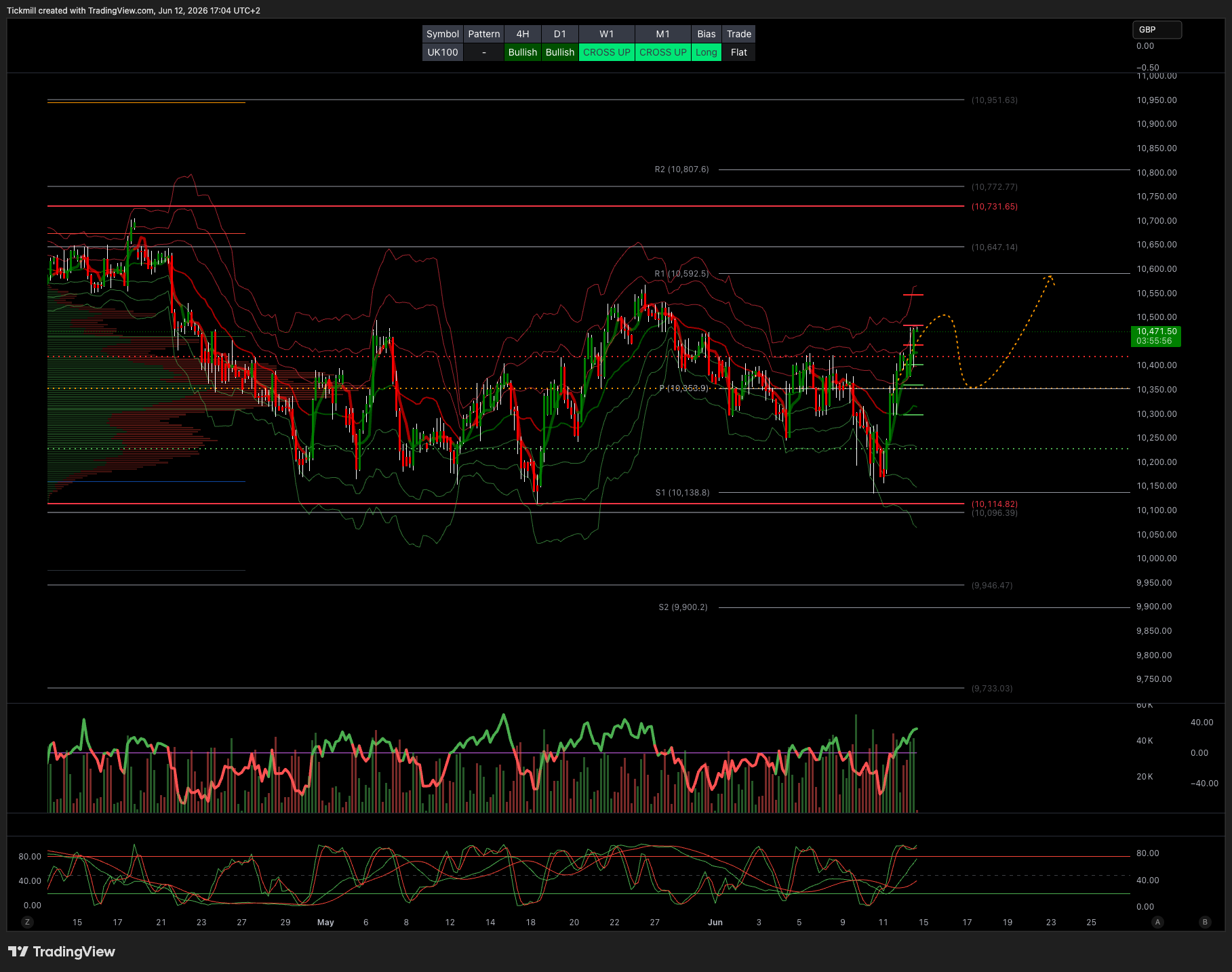
TECHNICAL & TRADE VIEW – FTSE100
Daily VWAP Bullish
Weekly VWAP Bullish
Above 10500 Target 11000
Below 10100 Target 9469
Comments
Log in or sign up to join the conversation.