


U.K. stocks turned in a mixed performance on Friday, with investors largely staying cautious after fresh data showed the British private sector remained in contraction for a second month. Miners and selected industrials found modest support, but banks, consumer names and defensives struggled as the market weighed soft activity data, elevated policy uncertainty and the next stage of the Labour leadership transition. The FTSE 100 lacked a clear direction. The index was not under heavy pressure, but the tone was hesitant. The main reason was the S&P Global PMI data, which showed that the U.K. economy is still losing momentum. The Composite PMI fell to 49.3 in June from 49.7 in May, revised slightly lower from the flash estimate of 49.4. That marked a second consecutive month of contraction after 11 months of expansion in private-sector activity.
The services reading was the bigger concern. The Services PMI dropped to 48.8 from 49.3, confirming that the largest part of the U.K. economy is now shrinking. Manufacturing remained in expansion but slowed, with the Manufacturing PMI falling to 52.5 from May’s 53.9. The split matters for markets: manufacturing is still holding up, but the U.K.’s growth engine is services, and that engine is showing strain. That activity backdrop reinforced the Bank of England’s wait-and-see stance. Governor Andrew Bailey has effectively signalled that rate cuts remain off the table for now because of concerns over delayed energy-price pass-through, while also acknowledging weakness in activity and softness in the labour market. Markets are broadly aligned with that message. Rate hikes are no longer fully priced for this year, although a quarter-point increase is still expected by April 2027. That is a difficult balance for equities. Softer growth argues against further tightening, but inflation persistence argues against cuts. The result is policy limbo: not hawkish enough to trigger a major sell-off, but not dovish enough to support a broad risk rally. Friday’s mixed market performance reflected exactly that.
Banks were among the weaker areas. Lloyds Banking Group, Barclays and NatWest drifted lower, alongside broader weakness in financials. With services contracting and the housing market still fragile, investors were reluctant to add exposure to domestic credit-sensitive names. A higher-for-longer rate environment can support margins, but only if loan demand and asset quality remain resilient. The PMI data did not strengthen that case. Consumer names were also under pressure. InterContinental Hotels Group fell 2.3%, while Diageo, Games Workshop, Entain, Tesco, Unilever, Reckitt Benckiser, Kingfisher, Marks & Spencer and J Sainsbury declined between 1.3% and 1.7%. Next, Bunzl, Imperial Brands, British American Tobacco, IAG and Babcock International also moved lower. The weakness across retailers, staples, leisure and travel suggested investors were taking a more cautious view of household demand. Food retailers had helped lift the market earlier in the week, but Friday’s move looked like profit-taking mixed with concern that weaker services activity may translate into softer employment, slower wage momentum and more cautious consumer behaviour.
There were still pockets of strength. ICG, St. James’s Place, Weir Group, Lion Finance, Metlen Energy & Metals, SSE, Fresnillo, Abrdn and Smiths Group gained between 1% and 2%. National Grid, IMI, Anglo American, Polar Capital Technology Trust, Melrose Industries, Rolls-Royce and Persimmon also moved higher. Miners found modest support after a difficult few sessions, helped by stabilisation in commodity sentiment and selective demand for globally exposed cyclicals. Anglo American, Fresnillo and Metlen Energy & Metals moved higher, while industrials such as Weir, IMI, Melrose and Rolls-Royce also gained. That leadership suggested investors were not abandoning risk altogether; they were simply being more selective. Utilities and infrastructure-linked names also attracted demand, with SSE and National Grid moving higher. In a market worried about growth but not yet pricing an easing cycle, regulated and infrastructure-style cash flows remain attractive, especially when investors want exposure to long-term investment themes without taking excessive consumer risk.
Politics is now moving to the centre of the market narrative. The Labour leadership contest will dominate the coming week. The nomination window runs from 9 to 16 July, during which candidates must secure the backing of 81 MPs and then the required affiliate support. Following his victory in the Makerfield by-election, Andy Burnham is expected to run unopposed, although Al Carns, the former Under-Secretary of State for the Armed Forces, has not ruled himself in or out. For markets, the base case remains that Burnham becomes prime minister. The bigger questions are what comes next: who becomes Chancellor, how quickly the new economic agenda is laid out, and how Burnham intends to fund key initiatives while respecting the fiscal rules. Investors have so far given him credit for sounding fiscally disciplined, but they will need detail before fully trusting the transition.
That detail matters because gilt yields remain a central constraint. Earlier in the week, the U.K. 10-year yield rose toward 4.81%, while the government sold £3.25 billion of 2037 gilts at an average yield of 4.934%. Those levels underline how expensive fiscal ambition can become if investors question credibility. Any new Chancellor will need to reassure markets that growth plans, public investment and union-facing commitments will not translate into uncontrolled borrowing. The Bank of England will also remain in focus. Next week’s domestic data calendar is not especially market-moving, with construction PMI, the REC jobs report and the RICS housing survey the main releases. None look likely to significantly change the broader market direction on their own. However, the BoE’s financial stability report on Tuesday could attract more attention, especially given weaker activity data, tighter credit conditions and elevated gilt yields.
There will also be more central-bank commentary. Catherine Mann speaks on Monday, followed by Sarah Breeden on Thursday. Mann’s recent comments were hawkish, with her view shifting away from rate cuts and toward a longer hold, and potentially a need to lean against inflation risk. Breeden’s remarks will be watched for whether she leans closer to Bailey’s wait-and-see approach or Mann’s more inflation-focused stance. Geopolitics remains an important background risk. The easing of immediate Strait of Hormuz supply concerns has helped oil prices retreat from their most stressed levels, but U.S.-Iran diplomacy has yet to deliver a lasting peace breakthrough. That leaves markets exposed to headline risk, especially through energy prices, inflation expectations and the Bank of England’s reaction function.
Finish Line: The FTSE 100 ended the week on a mixed and cautious note as a second month of private-sector contraction kept investors from chasing risk. Services activity weakened further; banks and consumer names slipped, while miners, utilities and selected industrials found support. Bailey’s message that cuts remain off the table, even as activity softens, leaves markets stuck in policy limbo. Next week, attention shifts from data to institutions: the BoE financial stability report, speeches from Mann and Breeden, and the Labour leadership process as Andy Burnham moves closer to becoming prime minister. The market can live with a soft economy or tight policy, but it is less comfortable when it has to price both at the same time.
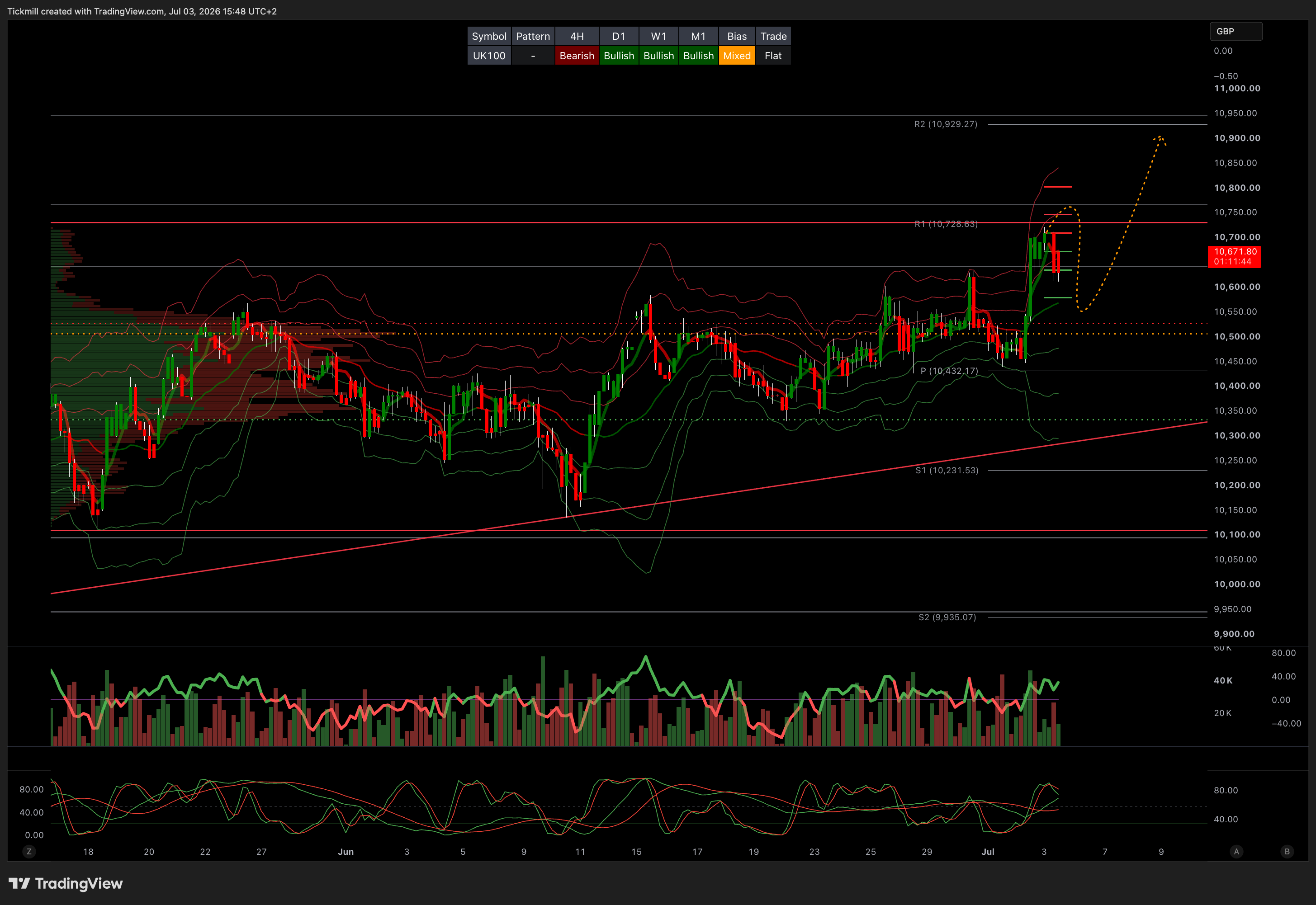
TECHNICAL & TRADE VIEW – FTSE100
Daily VWAP Bullish
Weekly VWAP Bullish
Above 10300 Target 11000
Below 10100 Target 9469


Comments
Log in or sign up to join the conversation.