


London moved higher on Friday, with the FTSE 100 supported by gains in HSBC and broader strength across financial stocks, even as investors continued to monitor Middle East tensions, softer oil prices and new U.S. tariffs. Both the 100 & 250 indexes were on track to end the week higher. The session had a more constructive tone than Thursday’s late selloff, when the FTSE slid into the close as precious metal miners weakened and rate concerns returned. Friday’s rebound was led by financials rather than commodities, giving the market a different shape. Investors appeared willing to add exposure to banks, investment companies and brokerages, helped by company-specific news and improving domestic activity data.
HSBC was a key driver. The lender’s shares rose 1.2% after Allianz agreed to acquire HSBC’s life insurance business in Singapore for S$2.7 billion, or about $2.1 billion. The deal fits HSBC’s broader strategy of simplifying its operations and concentrating on its core Asian banking franchise. For investors, the disposal reinforces the view that management remains focused on capital efficiency, strategic discipline and higher-return markets. The HSBC move helped lift the wider financial sector. Investment banks and brokerages rose 1.6%, making them the strongest-performing industry group. 3i Group was among the top FTSE 100 performers, gaining 3.1% after UBS raised its target price for the investment company to 3,200 pence from 2,900 pence. The upgrade provided another stock-specific catalyst for financials and supported the broader market advance.
The strength in financials also reflected a more supportive domestic backdrop. Earlier in the week, labour-market data showed unemployment holding steady at 4.9%, while wage growth moderated. June CPI then surprised to the downside, easing to 2.6% from 2.8%, below consensus and far below the Bank of England’s projected path. Together, those reports support the view that the UK economy is cooling without cracking, giving the BoE room to remain on hold at 3.75%.
Friday’s activity data added to that more balanced picture. British retail sales unexpectedly increased in June, helped by warm weather and the soccer World Cup, suggesting consumer spending held up better than feared. British firms also reported their first growth in three months in July after a brief respite in the U.S.-Iran war. The data reinforced hopes that the economy is still capable of generating modest growth despite elevated rates, higher living costs and geopolitical shocks. That matters for equities because the UK market has been trading on a narrow set of themes: energy risk, central-bank caution, fiscal credibility and the resilience of the consumer. Stronger retail sales and improving business activity reduce the likelihood of a near-term demand slump. At the same time, softer inflation reduces the risk that the Bank of England will be forced into a more hawkish stance. For financials, that combination is broadly constructive.
Geopolitics remained a major focus. U.S. President Donald Trump promised “major military punishment” for Iran and its Houthi allies, escalating concerns about a broader regional conflict and potential disruptions to energy flows. The remarks kept Middle East risk firmly in the market’s line of sight, particularly after recent attacks on tankers and persistent concerns around shipping through the Strait of Hormuz and the Red Sea. Despite those tensions, oil prices retreated on Friday, weighing on energy stocks. The energy sector fell 1.1%, with BP down 1.6% and Shell off 0.9%. The decline showed that geopolitical risk alone was not enough to keep crude-linked equities higher. Investors were also weighing supply expectations, demand risks and the possibility that higher prices earlier in the week had already priced in much of the immediate disruption risk.
Energy weakness acted as a drag on the FTSE, but unlike previous sessions, it did not dominate the broader index. Financial strength and better domestic data offset the decline in oil majors. That rotation was important because it showed the FTSE’s weekly gain was not solely dependent on energy support. Banks, investment names and selected cyclicals were able to carry more of the market burden into the end of the week.
Trade policy added another complication. The United States imposed new tariffs of 10% and 12.5% on goods from 60 trading partners, giving investors another risk to assess alongside Middle East escalation and central-bank uncertainty. The measures raise questions about global trade flows, corporate margins and supply-chain costs. For the UK market, the immediate impact may be uneven, but the broader concern is that tariffs could add to inflation pressure while weighing on global growth.
Among mid-caps, discoverIE surged 12.5% to the top of the FTSE 250 after the electronics components maker said annual earnings are expected to exceed market expectations. The sharp move reflected investors’ willingness to reward companies that can deliver earnings upgrades despite a difficult macro environment. It also helped improve sentiment toward the mid-cap space, which has been more exposed than the FTSE 100 to domestic growth concerns.
The policy backdrop remains active. Prime Minister Andy Burnham has moved quickly in his first week, announcing measures aimed at easing pressure on households and businesses, including plans to cut household energy bills by scrapping the Digital ID Programme and reduce business rates for pubs, clubs and live music venues by 20% from April. Markets are still giving the new government some room, helped by slightly better borrowing data, but fiscal credibility remains a key test.
For the Bank of England, the week’s data support patience but not complacency. Inflation has surprised to the downside for three consecutive reports, wages are moderating, and the labour market is stable. However, renewed energy risks, tariffs and producer-level cost pressures mean the disinflation path could still become uneven. A hold at 3.75% remains the cleanest near-term message, but policymakers will need to communicate carefully if energy prices or services inflation reaccelerate.
Finish Line: The FTSE 100 rose 0.3% to 10,674.68, with HSBC and financial stocks driving the rebound and both the FTSE 100 and FTSE 250 on track for weekly gains. HSBC gained after selling its Singapore life insurance business to Allianz, while 3i rose on a UBS target-price upgrade and investment banks led sector gains. Energy stocks fell as oil prices retreated despite fresh threats from Trump against Iran and Houthi allies, with BP and Shell lower. UK retail sales unexpectedly rose in June, and business activity returned to growth in July, supporting the view that the economy is holding up. But new U.S. tariffs, Middle East escalation and lagged energy-price risks keep the outlook complicated. For now, softer inflation and steadier activity leave the BoE in active-hold mode, while Burnham’s government faces the continuing challenge of easing living costs without unsettling fiscal credibility.
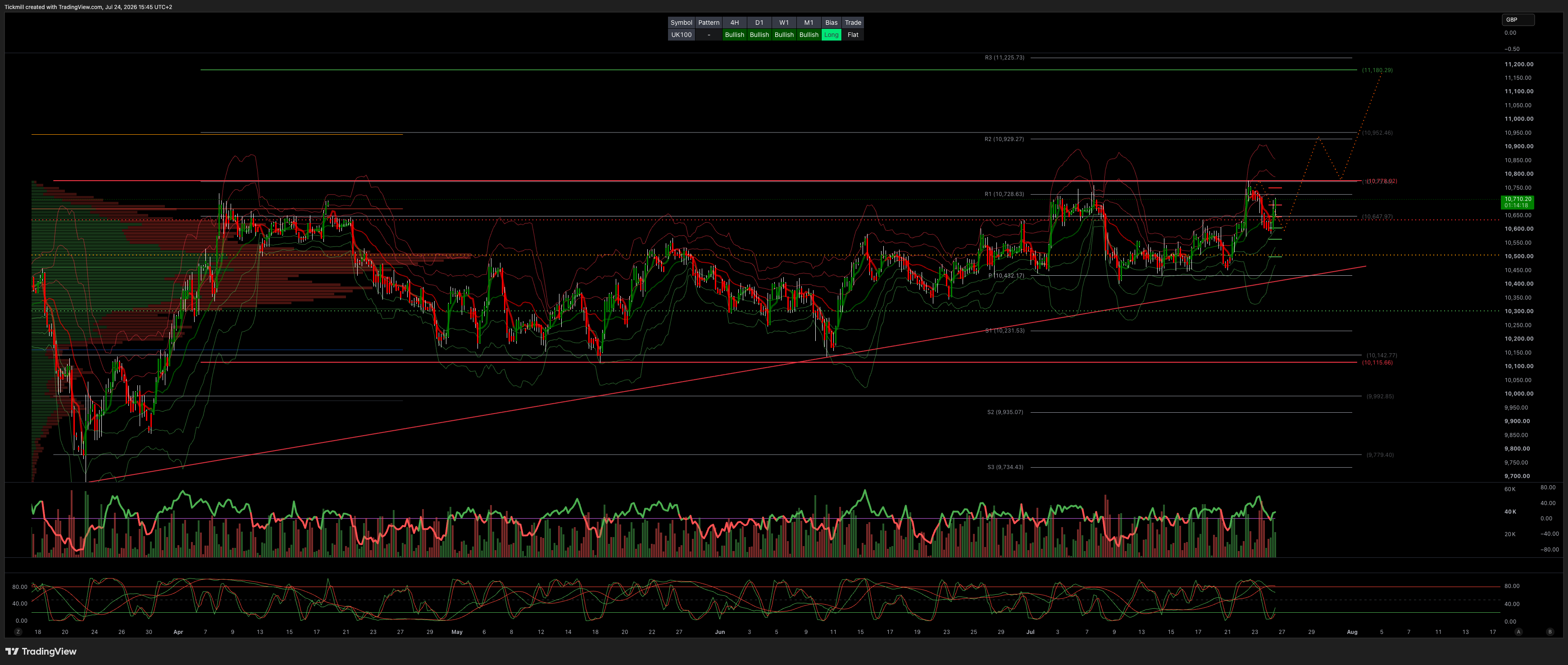
TECHNICAL & TRADE VIEW – FTSE100
Daily VWAP Bullish
Weekly VWAP Bullish
Above 10500 Target 11000
Below 10400 Target 9500


Comments
Log in or sign up to join the conversation.