

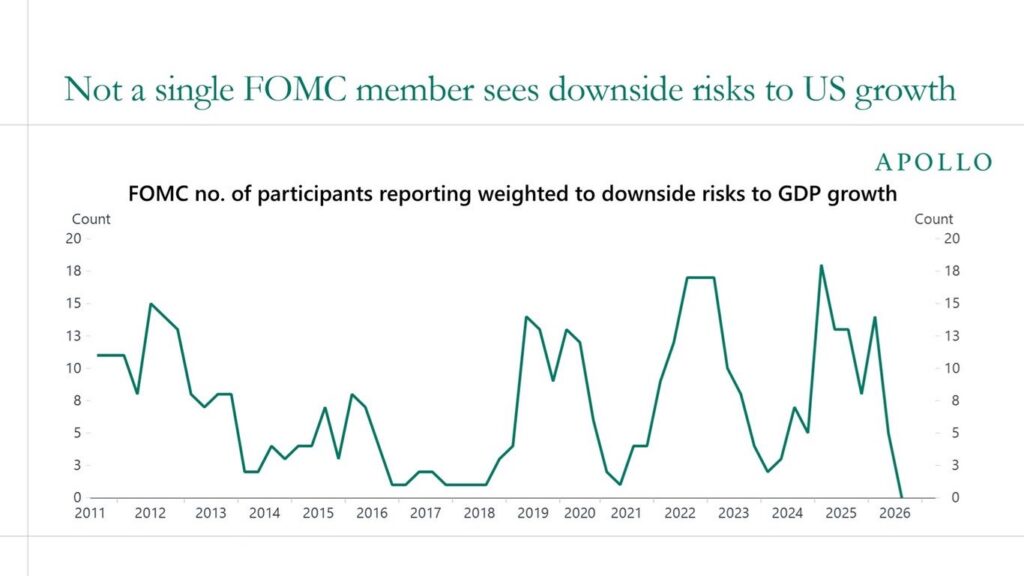
The graph below, courtesy of Apollo, shows that not one FOMC member sees downside risks to the economy. This must be a very bullish signal, given that most FOMC members are seasoned business veterans or economists. Further, they are supported by over 400 PhD’s in economics. Unfortunately, despite the experience and educational background of the FOMC members and their staff, their outlooks have little predictive value.
Across the four major peaks of pessimism and troughs of optimism since 2012, economic growth was weaker six months later in 7 of the 8 cases. If we look at their forecasts 12 months after the peaks and troughs of pessimism and optimism, we find that economic growth after two peaks of pessimism and two troughs of optimism was higher than where it started, and the economy was weaker after two of each. In other words, a coin flip is worth the same as FOMC members’ forecasts.
With confidence in economic growth higher than it has been in 14 years using this measure, we must be wary. But at the same time, realize that the risk assessment carries zero forecasting content. To add further doubt to their forecasting ability, it’s worth noting that in January 2021 only one member saw upside risks to inflation despite numerous signs of a gross supply-demand mismatch forming in many parts of the economy.
We remind you of Bob Farrell’s Investment Rule #9:
When all the experts and forecasts agree, something else will happen.
What To Watch Today
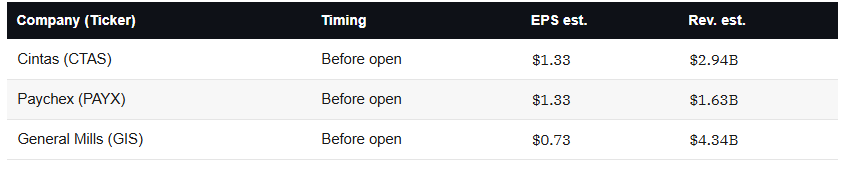
Earnings
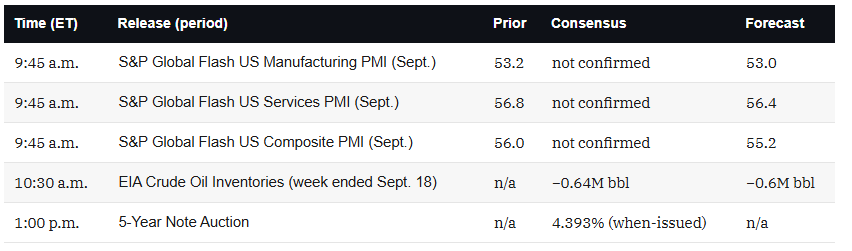
Economy
Market Trading Update
Yesterday, we looked at the split between the Dow and the Nasdaq and asked whether it was an omen or ordinary rotation. Today, the 2027 earnings growth outlook, according to a Nomura note that landed this week, puts an S&P 500 target of 9,000 on the next twelve months and a 78% probability that real earnings growth stays above trend.
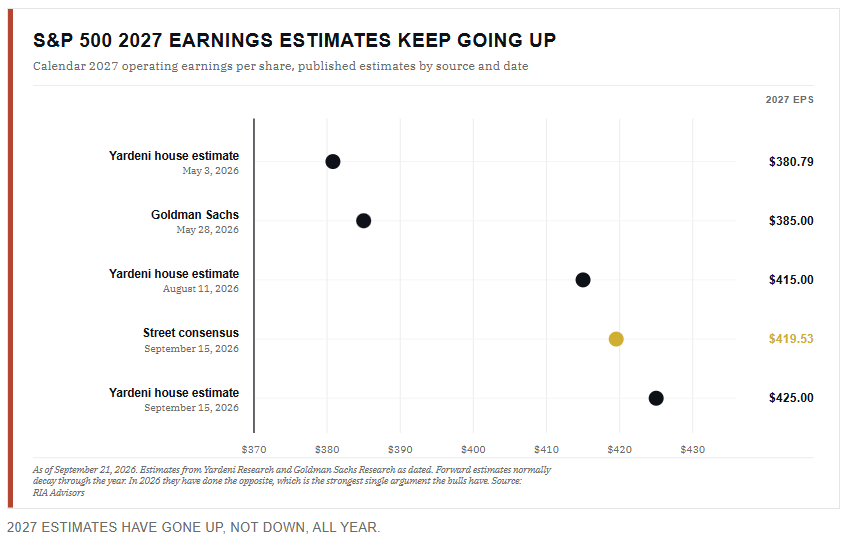
Give the bulls their due first. Forward estimates normally decay through the year. This one has climbed. Consensus for 2027 has run from roughly $381 in May to $419.53, up about 13% year to date. That’s the strongest leg of the bull case, and it isn’t small.
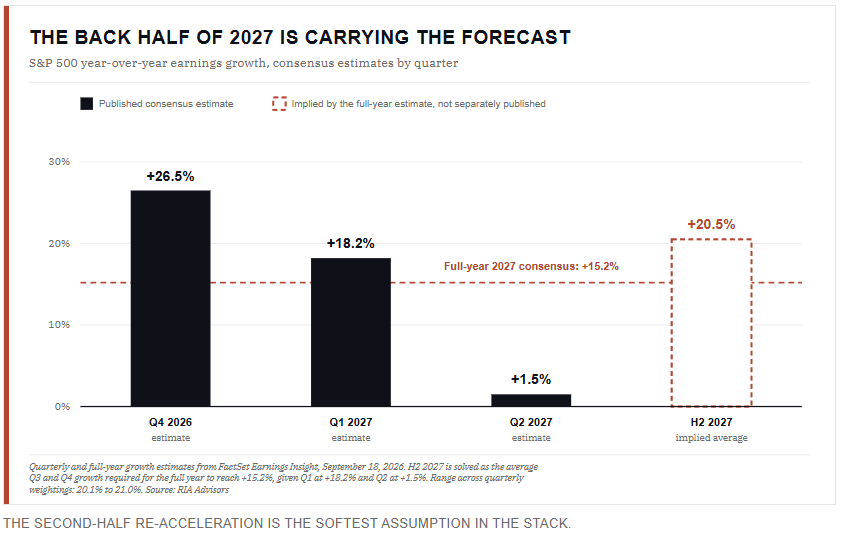
Now look at the shape instead of the level. Consensus has the fourth quarter growing 26.5% and the first quarter of 2027 growing 18.2%. Then the second quarter drops to 1.5%. For the full year to land at 15.2%, the back half has to average roughly 20%. Tell me that’s one soft quarter and I’d usually agree. Not when the quarters behind it carry the year.
Here’s what bothers me more. Consensus has 2027 earnings growing 15.2% on revenue growing 9.1%. That six-point gap is the margin, not demand. Net margin hit 17.0% in the second quarter, the highest since FactSet began tracking in 2009. So the forecast needs a record to expand from.
And about half of that growth is in the four capital budgets. Goldman puts AI infrastructure at roughly half of S&P 500 earnings growth across 2026 and 2027, which makes Nomura’s “strong AI investment” and “broader private demand” one driver counted twice. That spending has also stopped funding itself. FactSet tracks hyperscaler capex near $800 billion this year, free cash flow at or below zero for all but Alphabet (GOOGL) and Microsoft (MSFT), and borrowing up from 9% of capex to 32%. Compute is now 60% of the spend, and FactSet notes that useful lives of three to four years, rather than the assumed five to six, would mean materially higher depreciation. I’ve made that argument here before. The charge lands in 2027.
Which brings me to the probability. The 78% covers real earnings growth, beating TREND. Consensus isn’t asking for a trend. It’s asking for 15.2% stacked on 31.8%, funded by margin expansion off a record, with half the engine running on borrowed money. High confidence in the easy claim is being used to underwrite the hard one.
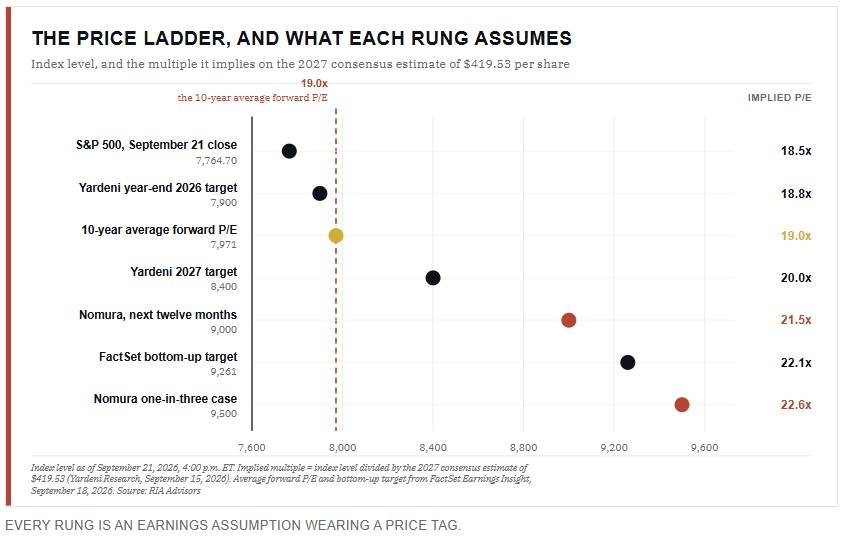
My read: 2027 earnings should be strong. I doubt they’re 15.2%. Such is the problem with a price that already assumes the good outcome. Strong and disappointing, stop being opposites.
We aren’t fighting this tape. For now, we remain fully allocated, trim the most extended technology back to target, and let that cash sit. Own 9,000 if it comes. Don’t build the portfolio that needs it to.
Crude Oil Shortages And Consumption
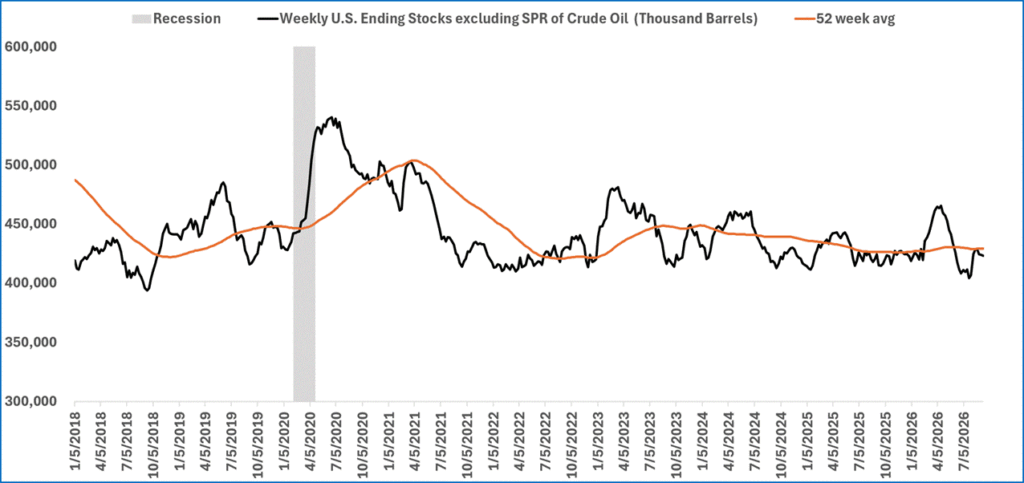
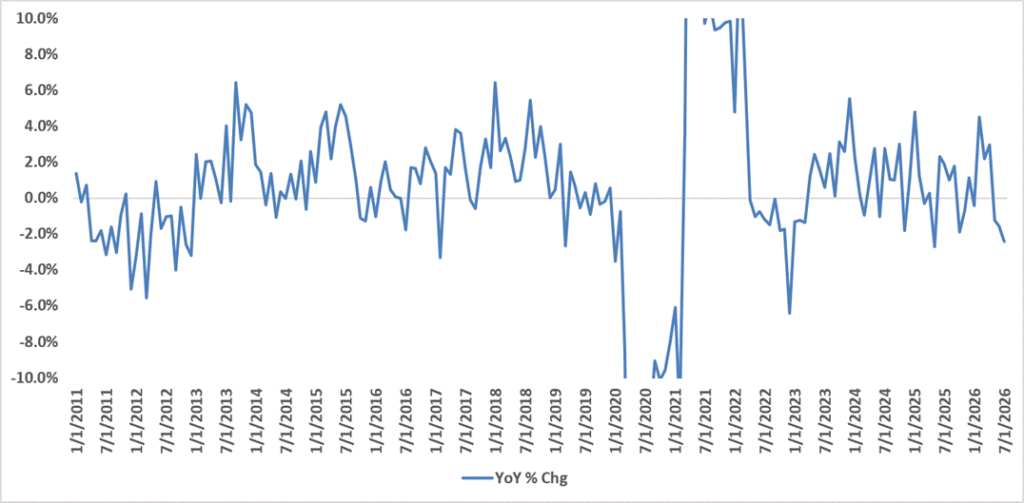
A friend recently shared his analysis comparing oil market dynamics and personal consumption. Given the recent tightening of monetary policy, the economic importance of oil and oil prices, and the fact that personal consumption accounts for about two-thirds of economic activity, his analysis is timely. His first graph below is very bullish for oil prices, showing that the stock of oil, excluding the Strategic Petroleum Reserve (SPR), is near 8-year lows. While the supply situation argues for higher prices, the second graph shows that higher prices are eroding demand. Year-over-year crude oil consumption is negative and trending slightly lower.
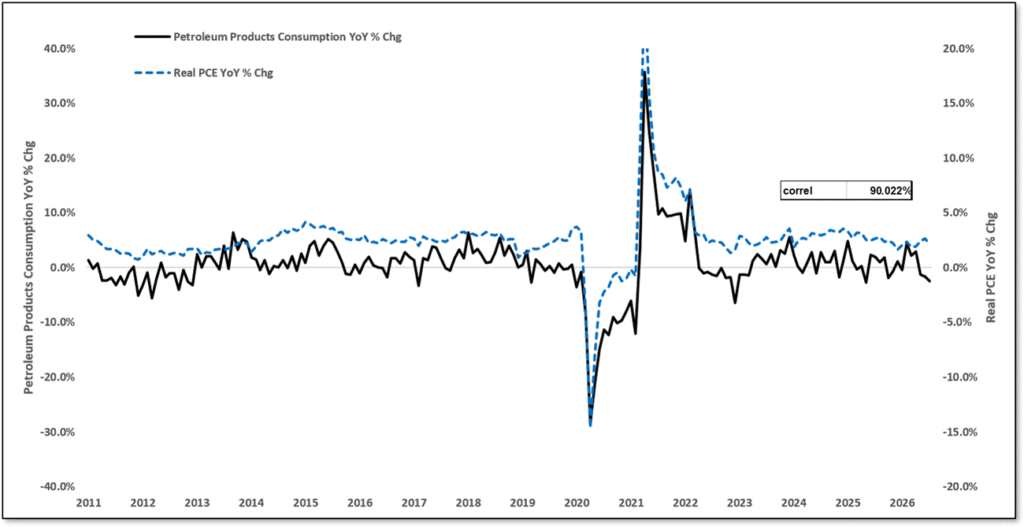
The third graph is where the rubber meets the road. Per the graph, our friend writes:
Furthermore, I looked at the Real PCE dollars annual percent change and graphed it versus the Crude consumption annual percent change from above and there’s a 90% correlation, which makes sense.
Higher oil prices are impacting demand for oil and likely many other goods and services. While the Fed hikes rates largely to quell concerns about higher oil prices and their impact on inflation, higher oil prices are negatively affecting demand across many other parts of the economy. Could the Fed be making a policy error, especially since its policies have very little impact on the price of oil?
Tweet of the Day


Comments
Log in or sign up to join the conversation.