


This week’s Fed minutes fall between Nvidia’s earnings and Anthropic’s IPO and may get lost in the mix. However, they shouldn’t be overlooked, because if the hotter-than-expected jobs and CPI reports accomplished anything, it was forcing the market to reprice the Fed policy outlook. Right now, the market is pricing in an 89% probability of a 25-basis-point rate hike in December and an 11% probability of a 50-basis-point hike.
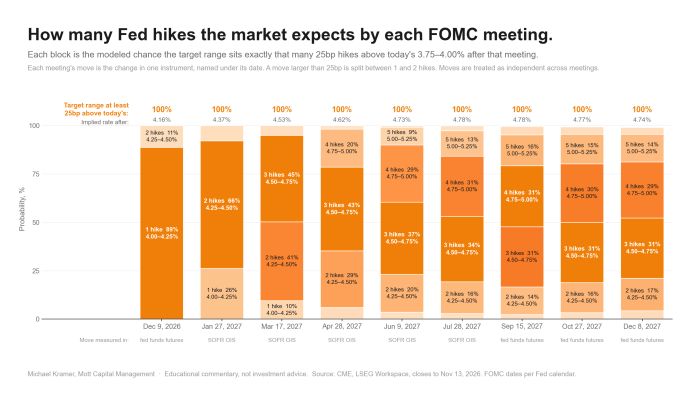
In fact, the entire implied path for Fed policy has shifted, with the market now pricing in a much steeper series of rate hikes. Just a week ago, the implied path peaked at around 4.35%. Now, it peaks at approximately 4.8%. With the effective Fed funds rate currently at 3.88%, that implies roughly three to four additional 25-basis-point hikes.
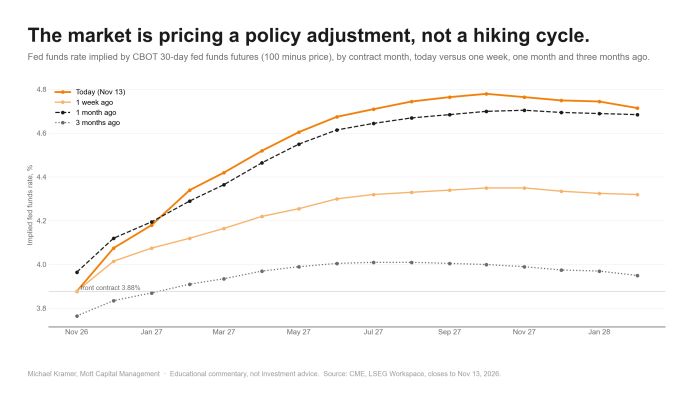
Still, notice that even at its highest point, the implied path only takes the Fed funds rate back to around 4.8%. In other words, the market isn’t anticipating a hiking cycle that returns rates to their 2023 highs. Instead, it appears to be pricing in something more akin to a mid-cycle adjustment.
I’m not convinced that a mid-cycle adjustment will be enough. In my view, if the Fed never managed to bring inflation back to its target in the first place, it stands to reason that interest rates may ultimately need to rise above their 2023 highs.
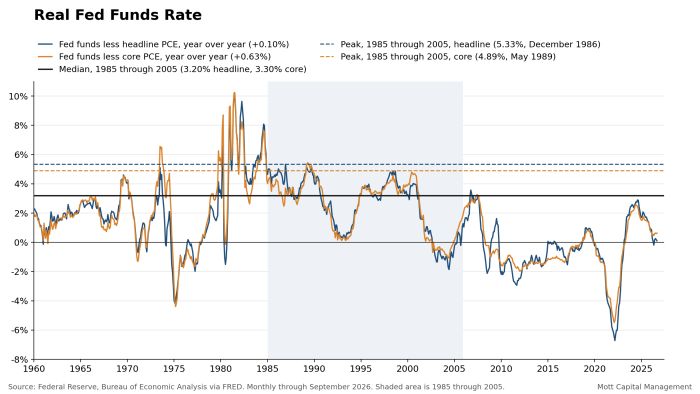
The Fed minutes are unlikely to tell us how high rates will eventually need to go, but they should offer some insight into how policymakers assess the current degree of monetary accommodation. My suspicion is that they don’t view policy as particularly restrictive. After all, the real effective Fed funds rate remains relatively low by historical standards.
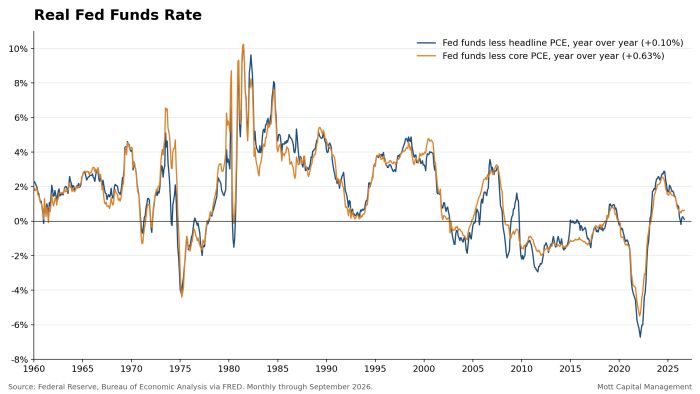
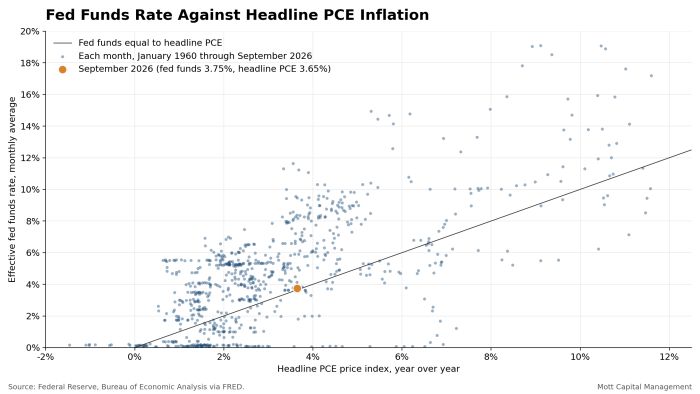
I would argue that, over the past several decades, the Fed funds rate has generally been above the inflation rate. There have been relatively few periods when inflation has been this elevated while the Fed funds rate has been at or below it.
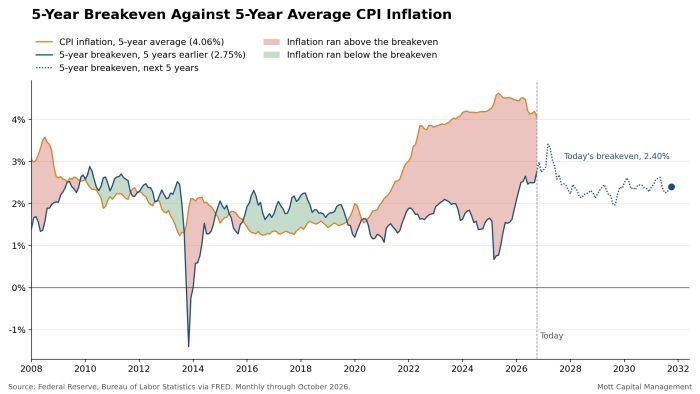
Some will point to the five-year breakeven inflation rate, currently around 2.3%, and argue that monetary policy is already restrictive in real terms. The problem with that argument is that, in every month since 2021, the realized five-year average inflation rate has exceeded what the five-year breakeven rate implied five years earlier. Given that track record, I would rather assess how restrictive Fed policy is based on the inflation we’re actually experiencing, rather than what the market expects inflation to be.
Let’s imagine that, since today’s AI boom has been compared to the 1990s on so many occasions, the real Fed funds rate should get back to something like what it was from 1985 to 2005, and say that is where it should peak. Let’s call that range around 3% to 3.5%. Even in the last cycle, with the Fed funds rate at 5.33%, the real rate topped out near 2.9% and never got there.
Let’s assume that a real Fed funds rate of roughly 3% to 3.5% would be appropriate at the peak of the cycle. Based on current inflation rates, that would imply a nominal Fed funds rate somewhere between 6.5% and 7%.
Then again, perhaps this isn’t the 1990s, and the AI boom won’t produce the same economic dynamics as the internet boom or the strong growth experienced during the 1980s.
Either way, the current policy stance doesn’t appear to be doing enough to bring inflation back under control. If that’s the case, a mid-cycle adjustment may not be sufficient, and the Fed may ultimately need to tighten policy far more aggressively than the market currently anticipates.


Comments
Log in or sign up to join the conversation.