

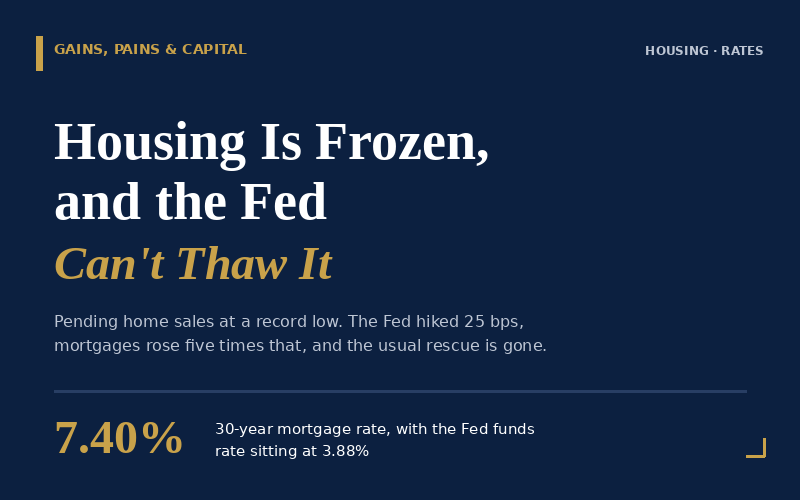
Last week I wrote that the Everything Bubble was already deflating, just not where everyone was looking. The asset letting air out was housing, where Redfin (RDFN) had sellers outnumbering buyers by the widest margin in its records.
Yesterday the official data caught up. The National Association of Realtors reported that pending home sales fell 7.3% in September. Economists had expected a decline of half a percent. The index dropped to 66.0, the lowest reading in its history, and sales fell in all four regions of the country. On a yearly basis pending sales are down 11.3%.
So the thesis is no longer a Redfin data point. It is the NAR’s own index at a record low. Today I want to add the piece I did not have room for last week, because it is the part that tells you how long this lasts.
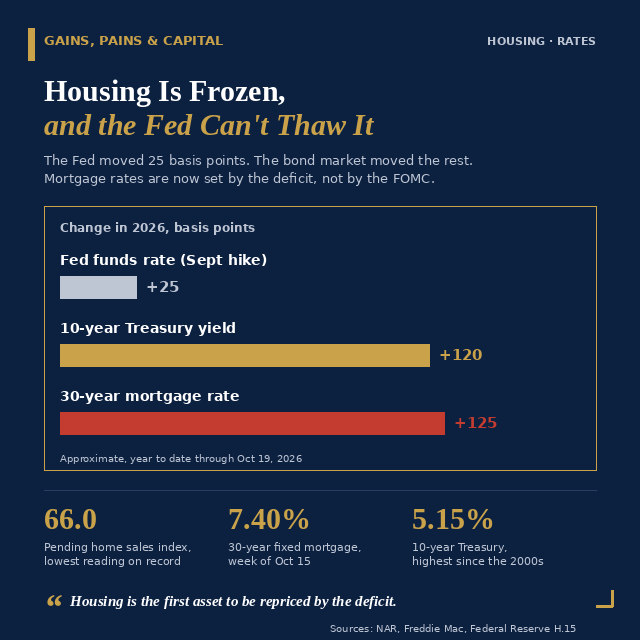
The explanation you will read everywhere is that the Fed’s rate hikes are hurting housing. Look at what the Fed has actually done this year. One hike, 25 basis points, in September. The funds rate sits at 3.75% to 4.00%. That is the entirety of the Fed’s tightening in 2026.
Now look at what the market did. The 10-year Treasury yield has risen roughly 120 basis points this year. It touched 5.34% earlier this month, a level not seen since the early 2000s, and sits around 5.15% today. The 30-year mortgage rate is 7.40%. NAR’s own chief economist said it plainly: mortgage rates have risen far more than the Fed’s short-term rate hikes.
The Fed moved 25 basis points and mortgages moved roughly 125. The gap between those two numbers is the whole story.
For 40 years the deal was simple. The Fed set short rates and long rates followed. When the Fed cut, mortgage rates fell and housing recovered. That link has broken. Long rates are now set by how much debt the Treasury has to sell and how much extra yield investors demand to hold it for ten or thirty years. That extra yield, the term premium, has been climbing all year because the deficit is running at wartime levels and the market knows there is no plan to shrink it.
This is the Everything Bubble, and it is doing what I said it would do when I coined the term in 2014. The bubble was never really in stocks or houses. It was in sovereign bonds. Central banks drove the yield on the safest asset in the world to the lowest levels in recorded history, and because every other asset is priced off that yield, the bubble spread to everything. The 10-year Treasury is the foundation the whole structure sits on.
That foundation is now repricing. A 10-year at 5.15% is the bond bubble letting air out, and the deficit is the pin. Every asset built on top of it has to reprice too. Housing goes first because it is the asset most directly tied to long-term yields: a home is the most leveraged purchase a family ever makes, and the price they can pay is almost entirely a function of the mortgage rate. When the 10-year was 1.5%, a 3% mortgage made almost any price affordable. At 5.15%, a 7.40% mortgage makes almost no price affordable.
So the Fed did not freeze housing. The bond bubble deflating did. That distinction matters, because it tells you the usual fix will not work the way it used to.
Here is why this matters for how long the freeze lasts. In every prior housing slowdown, the Fed cut rates, mortgage rates followed within months, and buyers came back. That is the playbook of 1991, 2001, 2008 and 2020. The natural question is whether it works again. The answer is partly, and at a cost.
A Fed cut would pull mortgage rates down somewhat, because the 10-year yield is in part an average of expected short rates. But we have a recent test of what happens when the Fed cuts into a fiscal problem. In September 2024 the Fed cut by 50 basis points and kept cutting into December. The 10-year yield rose roughly 100 basis points over the following four months, and mortgage rates went from about 6.1% back above 7%. The bond market read the cuts as the Fed going soft on inflation and demanded more yield, not less.
That is the box the Fed is in today, except tighter. Its own projections show headline inflation at 3.7% this year, which is why it hiked in September and why the dot plot shows another hike coming. Cutting into that would risk a repeat of 2024, with long rates rising on the cut. So the tool that always rescued housing still exists, but it is weaker than it used to be and more expensive to use, and the Fed knows it. That is why housing is being left to reprice on its own.
That is also why I said last week this is a multi-year repricing and not a 2008-style event. There is no forced selling, owners with 3% mortgages are staying put, and the banks are fine. What there is, is a market that has stopped clearing, with the usual thaw mechanism compromised. It can stay frozen for a long time.
For investors the lesson extends well beyond housing. If the bond market can override the Fed in the largest asset class in the country, it can do it anywhere. The 10-year yield, not the funds rate, is now the number that prices everything, and it is being driven by Washington’s borrowing rather than by Kevin Warsh. Every asset you own is being repriced against a 5% risk-free rate the Fed did not choose and cannot easily undo. The assets that hold up in that world are the ones I laid out last week: hard assets and the producers behind them, not the rate-sensitive names that spent 15 years living off cheap long-term money.

Comments
Log in or sign up to join the conversation.