

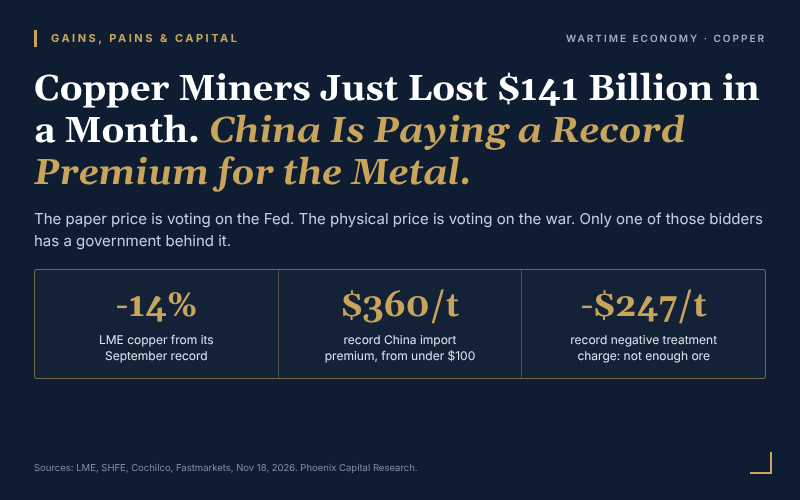
Copper fell for a fifth straight session yesterday, dropping as much as 5.6% on the London Metal Exchange to a seven-month low. It is now 14% below the record it set in September. Eleven of the largest copper miners in the world have lost $141 billion in market value in a month, $68 billion of it in the past week. Stan Druckenmiller, who spent the past two years as the most prominent backer of the AI copper trade, said on Tuesday that he is short.
That is the paper market. Now look at the physical one.
On the same day copper hit its low in London, the premium Chinese buyers pay to import physical metal hit a record $360 a tonne. In September it was under $100. Copper stocks in Shanghai warehouses fell 18% last week to 27,642 tonnes, the lowest since December 2023. The fee smelters charge to process ore has gone to a record negative $247 a tonne, which means smelters are now paying miners for the privilege of treating their concentrate, because there is not enough ore to go around. Chile, which produces a quarter of the world’s copper, is on track for its weakest year of output in 23 years.
So on Wednesday the price of copper on paper said recession, and the price of copper in a warehouse said shortage, and the two moved in opposite directions on the same afternoon.
I wrote last week about the two-price system the Pentagon created for rare earths, a China price and a war price, with Washington guaranteeing the second one. Copper now has two prices too. Nobody in Washington set them. The market did, and the gap between them is the most useful thing I can show you this week.
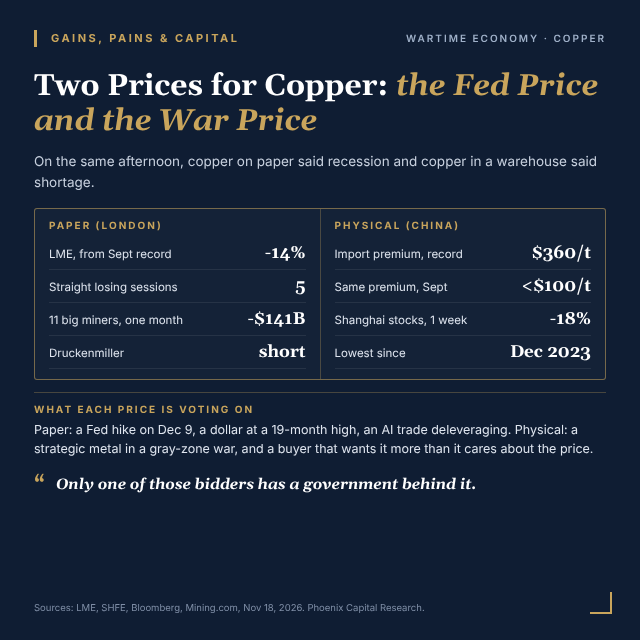
The paper price is a vote on the Fed. Copper is the most financialized industrial metal there is, and over the past two years it became a proxy for the AI buildout. Hedge funds bought copper futures the way they bought Nvidia, as a bet on data center construction. Over the past month that bet unwound. The dollar is at a 19-month high. The Fed is going to hike on December 9. Financing costs are rising, the AI complex has been deleveraging since the margin call on November 5, and the tariff trade that pulled nearly a million tonnes of metal into U.S. warehouses is fading as the odds of refined copper tariffs drop. When Druckenmiller says he is “really alert to the fact that the second half of ’27 could be economically disappointing,” that is the trade he is describing: a Fed mistake, a slowdown, and a metal that fell by half in 2008 and by a quarter or more in 2015 when the last two slowdowns hit.
He may be right about the Fed. I think he is. But the physical market is voting on something else.
The physical price is a vote on the war. China is paying a record premium to pull copper out of a market that paper traders are dumping. A buyer that expects a recession waits for lower prices. A buyer that pays a record premium into a falling market wants the metal more than it cares about the price, and China wants copper for the same reason the Pentagon wanted dysprosium: it is a strategic asset in a gray-zone war, and whoever holds the physical supply holds the chokepoint. The exchange stocks tell the story. About 85% of the world’s exchange-monitored copper, roughly 1.09 million tonnes, is sitting in U.S. warehouses, pulled there by the tariff trade. Shanghai is nearly empty. The metal went west on paper and China is paying up to bring it back east in fact.
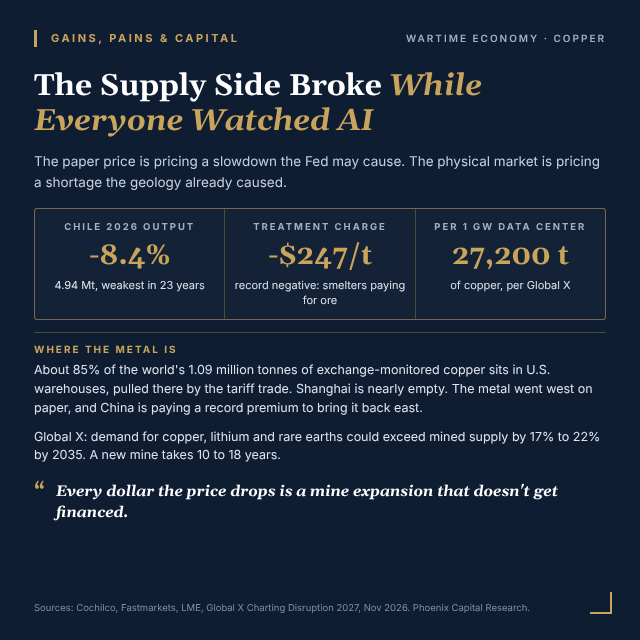
And the supply side has broken while everyone was watching the AI trade. A negative treatment charge is the rarest signal in the copper market. It means smelting capacity, most of it in China, is so far ahead of mine supply that smelters are competing for ore at a loss. Chile’s decline is not a one-year problem; its deposits are aging, its grades are falling, and its biggest mines depend on imported sulfuric acid. The Global X report this week put the number on the other side of the ledger: a single one-gigawatt AI data center needs about 27,200 tonnes of copper, demand for copper, lithium and rare earths could exceed mined supply by 17% to 22% by 2035, and a new mine takes 10 to 18 years to build.
Put it together. The paper market is pricing a slowdown that the Fed may well cause. The physical market is pricing a shortage that the geology has already caused. Both can be right for a while, and they cannot be right for long, because copper gets used. At some point a data center, a grid operator or a missile plant needs the metal, and it does not care what the futures curve thinks about the Fed.
This is what makes copper different from the AI stocks that dragged it down. Nvidia can fall 20% and nothing in the physical world changes. Copper can fall 20% and the shortage gets worse, because every dollar the price drops is a mine expansion that doesn’t get financed, in a world where the mines already take 15 years. Druckenmiller is betting that the paper price pulls the physical price down. The Chinese premium is a bet that the physical price pulls the paper price up. Only one of those bidders has a government behind it, and it isn’t the hedge funds.
What to do with it.
First, do not buy the dip in the miners yet. The paper market is deleveraging, the Fed is three weeks from a hike, and a market that has fallen five days in a row into a dollar at 19-month highs can fall five more. The names that lost $141 billion in a month can lose more. Druckenmiller’s timing on the macro has been better than almost anyone’s for 40 years, and the slowdown he is describing is real. Let the paper price finish voting.
Second, watch the premium, not the price. The Chinese import premium is the one number that tells you whether the physical bid is holding. As long as it stays above $200 a tonne while the paper price falls, the gap is widening, and a widening gap between a price and its underlying resolves violently. If the premium collapses back under $100, China has stopped buying and Druckenmiller wins outright.
Third, understand what you are watching. Three weeks ago it was rare earths, with the Pentagon putting a floor under the war price. Last week it was patches and exploits. This week it is copper, with China putting a floor under the war price with its own purchases while Western funds sell. The pattern is the same every time. Strategic assets get repriced by the side that needs them most, and the side that needs them most is never the one trading the futures.
I expect that by the end of the first quarter of 2027, LME copper trades back above $14,000 a tonne, and the gap between the paper price and the Chinese premium closes with the paper price rising rather than the premium falling. What would make me wrong: the import premium falling below $150 a tonne, which would mean Chinese demand has actually stalled, or a Fed hiking cycle that pushes the dollar high enough to break emerging-market demand entirely. The first would surprise me. The second is the real risk, and it is why I would wait for the Fed before buying anything.
Druckenmiller sold copper and bought gold miners. Read that as a vote on the Fed. China sold nothing and paid a record premium. Read that as a vote on the war. In a wartime economy, the second vote is the one that gets honored.
But honor it later. The thing to respect right now is the paper market, because the paper market is where crashes start. Copper is the most economically sensitive asset there is, and it has just fallen five days in a row into a Fed hike, a dollar at a 19-month high, and an AI complex that has been deleveraging since November 5. The last two times copper broke like this with the Fed tightening, 2008 and 2018, stocks followed within months. That is the setup Druckenmiller is describing, and whether or not he is right about copper, he may well be right about the stock market.
So for most readers the question this week has little to do with buying copper. The question is whether the paper market is telling you a bear market has started.
Comments
Log in or sign up to join the conversation.