


The Euro is on track for its eighth gain in nine sessions against the Pound, and the explanation that would normally cover a run of that length is not available. Bank Rate sits 150 basis points above the European Central Bank deposit rate, precisely where it has sat since the middle of June, and that spread is what dragged this cross to a one-year low in the first place. The gap has not moved. The cross has.
The spread that never narrowed
Currencies do not trade the rate differential printed on the screen. They trade the one the forward curve expects to exist in six months, which is how a cross can sit still for weeks under an enormous posted gap and then travel a full percent while that gap is unchanged. Since the middle of July the expected differential has narrowed steadily, and almost all of that narrowing has come from the British side.
The mid-July low just over 0.8450 marked the point of maximum agreement that the Bank of England would stay restrictive for longer than the European Central Bank. That view has been taken apart in stages since, mostly by British data and partly by a European central bank that has quietly told the market it has more to do.
One committee is loading while the other unloads
The European Central Bank held at 2.25% on 23 July, unanimously, then used the press briefing to make a September move sound close to inevitable. The President disclosed that some Governing Council members had asked whether rates should rise immediately, and warned that the longer energy costs stay elevated, the more likely they are to leak into broader prices through second-round effects. Roughly 70% odds of a quarter-point September move are now priced, with fresh staff projections landing at that meeting.
The Bank of England arrives on Thursday with the opposite problem. June Consumer Price Index (CPI) inflation cooled to 2.6% with services down to 3.6%, pay growth is decelerating, and forecasters expect the new Monetary Policy Report to show inflation peaking near 3% later this year. That projected peak is the whole argument, because a peak nearer 4% has previously been treated as the point at which second-round effects become statistically likely. A forecast topping out a full percentage point below that line disarms the Committee's own hawks.
Both tightening cases rest on the same barrel of Crude Oil, which is the part nobody is pricing consistently. The Gulf stand-down has pulled energy well off its July highs and weakened the inflation impulse on both sides of the Channel, and yet only one front end has repriced for it.
What the Pound was actually paid for in July
July was the best month the Pound has had in years, and it stood on three legs. Political risk unwound as an uncontested succession replaced the contest markets had feared, speculative shorts covered into the move, and traders held a firm expectation of another Bank of England hike before year-end.
Two of those legs have already been collected. The political premium was released the day Andy Burnham walked into Downing Street, and the hike expectation has been draining away since the June inflation print. What is left is carry, a thin defence for a currency heading into an October Budget with the highest long-end government yields in the Group of Seven behind it and borrowing above the official forecast.
Positioning tells the same story from the other end. One widely watched measure had the Pound more technically stretched against the Euro than at any point since before the Brexit referendum, and a July survey of investment banks found a clear majority expecting this cross back into the 0.8700 to 0.8900 area through 2027. Crowded trades do not need bad news to unwind, only the absence of fresh good news.
Thursday does the deciding
Thursday opens at 09:00 GMT with preliminary euro-area second-quarter growth, consensus 0.2% QoQ against a 0.2% contraction previously and 0.5% YoY from 0.3%. Unemployment is seen holding at 6.2% and the Economic Sentiment Indicator improving to 96 from 95. Friday adds the euro-area flash inflation estimate, headline seen at 2.9% YoY from 2.8% with core steady at 2.4%.
The Bank of England follows at 11:00 GMT, consensus a hold at 3.75% on a 7-2 vote, none for a cut and two again preferring 4.00%, with the Monetary Policy Report and minutes attached and a press briefing half an hour later. The hold carries no risk because it is fully priced, which leaves the vote split as the only live variable, and the asymmetry there runs one way. A third hawkish dissent would be a real shock against a forecast round showing a lower peak, while an 8-1 split or a unanimous hold confirms what that forecast already implies.
Technical levels
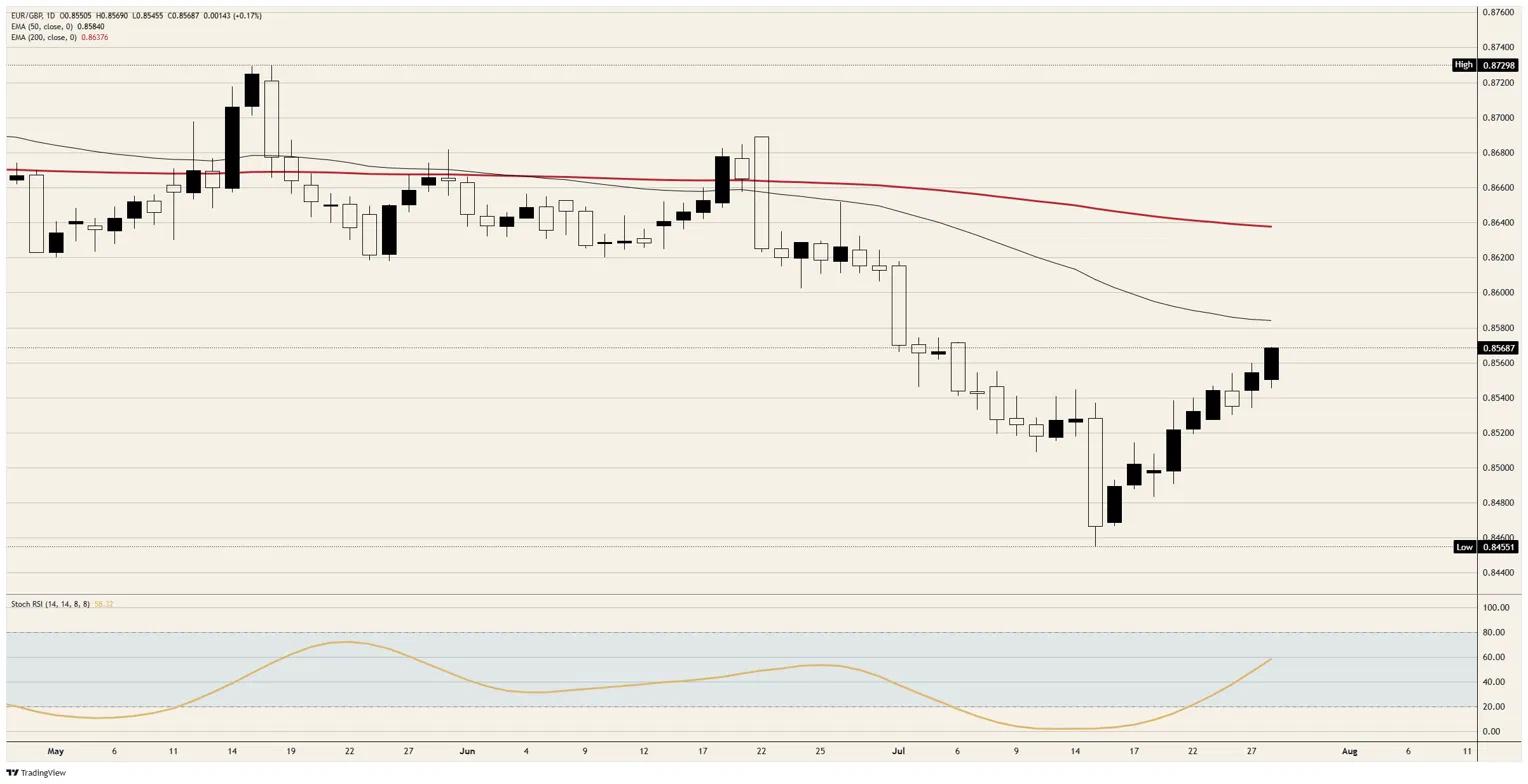
Resistance: The 50-day Exponential Moving Average just under 0.8600 is the first obstacle, and price has traded beneath it since late June. Above it sits the 0.8600 handle, then the declining 200-day Exponential Moving Average just under 0.8650, the level separating a retracement from a trend change.
Support: The 0.8550 shelf is immediate, defended at the session low just underneath. Beneath that, 0.8500 is the first real test of the recovery, with the mid-July base just over 0.8450 the line that ends it.
Bias: Bullish while above 0.8550, with the daily Stochastic Relative Strength Index turning up out of its July trough and Thursday's event risk skewed toward a softer British outcome. Objectives are the 50-day average just under 0.8600 and then the 0.8600 handle, with 0.8650 the decision point. Invalidation on a daily close back beneath 0.8500.
EUR/GBP daily chart

Comments
Log in or sign up to join the conversation.