


Micron (MU) fell about 4% on Monday and the NASDAQ 100 fell with it, while the Dow Jones Industrial Average, which holds no memory-chip maker, finished higher. The S&P 500, which holds Micron and all 30 Dow members, finished slightly lower. The index closed just above 51,800, its highest close in more than two weeks. Most of the coverage credited Salesforce (CRM), which supplied about an eighth of the gain.
The Dow counts dollars, and Micron has nearly a thousand of them
The Dow is price-weighted. It adds up its 30 share prices and divides the total by a divisor of about 0.168, so a $1 move in any member is worth about six index points, whatever the size of the company. Micron trades just under $1,000, which would make it the index's heaviest stock if it were a member, and its drop would have cost the Dow more than 200 points, more than Monday's whole gain.
Nvidia (NVDA), at under $230 a share, is the index's only semiconductor stock. It fell, as did Amazon (AMZN) and Cisco Systems (CSCO), and the three cost the Dow about 50 points between them. Microsoft (MSFT), Apple (AAPL), American Express (AXP) and Visa (V) added roughly 90 points between them, while Salesforce added about 20, and more than 20 of the 30 members rose.
Salesforce rose after Bank of America (BAC) moved it two notches to Buy from Underperform, on the view that artificial intelligence (AI) will entrench enterprise software rather than replace it. It traded up as much as 5% on the upgrade and kept less than a third of that. Goldman Sachs (GS), the index's heaviest stock at near $890, fell and was the largest single drag on the Dow.
Chevron (CVX), the Dow's only Crude Oil producer, added about as much as Salesforce. Crude Oil rose about 2%, with West Texas Intermediate (WTI) near $94.00 and Brent just above $106.50, after Houthi missile fire at Riyadh's airport and a Russia-Ukraine energy truce that Kyiv says Moscow has already broken.
A Fed voter calls Treasury yields modest with the bond market shut
Cleveland Fed President Hammack, who votes on policy this year, said a restrictive stance is appropriate and that the Fed should make smaller rate changes but make them quickly. The Fed's rate has been 3.75-4.00% since the September 16 increase under Fed Chair Warsh, with the next decision on October 28. She also described Treasury yields as modest by historic standards, on a day the cash Treasury market was closed for Columbus Day, and the 10-year yield was still at Friday's 5.24%.
Mortgage rates are set off the 10-year, so Home Depot (HD) and Sherwin-Williams (SHW) feel it first. Tighter policy won't put off the hyperscalers, the cloud companies building AI data centres, but may reach companies in other industries, she said. Microsoft, Alphabet (GOOGL) (GOOG, GOOGL) and Amazon are three of the Dow's 30 members, and the other 27 are from other industries.
She also said lower-income workers have moved from trading down to choosing which bills to pay. That describes a large share of the customers at Walmart (WMT) and McDonald's (MCD), two of the index's consumer names.
The Dow's heaviest stock slipped the day before its earnings
Goldman Sachs and JPMorgan Chase (JPM) report on Tuesday before the open. Every 1% move in Goldman is worth about 50 index points and every 1% in JPMorgan about 20. FactSet (FDS)'s tally has S&P 500 earnings up about 29.6% from a year earlier for the quarter, which would be a fourth straight quarter above 25%, carried mostly by the data centre spending of Microsoft, Alphabet and Amazon and by Nvidia's sales into it.
The Consumer Price Index (CPI) follows on Wednesday at 12:30 GMT, with headline inflation forecast to rise to about 3.7% from 3.4% in August, mostly on gasoline, which Chevron sells and Walmart's and McDonald's customers buy. Producer prices come on Thursday at 12:30 GMT.
Futures price a hold on October 28, so a hot headline number would move the odds of another increase rather than the base case, and higher odds mean higher yields for the Dow's housing names. The core measure, which strips out food and energy, is forecast near 2.4%, the slowest since March 2021, and the Fed raised its rate in September with core at that level.
Dow Jones Industrial Average levels under the 50-day average
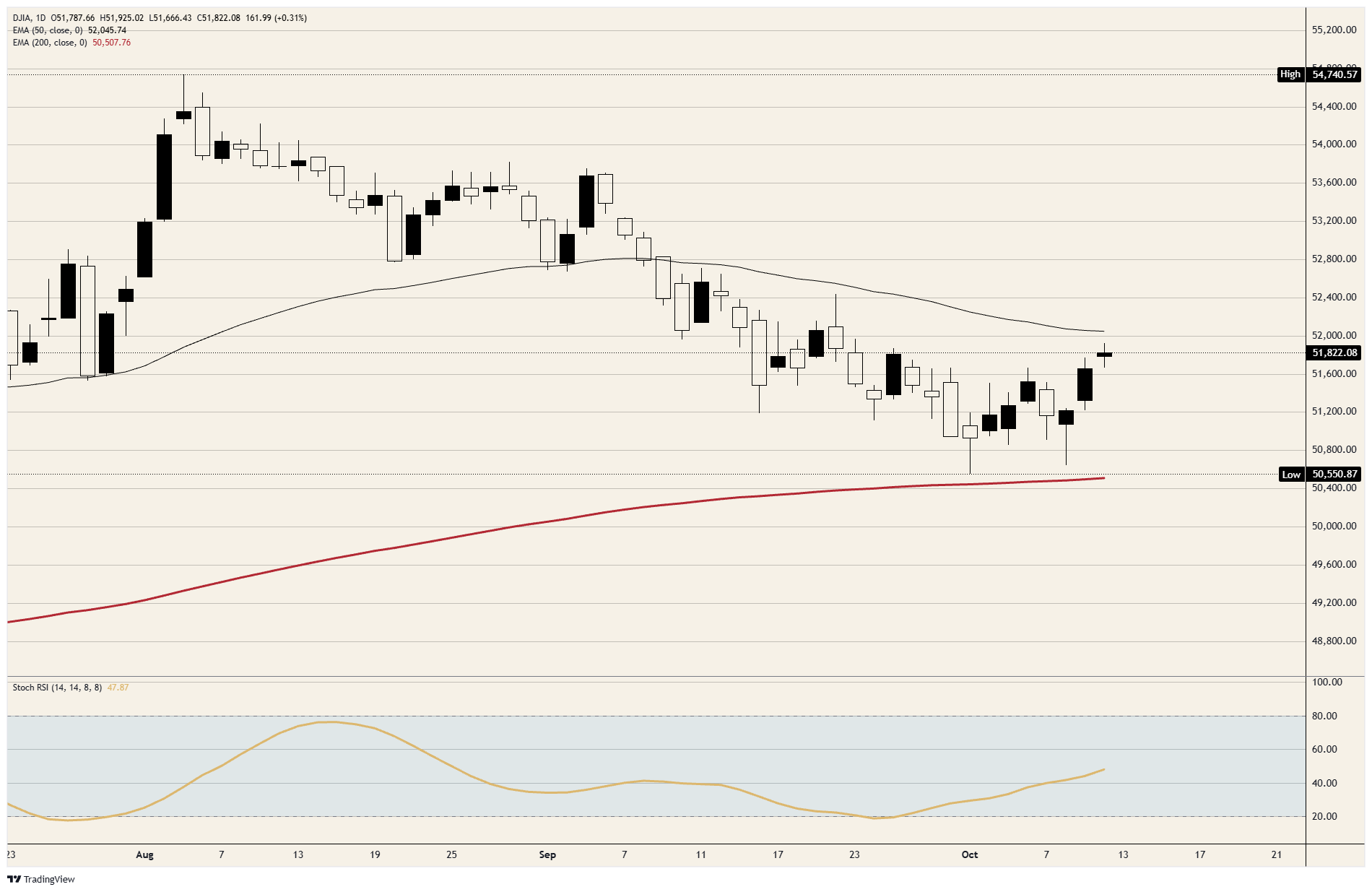
Resistance: The rally stopped just above 51,900, short of the 50-day Exponential Moving Average (EMA) just above 52,000. The index has closed beneath that average every session since September 9, so a close above it turns a two-day bounce into a recovery. The September 22 high just under 52,500 is next.
Support: Monday's low just under 51,700 held at Friday's close, and Friday's low just above 51,200 is the base the two-day run started from.
Bias: Lean long while 51,200 holds on a closing basis, with the 50-day EMA just above 52,000 the first objective and 52,500 the second. The daily Stochastic Relative Strength Index (Stoch RSI) is near 48 and has been rising from the bottom of its range since late September, so the run isn't stretched. A daily close back under 51,200 erases the two-day run and ends the long.
Dow Jones daily chart


Comments
Log in or sign up to join the conversation.