


I’ve been ambivalent about whether the mania for AI is a Boom or a Bubble. That’s because whether its use is transformative or, like Steve Jobs’ claims that the Segway would revolutionize transportation, not so much.
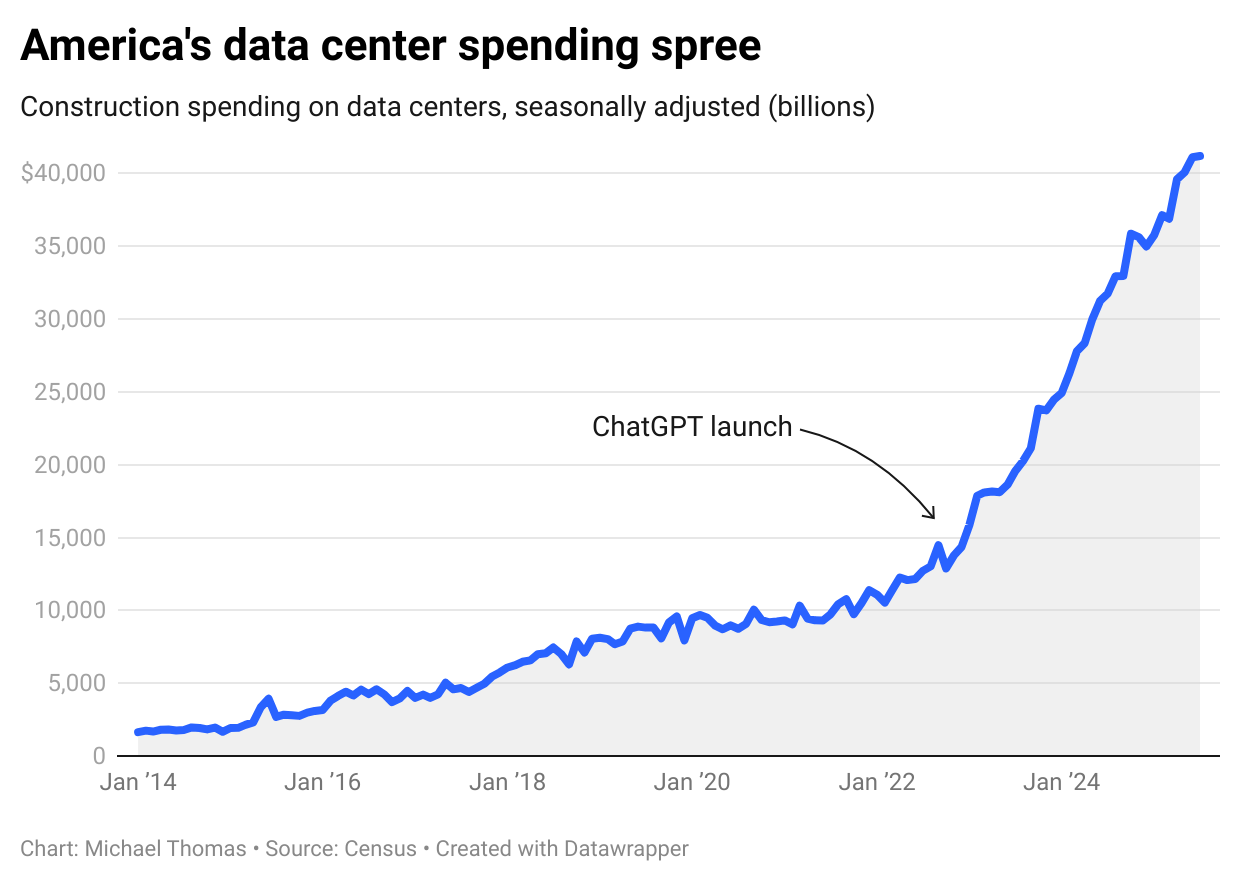
But what has become increasingly clear is that virtually the entire economy has been downstream of its growth. Here’s just how exponential the growth of spending on AI data centers has been:
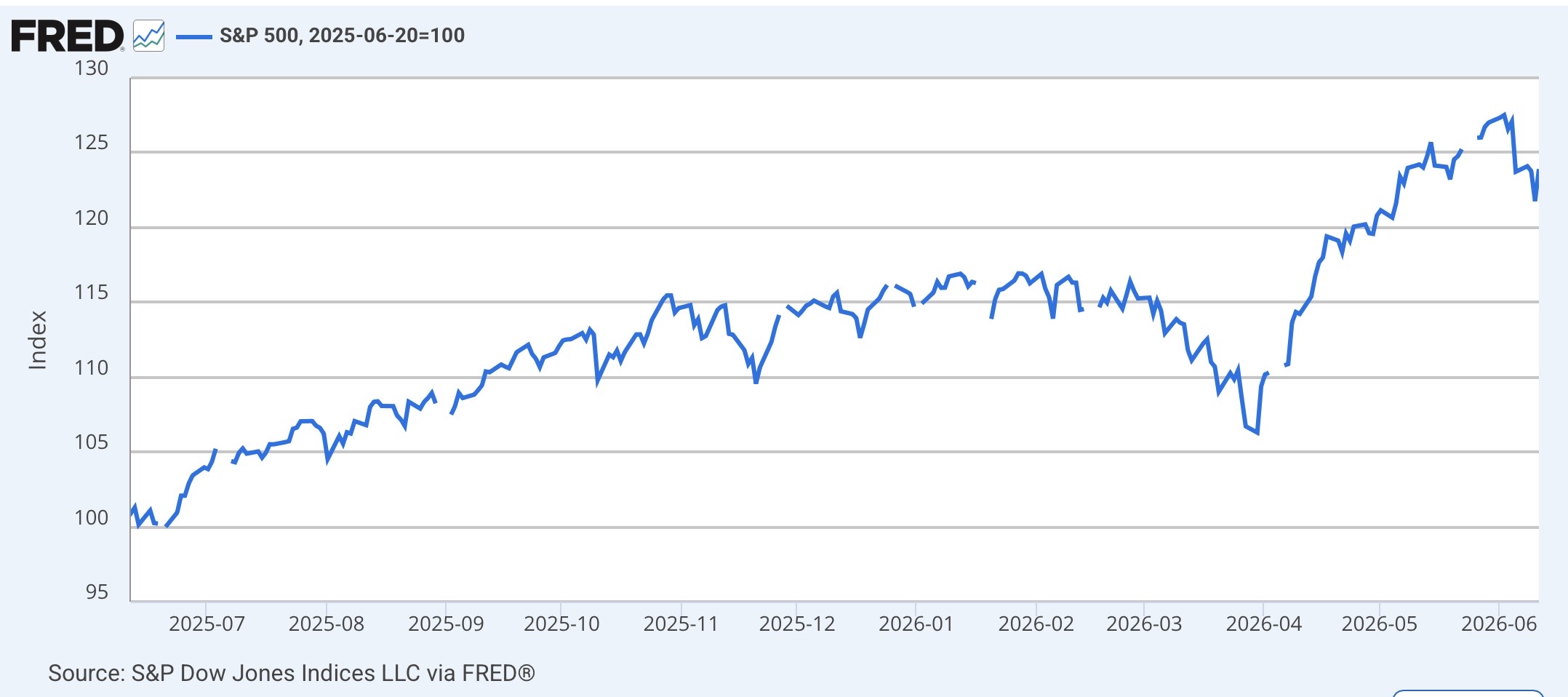
The stock market has boomed:
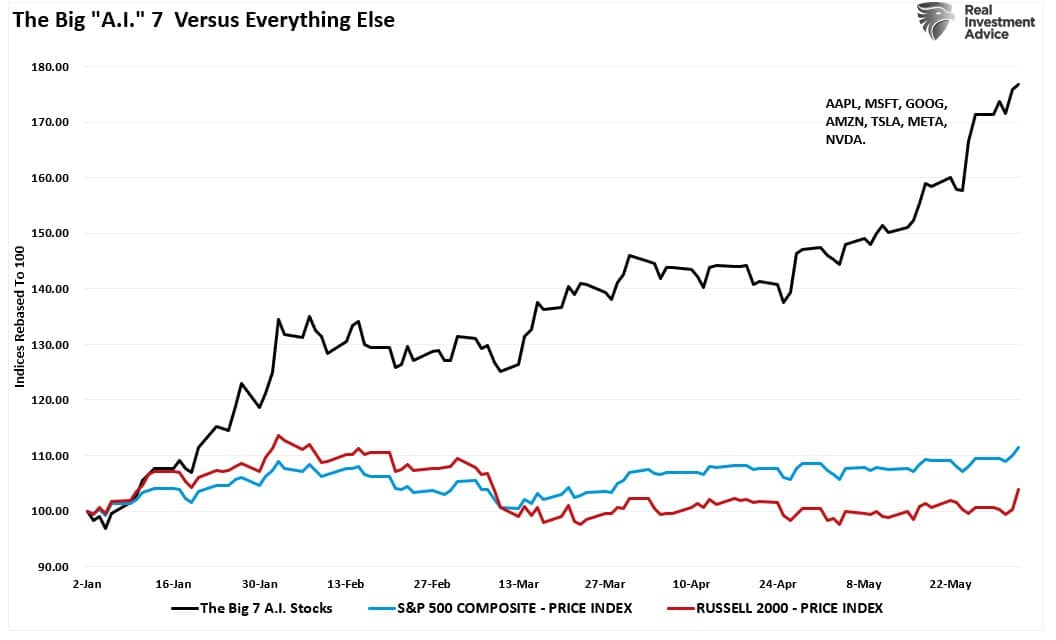
But the stock market Boom has been based almost exclusively on that AI spending:
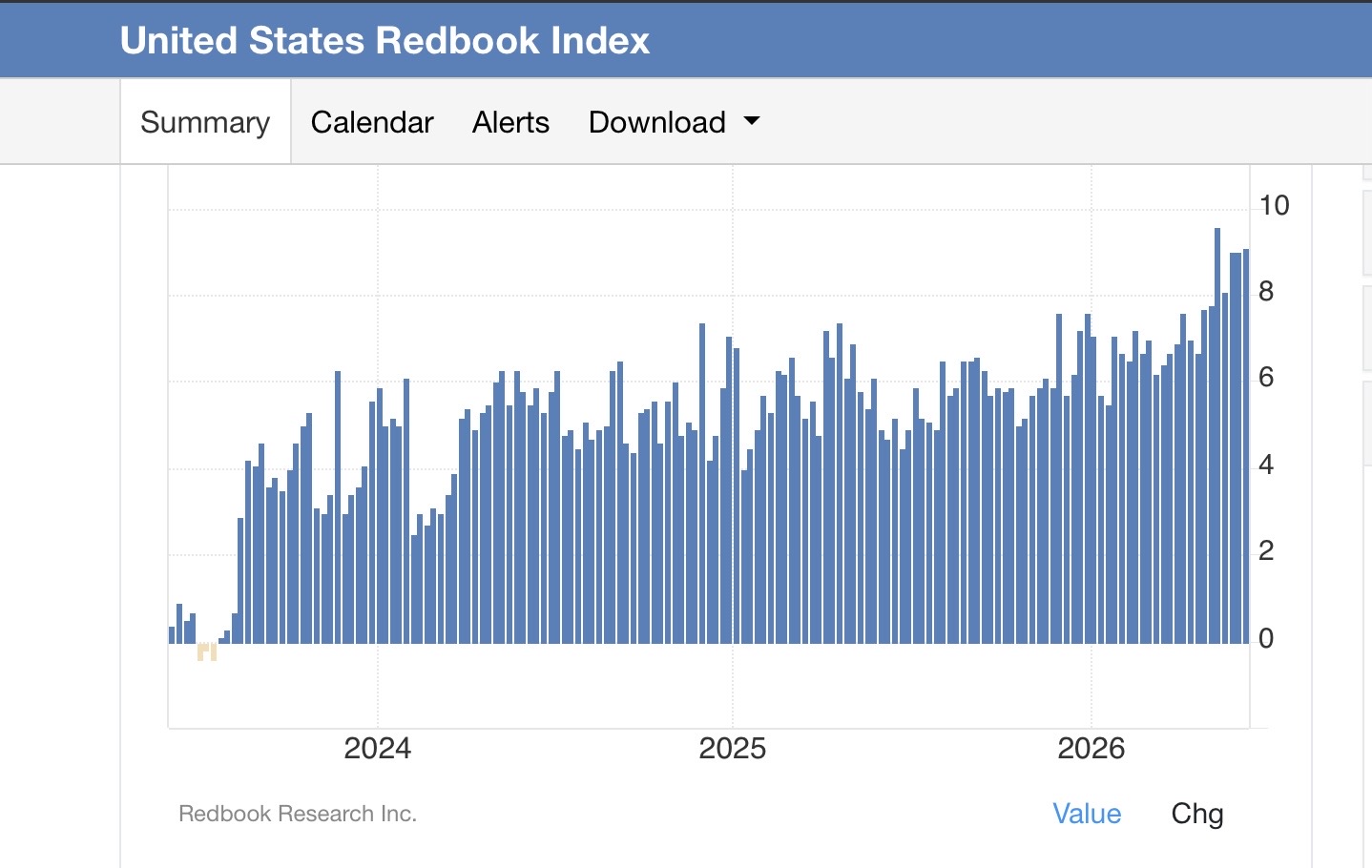
And the wealth effect of that stock market Boom has led to accelerating spending by the affluent, as shown in Redbook’s weekly retail sales data:
And, as consumption leads employment, that spending has spread out to an increase in not just goods-producing jobs (orange, right scale), but broad service-providing jobs (blue, left scale) as well:
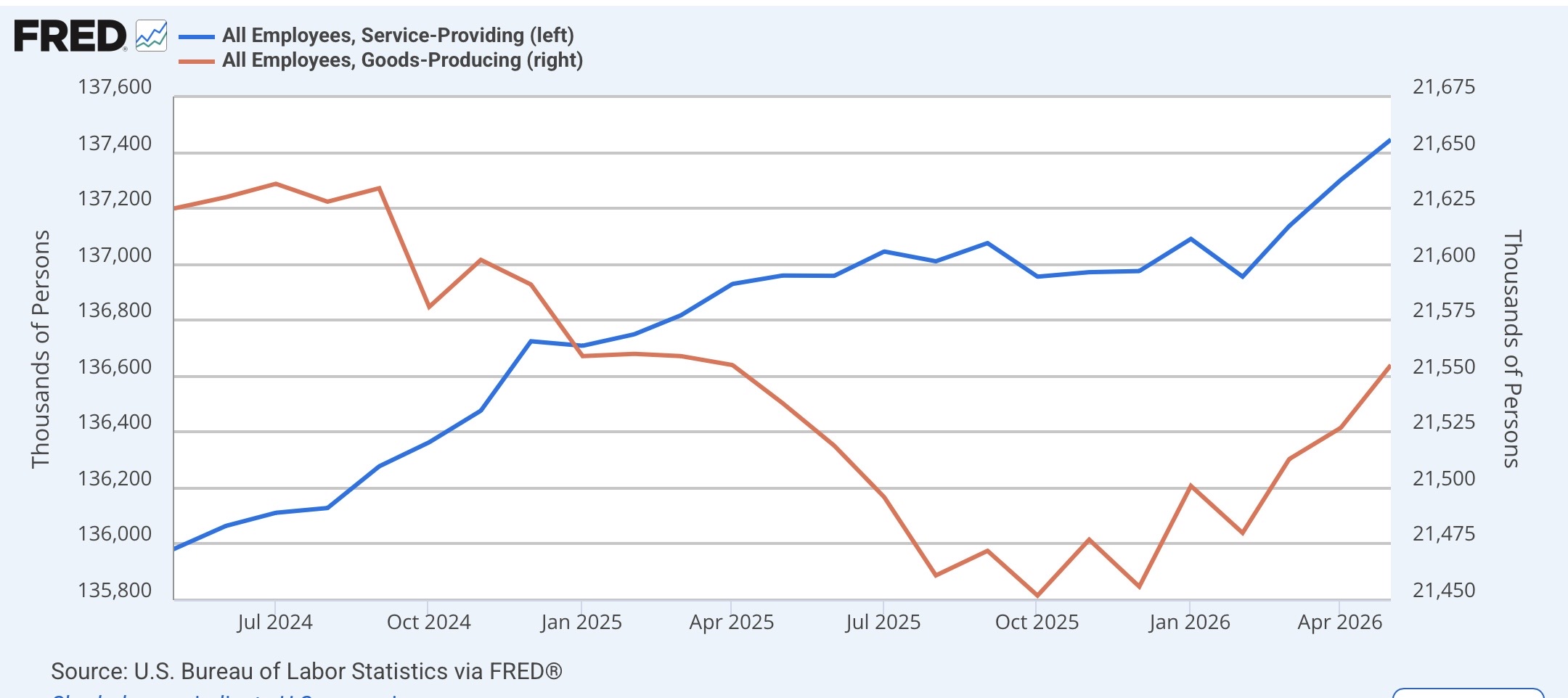
Meanwhile, the spike in inflation has caused consumers, most of whom do not have much, if any, stock holdings, to dig deeper into their savings to a near record low:
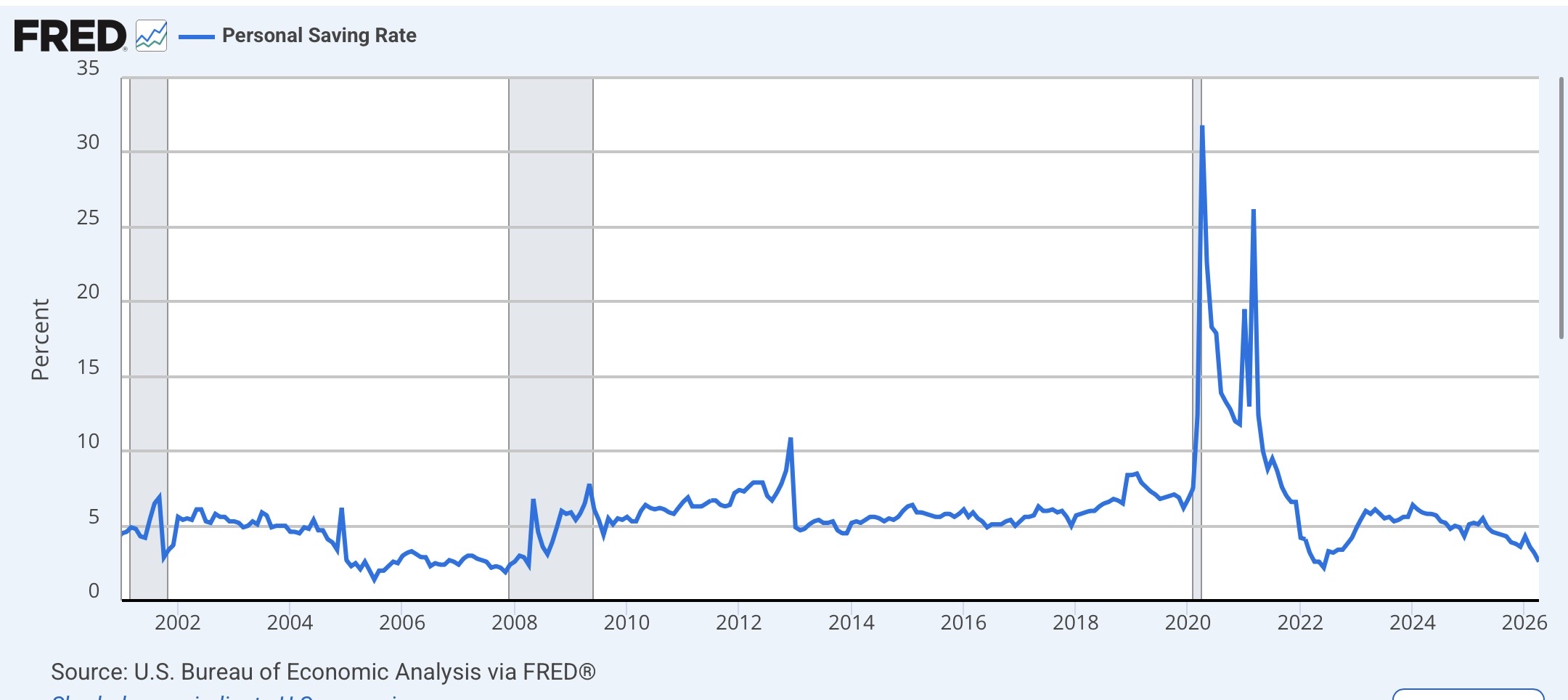
In summary, if it weren’t for the Boom in AI-related spending, it’s likely that consumer spending would be flat or even negative (remember that real average hourly wages have gone negative YoY, and real aggregate nonsupervisory payrolls have grown just barely in the past year:
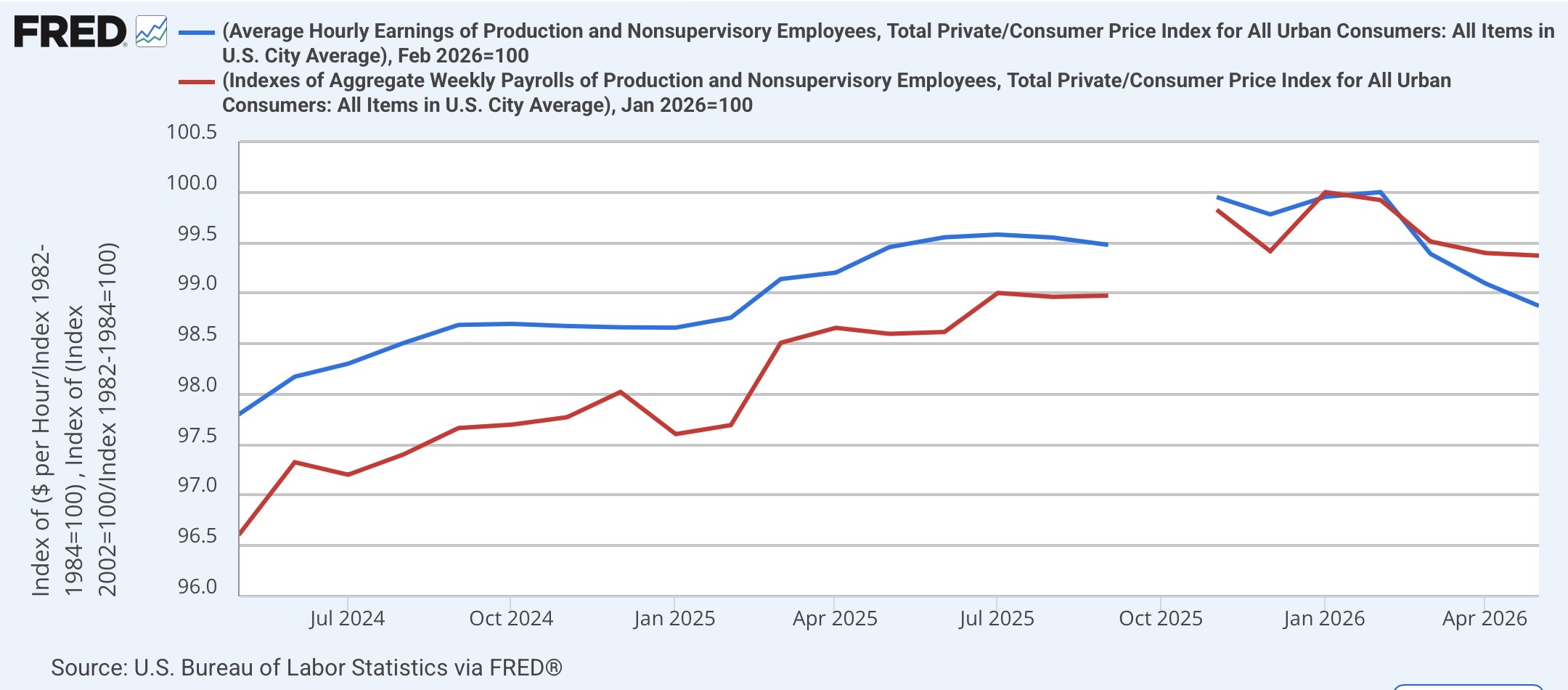
In other words, the US economy would likely be in a recession right now.
That’s an awful lot of weight that is being borne by one small sector of the economy.
But I have come to conclude that, even if AI’s usefulness were to live up to its hype, there is one aspect that strikes me as clearly a bubble.
That’s because there are 10 or 20 companies all rushing to build out full-blown, all-encompassing data centers. But almost certainly when it all shakes out, even under the best of circumstances, there are likely to be only 2 or 3 left. All of the others - and their huge construction and usage footprint - are likely to vanish.
In other words, whether or not the AI Boom is like the dotcom bubble of 1999-2000, it is almost certainly like the browser wars of the 1990s, when there were a variety of providers like Alta Vista and Ask Jeeves that all got eclipsed by Google (GOOGL) and all but vanished from the scene.
And think of the auto industry. Early on, there were dozens of manufacturers. But by the end of the Second World War, there was one dominant company (GM), one secondary company (Ford (F), and one also-ran (Chrysler). In computer chips, there has been one dominant company (Intel (INTC) and one (until recently) also-ran (Micron (MU). As Ron Insana pointed out, “In 1895, there w[ere] … 1,000 companies [that] made bikes as the new model of transport. By 1905, they were going out of business.”
Fortunately, I don’t have to write a more extensive piece, because it turns out someone else named Dan Wertman of Noetica/Thomson Reuters got there a short time ago, so I will quote them at length:
“Most people liken the AI boom to the dot com bubble. But the right comparison is the lesser-known portal wars. …
“Let’s go back to 1998. The internet had just gone mainstream, and a new kind of company was taking over the web: AltaVista, Excite, Lycos and Yahoo were each racing to become your home base online–the ‘interface’ to the internet. They competed on adding vertical workflows: features like news, email, weather and shopping. Venture capital poured in, and they grew fast. For a moment, it looked like any one of them, or all of them, could win, each differentiating themselves in domains in which they were marginally better from the other.
Then a pair of Stanford graduate students created a new model, a search algorithm called PageRank, which used the web’s own link structure as a proprietary data signal. … [W]ithin a few years, PageRank became what we know as Google, and every other portal had been rendered irrelevant.
“We are watching the same movie with AI startups today. Thousands of companies are building products on top of the same AI foundation models — OpenAI’s GPT, Google’s Gemini, Anthropic’s Claude – with no added proprietary content or data, only workflows, each aiming to be the “portal” for their vertical. They have different names, different user experiences, different pitches to investors. What most of them share is that the intelligence powering their product is available to every competitor, every established company, and increasingly to ordinary consumers at low or no cost because they’ve added nothing proprietary to enhance their offerings.”
It’s as if people build 20 Hoover Dams, when only 1 was needed. And the rest will ultimately sit idle - and probably fail.
So, dear reader, let me conclude. This aforementioned AI buildout, and that buildout (vs. whatever software value AI has) is all but certain to crash. When, and over what period of time, we do not know.
Hopefully not while the rest of the economy, as it is now, is downstream.


Comments
Log in or sign up to join the conversation.