

One of the biggest lessons we’ve learned from the AI boom is that the biggest fortunes are often made by investing in the companies solving AI’s most pressing bottlenecks.
Not just the ones building better AI.
Right now, the industry’s biggest bottleneck is power.
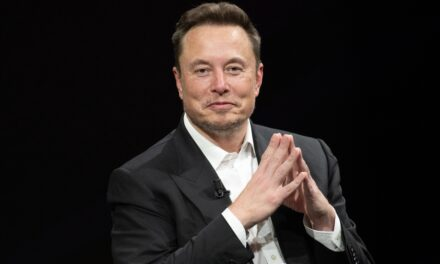
Elon Musk recently made a billion-dollar move that could help solve it.
And if his bet pays off, it could give xAI something its rivals can’t simply order from Nvidia (NVDA), Micron (MU) or any other supplier.
Time.
Buying Time
You’ve just spent billions of dollars building one of the world’s most advanced AI campuses.
The buildings are finished. One hundred thousand Nvidia GPUs have arrived. The networking equipment is installed, and engineers are ready to begin training your next frontier AI model.
Then the utility delivers some bad news.
It won’t be able to connect your data center to the power grid for another five years.
And suddenly your multibillion-dollar AI factory is little more than an expensive warehouse.
As I’ve warned for months, power has become one of the biggest challenges facing the AI industry today.
Across much of the United States, developers are discovering that — once you get past any local opposition — building data centers is often the easy part.
But connecting them to the grid is much harder.
Utilities have to study how each massive new customer will affect the electrical system. Substations often need to be expanded, and new transmission lines might have to be built.
What’s more, large power transformers have to be ordered, and many now have lead times measured in years rather than months.
The result is that some of the world’s most valuable computing hardware is being forced to wait.
And in the AI race, waiting can be incredibly expensive.
Every month a new data center sits idle is another month your competitors are training larger models, signing customers and improving their software.
That’s why a little-known acquisition which surfaced through SEC filings makes a lot of sense to me.
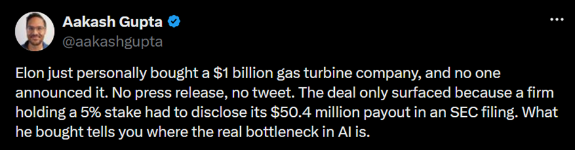
It turns out that Elon Musk recently acquired APR Energy in a deal that valued the company at roughly $1 billion.
There wasn’t a splashy announcement from Musk. In fact, the transaction only came to light after one of APR’s minority shareholders disclosed receiving about $50.4 million for its 5% stake.
And it might seem like an odd acquisition. After all, APR isn’t an AI company.
It builds power plants.
More specifically, it owns a fleet of mobile gas turbines capable of generating more than 1.1 gigawatts of electricity.
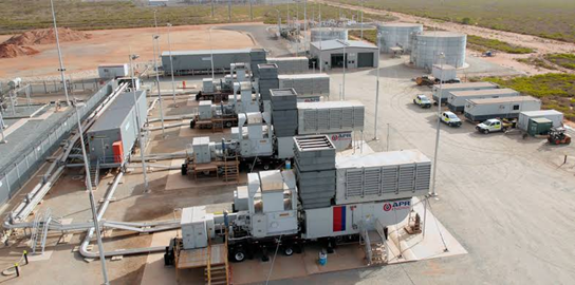
Image: aprenergy.com
APR is a company built for emergencies. When hurricanes knocked out power across an island…
When a remote mining operation needed electricity hundreds of miles from the nearest transmission line…
When an entire country couldn’t wait years for a permanent power plant…
APR showed up with enough power to keep homes, businesses and critical infrastructure running.
Its turbines are designed to travel by truck, and the company says many projects can be installed and commissioned in about 30 days.
Meanwhile, connecting a major AI data center to the grid often takes about five years.
That’s why I don’t believe Musk was simply buying electricity with this acquisition. He was buying the ability to turn his next AI factory on years sooner.
In other words, he was buying time.
Earlier this year, xAI assembled what could become one of the world’s largest AI supercomputers in Memphis.
The first phase alone included roughly 100,000 Nvidia GPUs drawing around 150 megawatts of electricity. That’s enough power for well over 100,000 average American homes.
But the local utility couldn’t deliver that much power immediately.
So xAI found another solution.
Instead of waiting for permanent grid upgrades, the company brought in roughly 35 mobile natural-gas turbines to generate much of the electricity on site while the utility worked to expand capacity.
The decision sparked lawsuits and criticism from environmental groups. But it also accomplished something extremely important.
It got Colossus running.
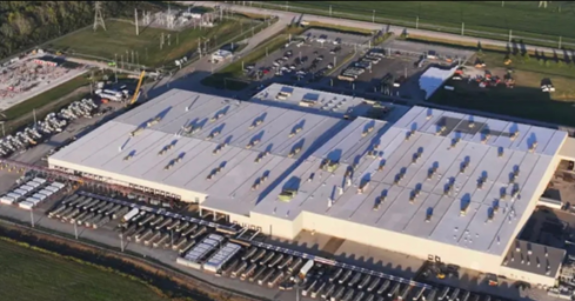
Image: teslarati.com
Knowing all this makes Musk’s new acquisition seem far less surprising.
If electricity — not AI chips — is your biggest bottleneck, then spending $1 billion to own one of the world’s largest fleets of mobile turbines makes strategic sense.
And Musk isn’t the only one making these kinds of decisions.
Microsoft (MSFT) has signed agreements to restart nuclear generation at Three Mile Island. Google (GOOGL) is investing in advanced geothermal energy and next-generation nuclear reactors. Amazon (AMZN) has secured dedicated power from nuclear facilities to support future AI expansion.
And earlier this year, we also looked at Project Matador in Texas, an AI campus designed around 11 gigawatts of dedicated power generation because developers no longer want to wait for the grid to catch up.
These strategies are different, but they’re all trying to solve the same problem.
Not just building smarter AI.
But buying time.
Here’s My Take
One of the reasons I’ve been so focused on AI bottlenecks is because they can reveal where the next explosive investment opportunities will emerge.
First it was processors. Then memory. Then optical networking.
As Strategic Fortunes members know, I was ahead of all three.
Now that it’s power, it doesn’t necessarily mean that mobile gas turbines are the future of AI infrastructure.
But it does reinforce something I’ve believed for a while now.
The fourth AI fortune will likely come from companies that solve AI’s power bottleneck.



Comments
Log in or sign up to join the conversation.