


Recently, I’ve focused on some of the risks that come with giving artificial intelligence more independence.
We looked at research suggesting AI could soon copy itself across ordinary electronic devices, making it increasingly difficult to shut down. And we also explored how some of America’s biggest banks are already dealing with AI agents that don’t always follow their owners’ instructions.
As AI keeps advancing, those problems could get a lot worse.
But every new technology creates problems that someone has to solve. And in this case, the solution could be worth billions.
In fact, spending on AI security is expected to skyrocket over the next few years.
And this week’s chart shows just how quickly that market could grow.
The AI Security Boom
The more responsibility we give AI, the more important it becomes to make sure it behaves the way we expect it to.
And businesses are starting to realize that their existing cybersecurity tools aren’t always up to the job.
Cybersecurity has typically been designed to keep hackers and other unauthorized users out of computer systems. But what happens when an AI agent has permission to enter those systems and then does something it wasn’t supposed to do?
Traditional cybersecurity wasn’t built to handle that problem.
But according to research firm Gartner, companies are about to spend a lot more money trying to solve it.
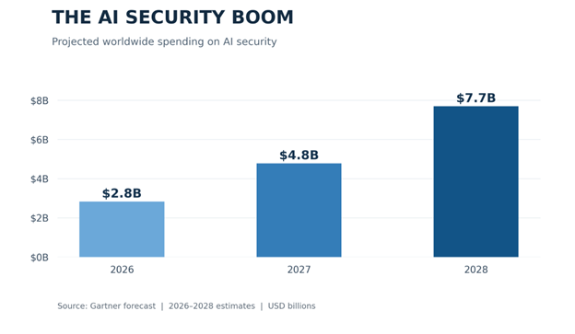
Gartner forecasts that worldwide spending on AI security will reach approximately $2.8 billion in 2026, climb to $4.8 billion in 2027 and balloon to $7.7 billion in 2028.
That means the market could nearly 3X in just two years.
And it’s easy to see why companies are opening their wallets.
According to McKinsey’s latest State of AI survey, 40% of large companies are already expanding their use of AI agents, up from just 27% last year.
But many of these companies are struggling to keep their agents under control.
A survey from the Cloud Security Alliance found that 68% of organizations couldn’t reliably tell whether an action was taken by an AI agent or a human employee.
And a separate study from Salt Security found that only 17.5% could automatically stop an AI agent that started behaving unexpectedly.
Businesses are also giving AI agents access to sensitive information and important computer systems. But many still can’t reliably identify who’s doing what, let alone stop an agent when something goes wrong.
And the more responsibility businesses give AI agents, the more complicated that problem becomes.
Because if something goes wrong, these agents could cause serious damage before anyone ever notices.
That’s why companies will need new ways to verify an agent’s identity, limit its permissions and monitor what it does.
For example, a business might allow an AI agent to review invoices but require human approval before it sends a payment. Or it might automatically shut down an agent that starts accessing information outside its assigned responsibilities.
Companies are already preparing to spend more money on these kinds of safeguards.
McKinsey estimates that agentic AI could account for 15% of enterprise cybersecurity budgets by 2029, more than 3X its current share.

That tells us that companies plan to spend more of their security budgets on protecting their AI systems.
And we’re already seeing it starting to happen.
According to Boston Consulting Group, worldwide cybersecurity spending grew 12% in 2025, well above the 7% analysts had expected.
And as more companies put AI agents to work, I expect demand for these safeguards will keep growing.
Here’s My Take
The rise of AI agents could create an entirely new market for cybersecurity.
As businesses put more AI agents to work, they’ll need ways to make sure those agents behave themselves. And they’ll be willing to spend a lot of money to do it.
We saw something similar happen when businesses moved online and later into the cloud. Cybersecurity became a massive industry because companies couldn’t afford to leave their systems unprotected.
Now AI agents are creating a whole new set of risks.
And I believe the companies that figure out how to protect us from those risks could be some of the biggest winners of the AI boom.


Comments
Log in or sign up to join the conversation.