


Is there an AI bubble? Some key indicators point to one — and when bubbles burst, there can be massive shocks in the housing and job markets that last for years. This weekly tracker will compare current trends on Wall Street with historical averages.
SpaceX: Elon Musk’s Greatest Scam? Mr. Arithmetic Weighs In
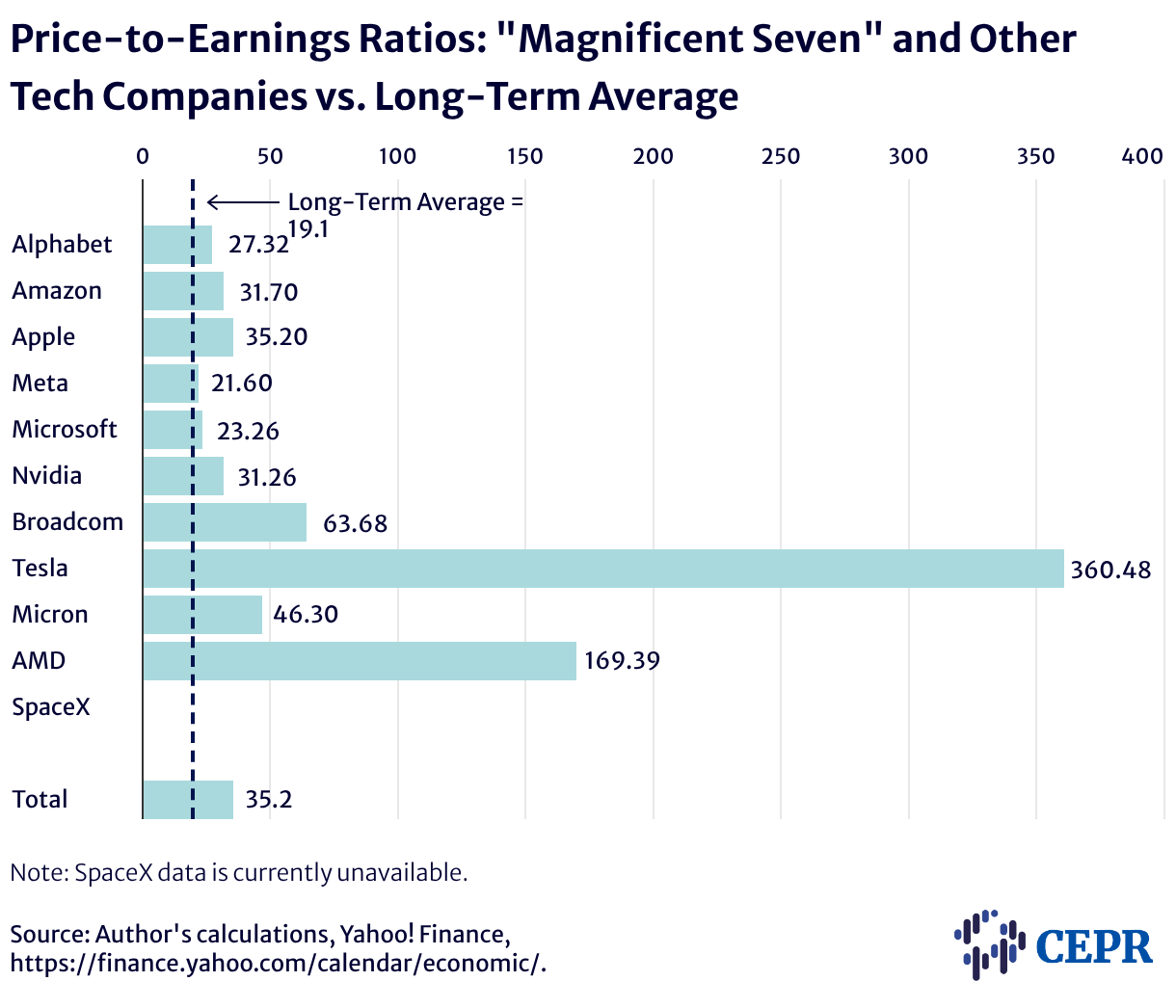
Here are the price-to-earnings ratios as of Friday, June 12. At 35.2, the average increased slightly over last week. For reference, the average at the peak of the late ‘90s tech bubble was 43.8.
Figure 1
Last week was a big one for the AI bubble. SpaceX (SPCX) had the largest IPO ever and Elon Musk became the world’s first trillionaire. In fact, it was such a big deal I thought I would summon Mr. Arithmetic out of retirement to get his insights.
First, if anyone is wondering what rockets have to do with the AI bubble, you have to look at the company’s registration statement. It projects that more than 90 percent of its future market ($26.5 trillion of $28.5 trillion) is in AI. So, SpaceX is first and foremost an AI company.
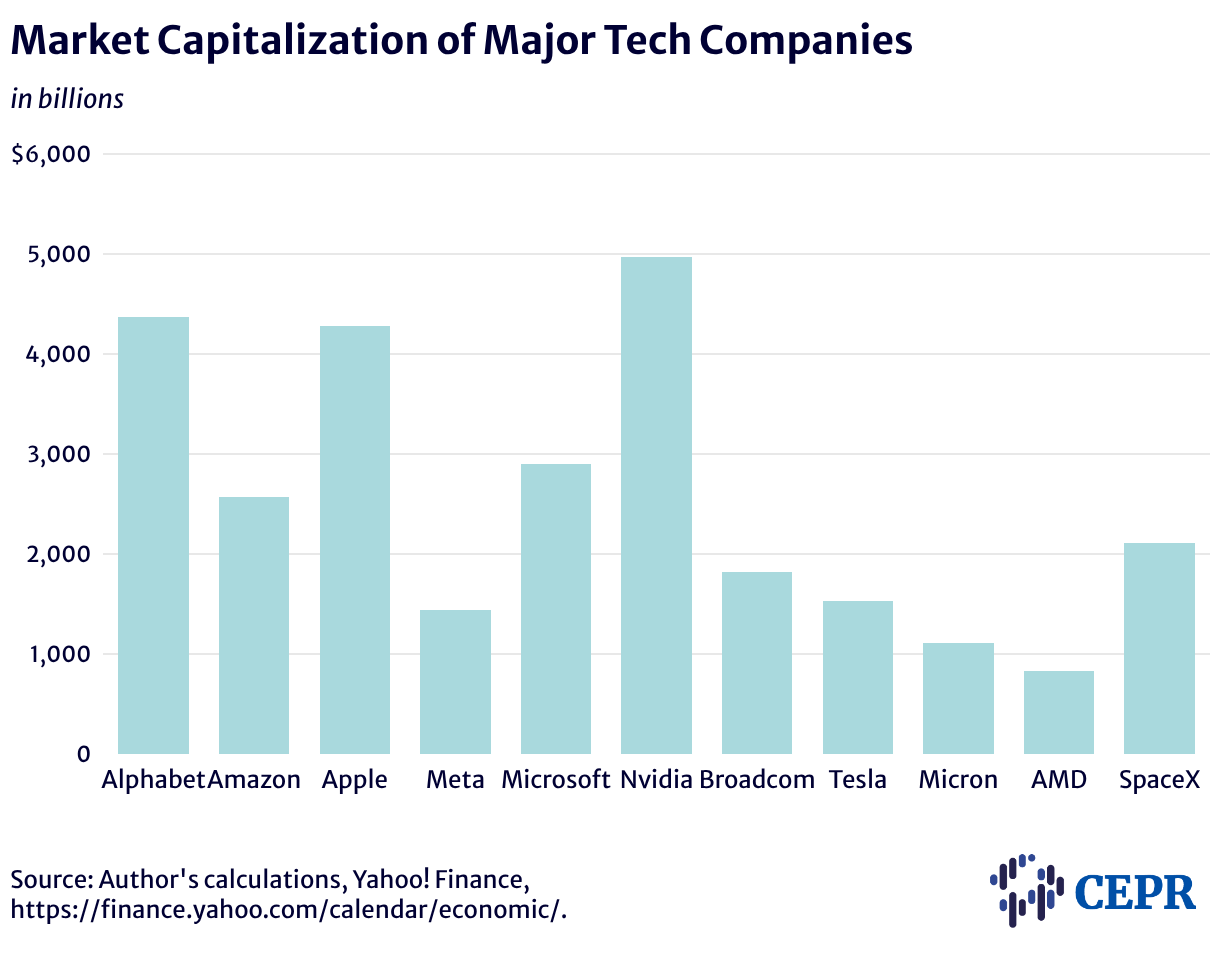
Now, let’s do the numbers. The Friday close on the listed shares for SpaceX’s IPO gave the company an implied market capitalization of $2.2 trillion. Does this valuation make sense?
Ordinarily, we would first look to its price-to-earnings ratio (PE) to see how high it is. But we can’t really do that with SpaceX, since it lost $5 billion last year. So, the company has a way to go here. Clearly the company’s IPO is a bet on Elon Musk.
I know there are some who insist the guy is a visionary and a genius, but his track record has not been great, nor has his relationship with the truth. Paul Krugman gave a few prominent examples of Musk’s boasts that have not panned out in his Friday Substack. His Boring Company, which was supposed to create superfast trains between cities, has literally gone nowhere. The same goes with his Neuralink company that is supposed to give us brain implants that allow us to circumvent our normal physical processes.
He has promised us that Tesla (TSLA) would give us full-self-driving cars next year for at least a decade. And he was supposed to have a full system of self-driving taxis last year. Apparently, Tesla now offers limited service in Austin, Texas. By contrast, Waymo has extensive service in San Francisco, Phoenix, and a number of other major cities.
And for those keeping score on such things, Tesla’s profits were $4 billion last year, roughly 0.25 percent of its market capitalization. And the overwhelming majority of the profits came from selling carbon credits, a system that Musk’s good friend Donald Trump wants to end. In short, Musk’s track record in his business dealings has been less than stellar.
But his ventures into politics look even worse. Apart from his presidential pick (he once said he loves Donald Trump as much as it’s possible to love another man without being gay), his grasp of numbers seems to be seriously lacking. When he was allowed to invent and run a “Department of Government Efficiency” Musk said he would eliminate at least $2 trillion in waste and fraud, according to Grok, his AI system. At one point, he suggested giving us all $5,000 annual DOGE dividends, which would come to over $1.3 trillion a year.
The most cursory examination of the federal budget would have told him that savings of this magnitude are absurd. The whole budget for 2025 was a bit over $7 trillion, with the overwhelming majority going to interest on the debt, Social Security, Medicare and Medicaid, and the military.
Reducing interest payments would mean radically altering monetary policy, which he didn’t have the authority to do, and would be a radical shift, to say the least. Social Security and Medicare have been endlessly scrutinized and found to have very little fraud. Medicaid surely has some, but it is hard to detect and getting to double-digit billions would be a huge stretch — and still less than 1 percent of Musk’s target. Defense surely has fraud and waste, but Musk’s boss didn’t want him to go there.
Spending outside of these areas was well under $2 trillion. This included education, scientific research, infrastructure, the FBI and criminal justice, agriculture, and foreign aid. Musk was able to score big in cutting the last category by cutting around $20 billion (1 percent of his promised savings), leading hundreds of thousands of people in Africa to get sick and likely die from AIDS and now Ebola.
Musk also routinely initiated and/or repeated whack job crazy claims like 20 million dead people getting Social Security. (The true number is low thousands, among a population of 70 million beneficiaries.) He also claimed, against all evidence, that Democrats are arranging to have millions of undocumented immigrants vote.
Maybe Musk never believed such craziness, and these were just lies to advance his political agenda. But if someone would so easily tell whack job crazy lies to advance their political agenda, is it reasonable to think that they wouldn’t tell lies to make themselves richer?
Does SpaceX’s Future Justify SpaceX’s Current Market Cap?
The question of the day: Does SpaceX’s $2.2 trillion market capitalization makes sense? We know the thing doesn’t make money now, but maybe at some point in the future Elon will be raking in the bucks to justify this price.
Let’s say we take a 10-year horizon. In 2036, SpaceX will be 34 years old, a more established company than Google (GOOGL) is today, so we might expect it to have profits somewhat in line with its share price, like most mature companies. But its share price should be far higher in 2036 than it is today. After all, people aren’t buying shares of SpaceX to just break even.
Historically, stocks have given somewhere close to a 10 percent nominal return. (I have argued that expecting that return going forward probably doesn’t make sense, but most people invested in this market probably do expect a return something like that.) But that is for a normal stock with real profits. People putting money in SpaceX are betting on a company that is losing large amounts of money and run by a person with an affection for ketamine and neo-Nazi propaganda. Surely, they expect a better return than the measly 10 percent you can get from investing in an airline or consumer products company.
Let’s assume your typical SpaceX investor is expecting a 20 percent annual return. (Use a different number if you prefer.) After ten years with a 20 percent annual return, SpaceX’s market capitalization will be 6.2 times its current level, or $13.6 trillion.
As a mature company, let’s say that in 2036 it will have a price-to-earnings ratio of 20, still well above the long-term average for the stock market. That would imply it would have annual after-tax earnings of $680 billion. Is that plausible?
The Congressional Budget Office (CBO) currently projects that, in the economy as a whole, after-tax corporate profits will be $4.1 trillion in 2036. That would mean that SpaceX will have almost 17 percent of all after-tax corporate profits. That is several times larger than the share that any company has ever had.
It also comes at a time when Musk’s rivals, Open AI and Anthropic, are also having IPOs expected to price them at well over $1 trillion. Don’t forget that Nvidia (NVDA) already has a market cap of almost $5 trillion and the rest of the magnificent 7, including Tesla, all have market caps of well over $1 trillion.
If you think that something here doesn’t add up, you would be right. But there is the possibility that the CBO is wrong — and not just by something like 3-5 percent, which would already be a big deal, but 20 percent, 30 percent or more, which would be huge and unprecedented.
We can’t rule that sort of extreme error out of the realm of the possible, but we can say some things about the world where it is true. Jason Furman, who was a top economic advisor in both the Clinton and Obama administrations, had a New York Times (NYT) column on Friday warning about the disaster facing Social Security as projections show a funding shortfall beginning in 2032.
While Furman is right that we will need additional funding for Social Security, the concern he expresses at the end for the well-being of our children is utterly absurd if economic growth is going to be hugely faster than the CBO projects, because of the wonders of AI. If the price of SpaceX and other AI companies come anywhere close to making sense, then concerns about the material well-being of future generations are complete nonsense.
Can completely contradictory views of the world exist on opposite sides of the New York Times home page and no one even notices? Having been around Washington policy debates for more than three decades, I can assure people that they can.
The people involved in policy debates tend not to be deep thinkers. They can miss massive contradictions right in front of their face. In fact, the same person can even argue massively contradictory positions themselves and fail to recognize the problem.
What do you know, here’s Elon Musk warning earlier this year that there is a “1000% chance” the government will go bankrupt. Anyone up for some shares in SpaceX?
Figure 2
The AI Bubble Monitor #1: June 8, 2026
The Lay of the Land
The US economy has had two major bubbles in the last three decades. There are signs that we are in the midst of a third.
In the late 1990s there was a tech bubble, driven to a large extent by excitement over the potential of the Internet. This drove stock prices to a peak value of 43.8 times earnings (known as the price-to-earnings ratio, or P/E), according to the calculations of Nobel Prize- winning economist Robert Shiller.
This bubble began to burst in March of 2000. The S&P (SPY) lost almost 50 percent of its value at its trough two-and-a-half years later in October of 2002. The NASDAQ (QQQ), which included all the major tech stocks, lost almost 80 percent of its value over this period.
The collapse of the bubble was a huge hit to the economy and the labor market. Measured by output, the recession that took place in 2001 due to the collapse was relatively mild, but measured by employment, it was huge. Job growth turned negative in March of 2001.
The economy did not get back the jobs lost for four full years. This was the longest period without job growth since the Great Depression. The weak labor market also brought the strong real wage growth of the late 1990s to an end, as the real median wage rose less than 1.5 percent from 2001 to 2007, when the next recession hit.
The Collapse of the Housing Bubble
The recovery from the collapse of the tech bubble was driven by the growth of a massive housing bubble, as inflation-adjusted house prices rose by 70 percent from 1996 to 2006, after being roughly flat for the prior century. Over the years from 2007 to 2010, most of this increase was reversed.
The consequences were enormous. Residential construction, which peaked at 6.7 percent of GDP in 2005, fell back to just 2.4 percent of GDP in 2010. This drop of 4.3 percentage points of GDP would be equivalent to losing more than $1.3 trillion in annual demand in today’s economy. The loss of trillions of dollars housing wealth also curtailed consumption.
The impact on the economy was massive, as GDP growth was almost 0 in 2008, and the economy shrank by 2.7 percent in 2009. The unemployment rate peaked at 10.0 percent in October of 2009. Job growth for 2008-10 was more than 12 million below projections. Millions of people also lost their homes.
Bursting Bubbles Are a Big Deal
This recent history is important to keep in mind as we look at the AI bubble. The bubble is arguably even larger relative to the economy than the tech bubble when it peaked in 2000. According to Shiller’s calculations, the PE in the stock market, at 39.6, is slightly lower than it was at the 2000 peak. However, after-tax profits are nearly twice as large a share of GDP than they were in 2000. That means that the value of the stock market relative to the economy is nearly twice as large as it was at the peak of the tech bubble.
The current value of all corporate stock is close to $80 trillion, more than 2.5 times GDP. If PE ratios fell back to their long-term average of just under 20, it would destroy close to $40 trillion in stock wealth, an average of almost $300,000 per household. If the PE fell back to its long-term average, and the after-tax profit share of GDP also fell back toward their level of a quarter-century ago, then the loss of wealth would be even larger.
It is impossible to know the timing for when a bubble will collapse. A quarter of a century later, it is still not possible to identify any event that caused the 1990s tech bubble to collapse. It’s also not clear what caused the housing bubble to stop growing and start deflating.
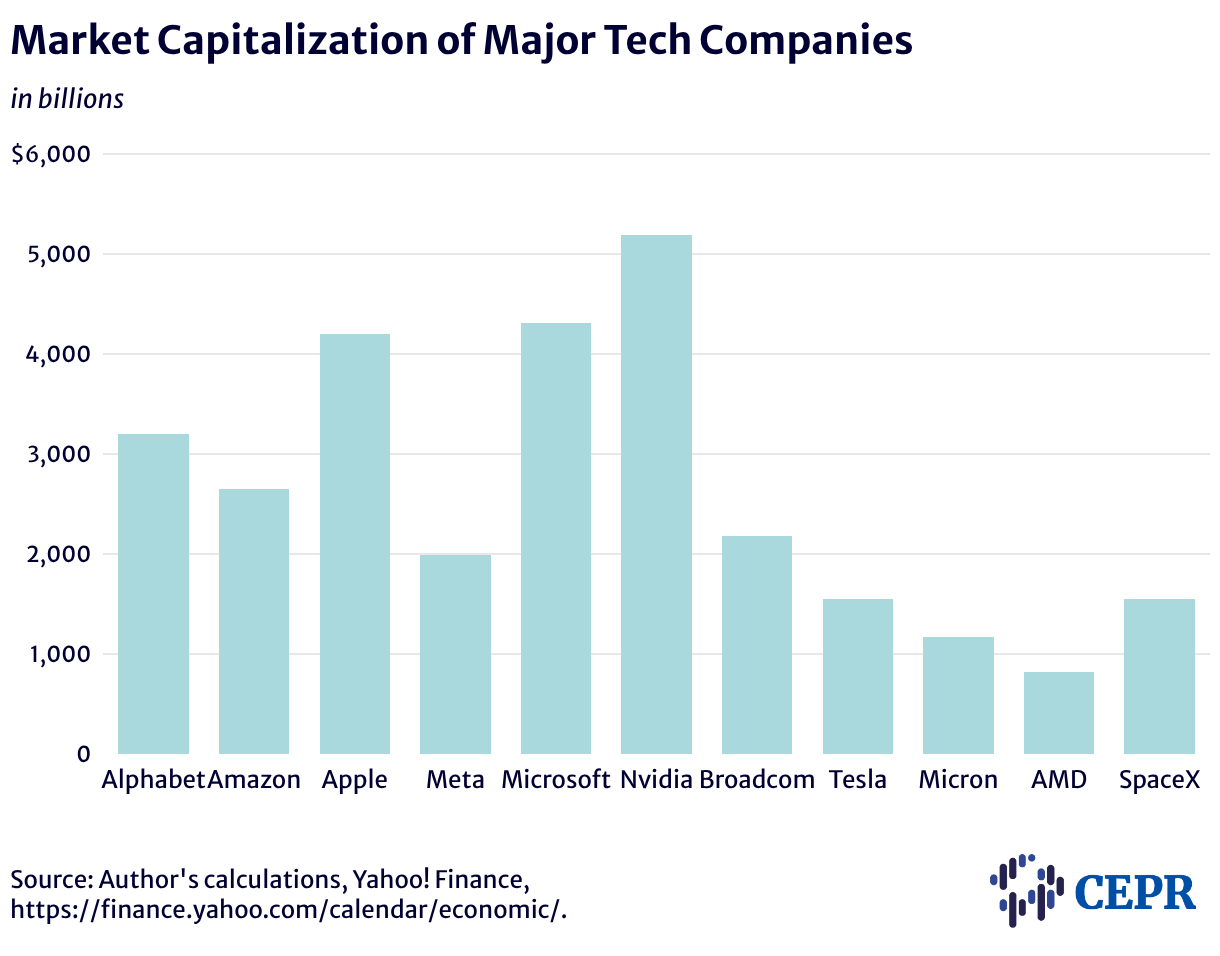
With that in mind, it is possible to track the bubble, looking at the growth in the prices of the most important stocks and changes in their PE. This is what the AI Bubble Monitor will do on a weekly basis.
Figure 1
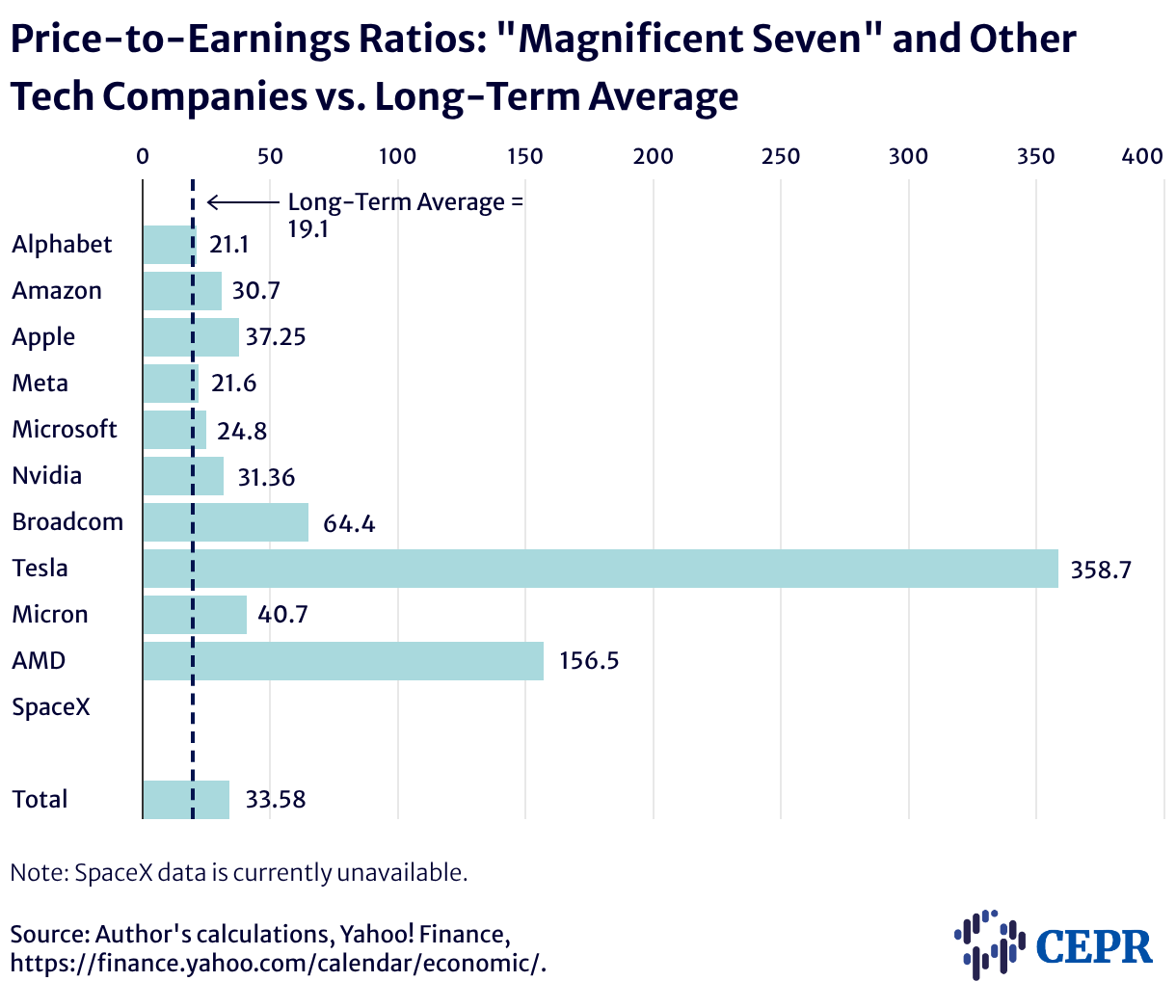
Figure 2



Comments
Log in or sign up to join the conversation.