

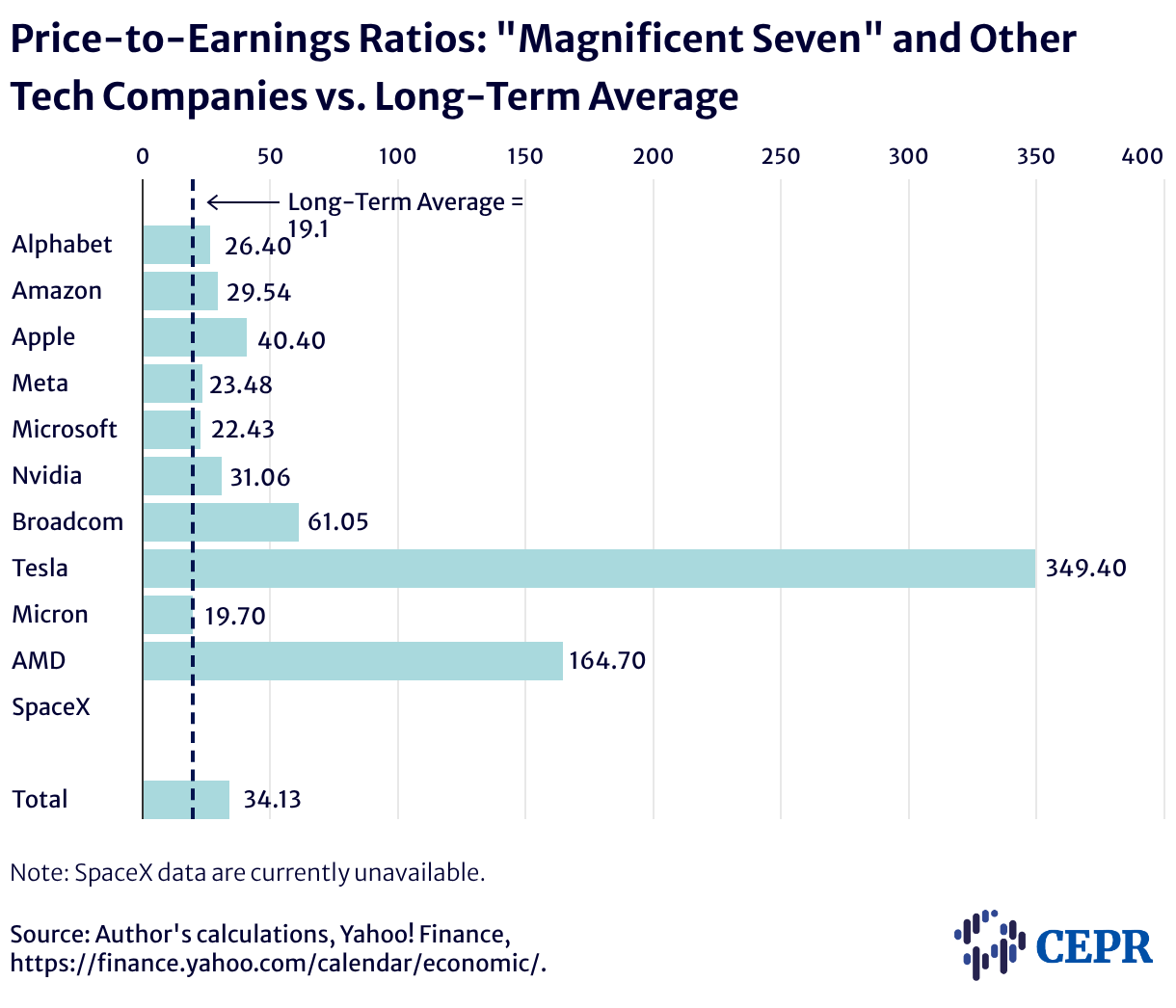
Here are the new price-to-earnings numbers:
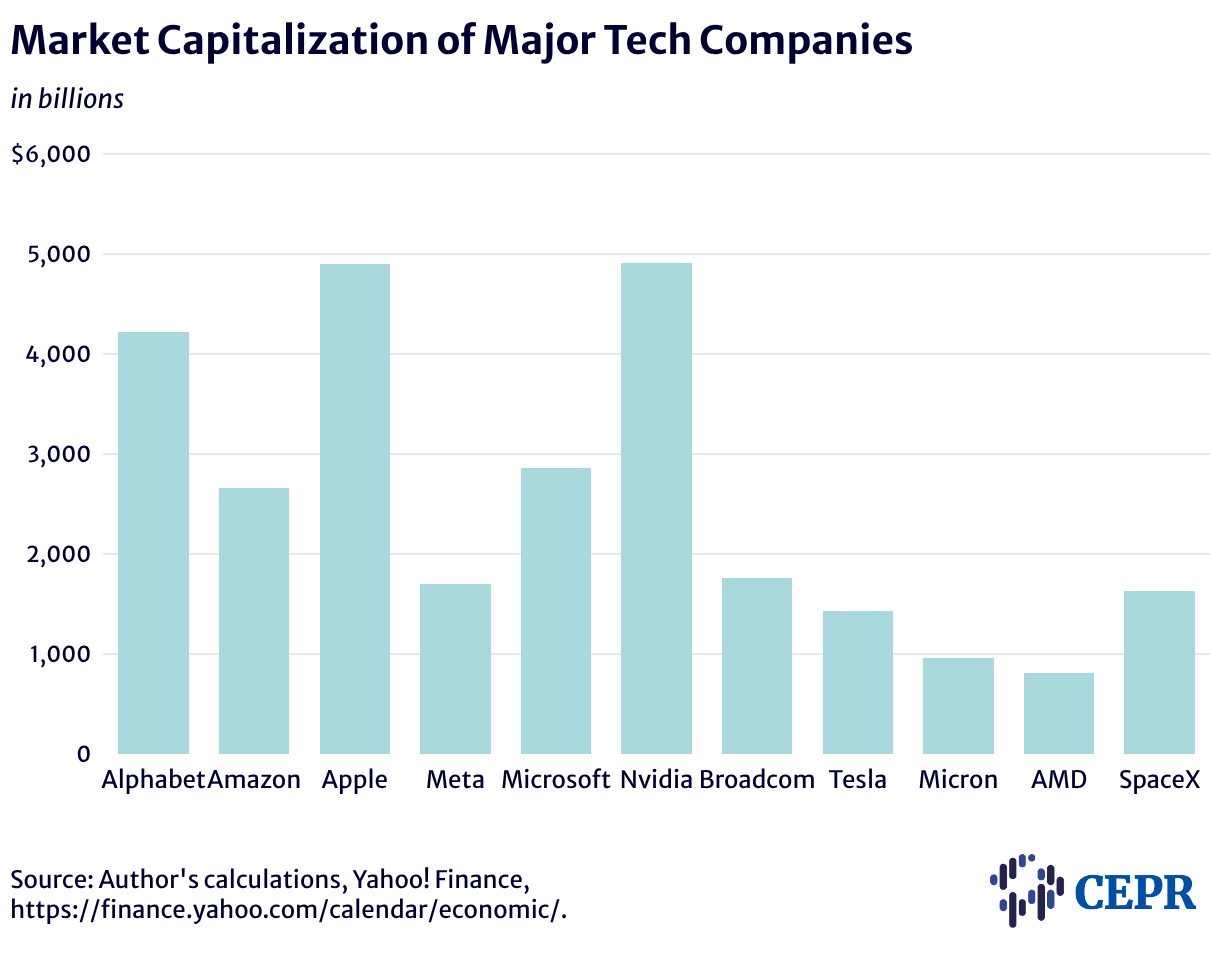
SpaceX’s shares took a big hit last week, ending the week at 124 at the NASDAQ close on Friday. This is more than 8 percent below the 135 price at its initial public offering last month, and a drop of almost 15 percent for the week. That corresponds to a loss of more than $200 billion in market capitalization. The Friday close was more than 40 percent below the peak price of 211 hit in the week after the IPO.
SpaceX was hit with some bad news last week, notably a rocket launch on Thursday that had to be aborted. But the company’s troubles may go beyond one failed rocket launch. The company’s stock had been falling for the last three weeks. It’s possible that investors have less confidence that Musk will be turning around a massive money loser into one of the most profitable companies in the history of the world.
Also, the lock-in period for insiders will likely be ending soon. This means that a lot of shares will be dumped by people looking to cash out big gains.
SpaceX wasn’t the only high-flyer seeing some rocky waters. The price of Tesla (TSLA), Musk’s other big company, fell by 6.6 percent last week, reducing its market capitalization by $100 billion from the week before.
And it wasn’t just Musk’s companies that had troubles. The big chipmakers all had bad weeks. Nvidia (NVDA)’s stock price dropped 3.9 percent last week, shedding $200 billion in market value. Broadcom (AVGO)’s valuation fell by $140 billion — 7.3 percent of its market value — and shares of both Micron (MU) and AMD fell by more than 10 percent.
It’s always hard to say what information moves markets, but there is a clear candidate this week. The Chinese AI company Moonshot unveiled a new model that scores right alongside the top models from OpenAI and Anthropic. The problem for the US AI companies — and the hyperscalers providing the computing power, as well the chip manufacturers — is not just that China’s leading AI companies can match the power of the US leaders, it’s that they sell their product at a fraction of the price.
As noted before, the story of a huge payoff to AI firms rests on three big assumptions, all of which look increasingly questionable. The first and most important is that there will be a massive payoff from AI in the form of an increased rate of productivity growth. To date we see no evidence of this. Productivity growth has been very weak in the last three quarters. (I’m including the second quarter of 2026 based on estimates of GDP growth and the data we have on hours worked.)
The second is that competition will not push down prices, allowing the benefits of the AI productivity boost to be widely shared by society rather than being locked in as extraordinary profits for the AI makers. The third assumption is that the US AI companies will be the ones getting the big profits.
The latest developments in Chinese AI make both the second and third assumptions very questionable. The Chinese companies are prepared to compete on price, offering a far lower cost product that will be fine for the needs of almost all users. This means both that the profits of AI companies are likely to be limited even if there prove to be massive productivity gains.
Remember, this is the story of Internet providers. Verizon (VZ) and Comcast (CMCSA) are big profitable companies, but they are not earthshaking giants. If Anthropic and OpenAI end up being the Verizons and Comcasts of the next decade, their shareholders will be looking at huge losses. And given the progress of the Chinese AI companies, they may prove fortunate even to achieve the status of the big Internet providers, as Chinese companies are dominating not just third markets, but increasingly the US market as well.
If this story proves to be right, and there is no pot of gold at the end of the AI rainbow, it’s hard to say how long it will take markets to catch up. The Internet bubble took two and a half years to deflate. The financial problems associated with the collapse of the housing bubble also took a long time to percolate through the system.
Nationwide house prices peaked in the summer of 2006, but the stock market continued to rise at a healthy pace through most of 2007. Even the stocks of the soon to be bankrupt companies fared well until the near the end. AIG still had a market capitalization of almost $180 billion at the end of 2007 — and even in the summer of 2008, just months before its collapse, its market capitalization was over $70 billion.
While markets may be forward looking, they don’t always see things with clear eyes. There might be some way that the big bets on the AI companies, the hyperscalers, and the chip makers make sense, but it is difficult to see what it is at this point.
Why I’m Not on the Economists’ Statement on AI
Most readers have probably heard about the economists’ statement on AI. At this point, it has more than 2,000 signatures, including at least 16 Nobelists. I chose not to add my name for two reasons.
First, I worry that it contributes to the hype around AI. There already is enough hype around AI. As I, and others, have repeatedly pointed out, we do not see any evidence that it is leading to mass unemployment and earth-shattering gains in productivity. That could change in the future, but it’s not clear why the story will be hugely different in 2027 and 2028 than it was in 2025 and 2026. We get enough hype about AI from Sam Altman and Elon Musk; we don’t need 2,000 economists to give us more.
Again, I don’t question that AI will have a large impact on the economy and society. So did the Internet. I don’t recall massive economist sign-on letters warning of the dangers of the Internet.
The other reason I didn’t sign is that I’m not sure exactly who the call to action is addressed to. Are we asking the White House to form a commission? That seems ill advised, since we will probably just see Donald Trump auctioning off membership positions.
Alternatively, is the hope that Congress will step forward? That doesn’t seem much better given the current Congress is led by people who can’t figure out who won the 2020 presidential election.
We do need economists, sociologists, political scientists, and other researchers examining the impacts of AI in different areas, but I’m not sure the economists’ call to action will have much impact on this front. People are already doing this work, perhaps the statement will prod a few more, but I doubt it will change many people’s research agendas.


Comments
Log in or sign up to join the conversation.