The Tesla market cap demands a massive autonomous transportation network. Later today, the company will try to make that future more tangible with its Cybercab launch event in Austin. Building a car without a steering wheel or pedals is a great visual. The real test is whether Tesla can prove the software is safe enough, mass produce the vehicles, and legally deploy them at commercial scale. Federal rules currently limit the commercial deployment of vehicles that do not meet existing safety standards, while competitors already operate paid driverless fleets. Investors have to figure out whether this event marks the beginning of a real business or another polished technology demonstration.
|
Moving Beyond The Steering Wheel |
|
 |
Verdict: Tesla has begun producing purpose built Cybercab hardware, but today’s event still has to show whether the vehicle can operate safely, reach paying customers, and scale beyond a small authorized fleet. Regulation matters, but software reliability and fleet operations may be just as important.
|
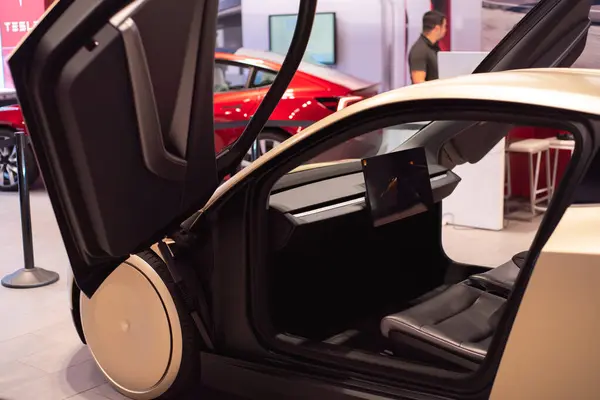
Tesla is hosting its highly anticipated Cybercab event in Austin today. The company is showcasing vehicles designed entirely around a camera only vision system, deliberately omitting manual controls like steering wheels and pedals.
|
Texas Department of Motor Vehicles records listed 45 Cybercabs under Tesla’s automated vehicle authorization as of Wednesday evening, part of 420 Tesla autonomous vehicles registered in the state. That establishes an early fleet count, but it does not prove all 45 Cybercabs are active, available to riders, or operating without human oversight. |
|
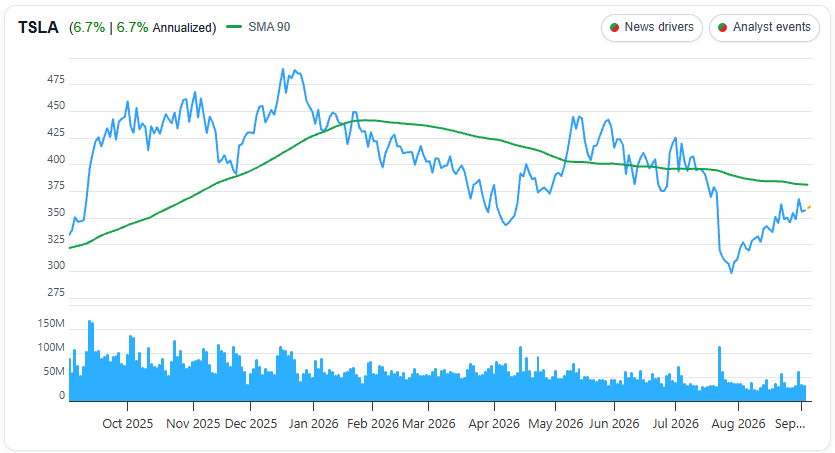 |
Tesla (TSLA) 1 Year Chart
|
A successful transition to a closed loop mobility network could change Tesla’s cash flow profile. Instead of selling a vehicle once, the company could collect fare revenue over the life of each Cybercab. The tradeoff is that Tesla would also take on the costs of owning, financing, charging, cleaning, repairing, insuring, and repositioning the fleet. The opportunity is recurring revenue, but the economics will depend on utilization and cost per mile.
|
What changed in the thesis
|
The thesis is not changing from software add on to fleet operator today. Tesla has discussed a company managed robotaxi network for years and began a limited Austin service in June 2025. What changes today is the evidence investors can demand. The event should show whether Cybercab is moving from a small production and testing program toward a repeatable commercial service, and whether Tesla can support its claimed cost advantage with real operating data.
|
What the market may be missing
|
Regulation is one bottleneck, but it is not the only one. If the production Cybercab cannot comply with current federal motor vehicle safety standards because it lacks manual controls, Tesla would generally need a temporary exemption from the National Highway Traffic Safety Administration for commercial deployment. Current Part 555 rules generally limit a manufacturer to 2,500 exempt vehicles introduced commercially in any 12 month period. That restriction can affect paid ride service, but it is not a blanket cap on how many vehicles Tesla can build or test. Tesla also has to prove that the software, remote support, maintenance, and fleet operations can work safely at scale.
|
Valuation and expectations
|
Tesla’s roughly $1.3 trillion market value leaves little room for autonomy to remain a small experiment. Investors do not need today’s event to prove that millions of Cybercabs are imminent, but they do need evidence of a credible path from dozens of authorized vehicles to a profitable network. A vague timeline, limited public access, or continued dependence on safety monitors would make the autonomy premium harder to defend. |
|
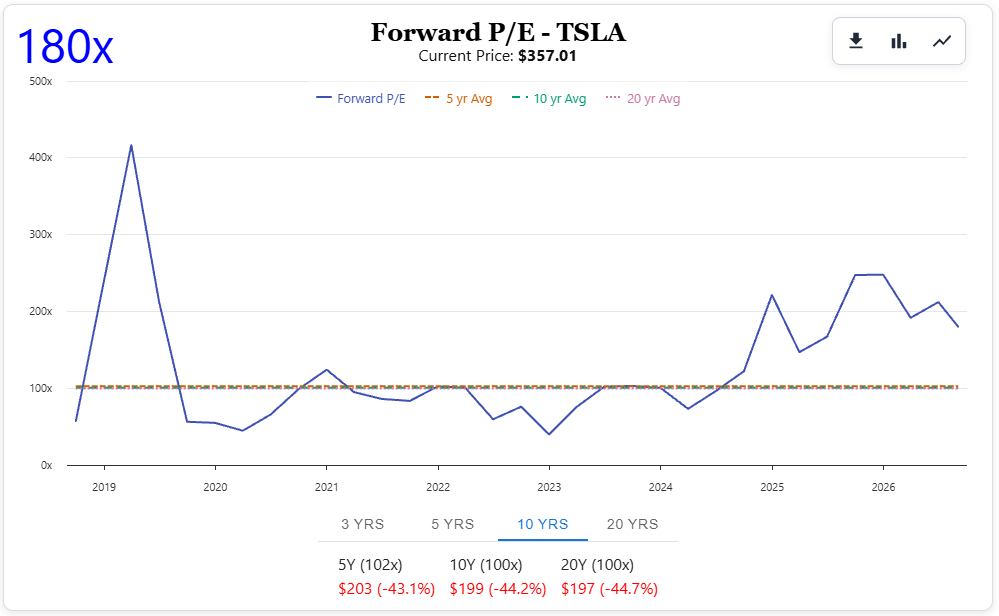 |
Tesla (TSLA) Forward PE Ratio
|
Forty five registered Cybercabs are evidence that Tesla has moved beyond a single prototype, but they are not evidence of commercial scale. The event matters only if Tesla provides clear answers on paid public availability, unsupervised operation, safety performance, regulatory approvals, and cost per mile. Until those pieces are visible, Cybercab should be valued as an early stage option rather than an established standalone business.
|
Broadcom reported $29.6 billion in quarterly revenue and raised its fiscal 2027 artificial intelligence chip revenue forecast to roughly $115 billion, but shares traded lower in early premarket after fourth quarter revenue guidance of $34.8 billion came in slightly below the average analyst estimate. Uber shares rose slightly following a workforce reduction of roughly 3,300 jobs aimed at focusing capital on its autonomous marketplace layer. The S&P 500 rose roughly 0.5% yesterday to close near 7,667 as technology shares climbed and bond yields held steady.
Why it matters this morning
|
Tesla is introducing a highly speculative future revenue stream into a market that is actively punishing technology multiples for anything short of flawless execution.
|
Waymo currently operates roughly 4,000 autonomous vehicles across 14 US cities. If Tesla successfully scales a camera only system, Waymo could face a permanent hardware cost disadvantage compared to its sensor heavy approach.
|
Uber serves as both a competitor and a potential partner. A vertically integrated Tesla network threatens rider demand. If Tesla struggles with customer acquisition, it might be forced to list its fleet on the ubiquitous Uber platform instead.
|
The push for end to end neural networks in automotive software requires massive data center compute. Broadcom benefits structurally from the resulting capital spending on custom artificial intelligence silicon.
|
The mechanics of the autonomous market dictate that progress by one company directly alters the structural advantages of its peers. The viability of the Tesla hardware will force investors to adjust their models for software platforms, ride networks, and semiconductor designers.
|
Texas Department of Motor Vehicles records to see whether the 45 registered Cybercabs turn into a larger active fleet. A Part 555 exemption petition or other National Highway Traffic Safety Administration action addressing federal standards for vehicles without manual controls. Evidence that ordinary riders can hail a Cybercab in Austin, rather than only a Model Y or an invite only demonstration vehicle. Disclosure on whether the Cybercab is operating without an onboard safety monitor, how much remote assistance is required, and how often rides are interrupted. Specific disclosures regarding manufacturing cost per vehicle, fleet utilization, and operating cost per mile.
The transition from a vehicle manufacturer to a transportation provider requires verified commercial data. Watch the regulatory filings and local transit registries. They will reveal the true timeline far better than stage presentations. |
|



Comments
Log in or sign up to join the conversation.