

 Every time a Tesla drives itself... a Megapack helps stabilise the electricity grid ... a humanoid robot learns a new task ... another AI model requires more computing power ... there's a question many investors are asking: How long will it take for Tesla's biggest innovations to become its biggest profits? This past week, Tesla (TSLA) reported another quarter of strong revenue growth, with sales rising to US$28.24 billion and vehicle deliveries reaching a new quarterly record. Yet the stock fell sharply after earnings as profits missed expectations and free cash flow turned negative. The reaction wasn't because Tesla's long-term vision has changed. Instead, investors are becoming more cautious about how quickly its massive investments in artificial intelligence, Robotaxis and robotics can generate meaningful returns. It's a reminder that markets don't simply reward exciting innovation—they reward companies that can turn innovation into sustainable earnings and cash flow. Today, Tesla is far more than an electric vehicle manufacturer. It is building businesses across autonomous driving, artificial intelligence, energy storage, robotics and software, each with the potential to become a meaningful long-term revenue driver. Fundamentals Tesla remains the world's most valuable automaker, but an increasing share of its long-term value depends on businesses beyond selling electric vehicles. During the quarter, revenue rose to US$28.24 billion, and vehicle deliveries reached a record 480,126 vehicles, while its Energy Generation and Storage division continued to perform strongly as demand for Megapack battery systems remained robust. Active Full Self-Driving (FSD) subscriptions also grew approximately 56% year-over-year to around 1.5 million, highlighting the continued growth of Tesla's recurring software revenue. However, profitability came under pressure as Tesla reduced vehicle prices to boost deliveries while significantly increasing investment in AI infrastructure, Robotaxis, and the Optimus humanoid robot. Operating expenses grew faster than revenue, earnings missed Wall Street expectations, and free cash flow turned negative due to heavy capital expenditure. At the same time, investors became more cautious about the timeline for Tesla's Robotaxi rollout as management placed greater emphasis on safety and reliability before expanding the service. While these initiatives still represent significant long-term growth opportunities, the market is increasingly focused on how quickly they can translate into sustainable profits. Technical |
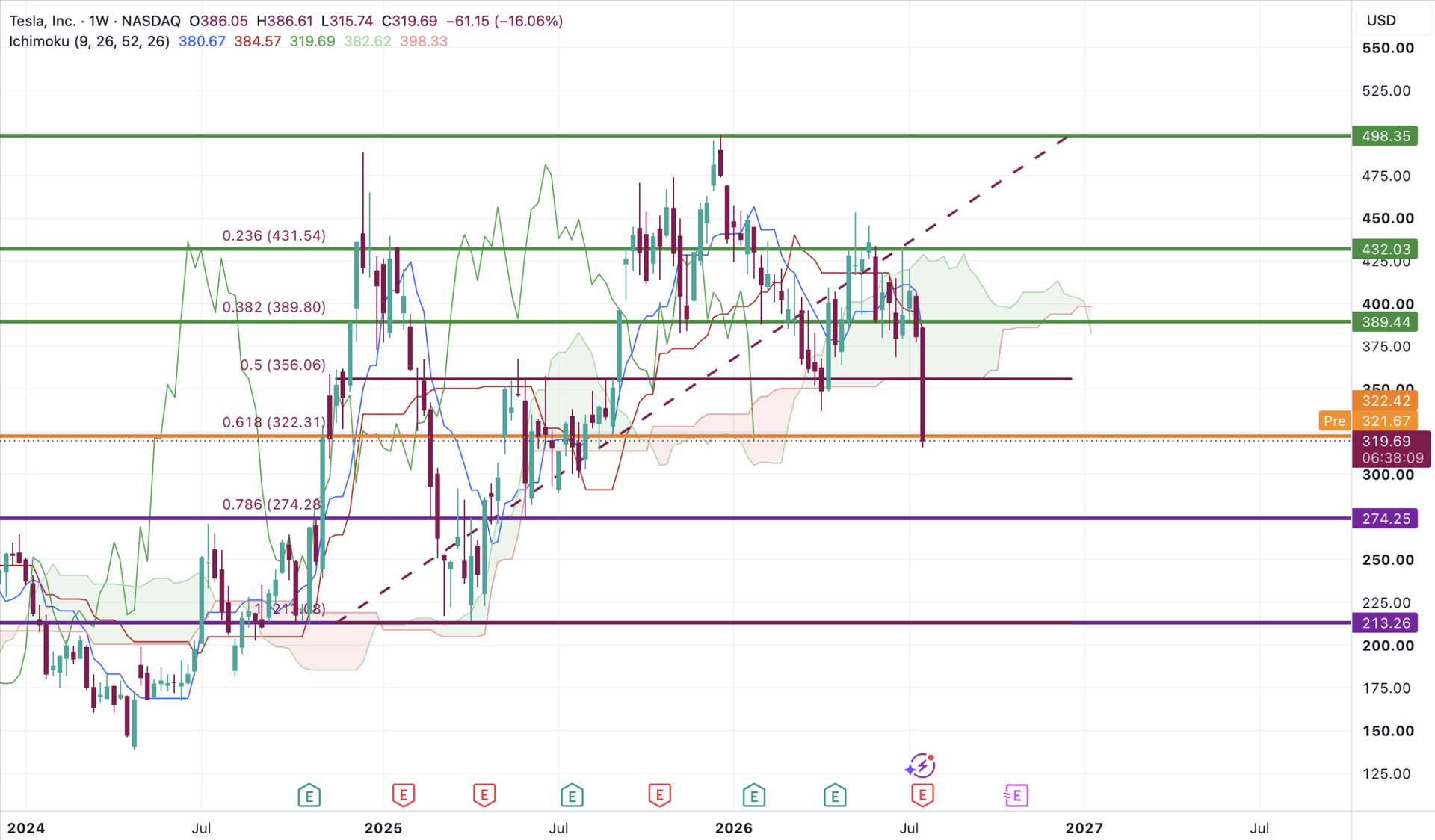 |
On the weekly chart, Tesla remained in a strong uptrend for most of 2025, reaching a new high of 498 in December. After making another new high in early 2026, the stock began pulling back as investors reassessed its premium valuation and became more cautious about the timeline for monetising its AI, Robotaxi and robotics initiatives. Following the recent earnings-driven sell-off, Tesla has broken below the Ichimoku Cloud, which is now acting as resistance. This confirms that the stock is currently in a downtrend on the weekly timeframe. The recent decline has also brought the price to the 61% Fibonacci retracement level. If the current bearish sentiment towards Tesla continues, the stock may experience further downward movement as the downtrend extends. Buy Limit Ideas
Profit Taking Ideas
|
Risk Level: High |
Tesla is a sentiment-driven stock and is often prone to significant price volatility, particularly around earnings announcements, product launches, and comments from CEO Elon Musk. While the company continues investing heavily in autonomous driving, artificial intelligence, robotics and energy infrastructure, these initiatives require substantial capital and may take years to generate meaningful profits. The company also trades at a premium valuation, making its share price especially sensitive to changes in investor expectations around growth, execution and future cash flow. Delays in commercialising new technologies, weaker-than-expected profitability or shifts in market sentiment can all lead to large swings in the stock price. Summary Tesla has evolved beyond an electric vehicle company into a business building the infrastructure for autonomous driving, artificial intelligence, robotics, and clean energy. This week's earnings highlight an important investing lesson: innovative companies can remain outstanding businesses while still experiencing significant share price volatility. For sentiment-driven stocks like Tesla, market expectations often matter just as much as financial results. |

Comments
Log in or sign up to join the conversation.