

The good news is:
The Dow Jones Industrial Average (DJIA) closed at an all time high last Wednesday.
The Negatives
The DJIA is made up of the bluest of the blue chips. As the market heads for a cyclical top there is a flight to quality as lower quality issues begin to falter. Last Wednesday the DJIA closed at an all time high that was not confirmed by anything. There could be more new highs for the DJIA in this cycle, but until new lows begin to diminish rapidly, those new highs will be marginal.
The first chart covers the past 9 months showing the Nasdaq composite (OTC) in blue and a 10% trend (19 day EMA) of Nasdaq new highs (OTC NH) in green. Dashed vertical lines have been drawn on the 1st trading day of each month.
I extended the duration of this chart to 9 months to show the progressive deterioration of OTC NH while the index was rising. These are likely to be the last new high charts I show for a while. New highs are only relevant in up markets.
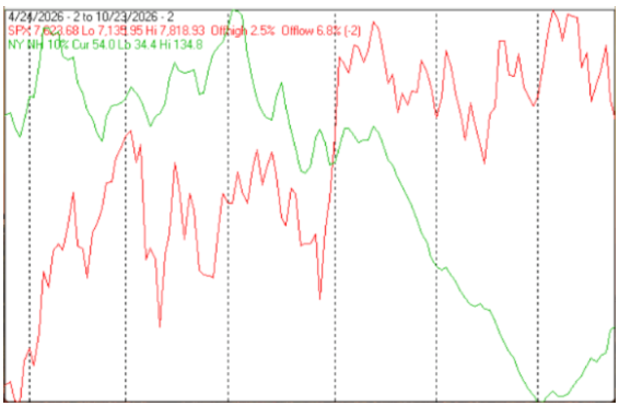
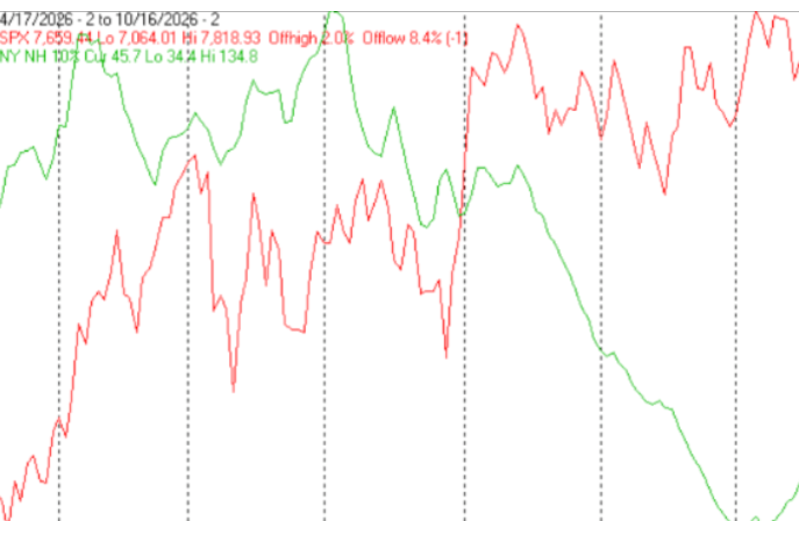
The next chart is similar to the one above one except it shows the S&P 500 (SPX) in red and NY NH, in green, has been calculated with NYSE data.
NY NH has not confirmed the increase in prices for months.
The next chart covers the past 6 months showing the OTC in blue and a 10% trend of Nasdaq new lows (OTC NL) in brown. OTC NL has been plotted on an inverted Y axis so diminishing numbers of new lows move the indicator upward (up is good).
OTC NL is headed downward. When a bottom has been reached new lows dramatically disappear and OTC NL will head upward.
The next chart is similar to the one above except it shows the SPX in red and NY NL, in blue, has been calculated with NYSE data.
The only good thing about this chart is it should be easy to tell when this cyclical decline has been completed.
The next chart covers the past 6 months showing the SPX in red and a 40% trend (4 day EMA) of NYSE new highs divided by new highs + new lows (NY HL Ratio), in blue. Dashed horizontal lines have been drawn at 10% levels for the indicator; the line is solid at the 50%, neutral, level.
You could almost call this chart a positive because it cannot go much lower from here.
The next chart is similar to the one above except it shows the OTC in blue and OTC HL Ratio, in red, has been calculated with Nasdaq data.
OTC HL Ratio has been a little stronger than NY HL Ratio, but following the same pattern.
The Positives
The average seasonal pattern calls for a cyclical low any time now, but, it has been running late all year.
Seasonality
Next week includes the 5 trading days prior to the 2nd Friday of October during the 2nd year of the Presidential Cycle. The tables below show the daily change, on a percentage basis for that period.
OTC data covers the period from 1963 to 2018 while SPX data runs from 1953 to 2018. There are summaries for both the 2nd year of the Presidential Cycle and all years combined. Prior to 1953, the market traded 6 days a week so that data has been ignored.
Average returns for the coming week have been positive by all measures.
Report for the week before the 2nd Friday of October.
The number following the year is the position in the Presidential Cycle.
Daily returns from Monday to 2nd Friday.
OTC Presidential Year 2
Year Mon Tue Wed Thur Fri Totals
1966-2 -1.42% 1.32% 0.22% 2.35% 0.32% 2.79%
1970-2 1.56% 0.69% 0.30% 0.21% -0.13% 2.63%
1974-2 2.56% -0.78% 2.57% 2.71% 2.18% 9.24%
1978-2 0.48% 0.22% 0.25% 0.22% 0.01% 1.17%
1982-2 -0.36% 0.40% 1.70% 1.88% 1.69% 5.31%
1986-2 0.13% -0.23% 0.15% 0.05% 0.13% 0.22%
1990-2 0.22% -2.59% -1.73% -2.29% 0.60% -5.79%
1994-2 0.91% 1.16% 0.19% 0.12% -0.11% 2.27%
Avg 0.28% -0.21% 0.11% -0.01% 0.46% 0.64%
1998-2 -4.85% -1.68% -3.20% -2.97% 5.17% -7.53%
2002-2 -1.80% 0.88% -1.34% 4.42% 4.05% 6.21%
2006-2 0.51% 0.16% -0.31% 1.64% 0.47% 2.48%
2010-2 -1.11% 2.36% -0.80% 0.13% 0.77% 1.35%
2014-2 -0.47% -1.56% 1.90% -2.02% -2.33% -4.48%
Avg -1.54% 0.03% -0.75% 0.24% 1.63% -0.39%
OTC Summary for Presidential Year 2 1966 - 2014
Avg -0.28% 0.03% -0.01% 0.49% 0.99% 1.22%
Win% 54% 62% 62% 77% 77% 77%
OTC summary for all years 1963 - 2017
Avg -0.02% -0.37% -0.05% 0.19% 0.48% 0.23%
Win% 58% 45% 50% 67% 71% 56%
SPX Presidential Year 2
Year Mon Tue Wed Thur Fri Totals
1954-2 0.56% 0.49% 0.40% -0.21% -0.06% 1.17%
1958-2 0.62% 0.57% 0.18% -0.02% 0.67% 2.01%
1962-2 0.00% 0.23% 0.07% -0.33% -0.18% -0.21%
1966-2 1.82% 0.51% 2.84% -0.19% -0.38% 4.60%
1970-2 1.54% 0.44% 0.05% -1.08% -1.01% -0.07%
1974-2 4.19% -0.17% 4.60% 2.90% 1.93% 13.45%
Avg 2.04% 0.32% 1.55% 0.26% 0.21% 3.96%
1978-2 1.03% -0.12% 0.89% -0.48% -0.21% 1.11%
1982-2 -0.38% 0.39% 3.27% 2.25% 1.75% 7.27%
1986-2 0.46% -0.16% 0.97% -0.35% -0.16% 0.76%
1990-2 0.64% -2.67% -1.54% -1.64% 1.55% -3.68%
1994-2 0.87% 1.47% -0.07% 0.50% 0.28% 3.05%
Avg 0.52% -0.22% 0.70% 0.05% 0.64% 1.70%
1998-2 -1.40% -0.40% -1.41% -1.16% 2.59% -1.78%
2002-2 -1.91% 1.69% -2.73% 3.50% 3.91% 4.45%
2006-2 0.08% 0.20% -0.26% 0.95% 0.20% 1.19%
2010-2 -0.80% 2.09% -0.07% -0.16% 0.61% 1.66%
2014-2 -0.16% -1.51% 1.75% -2.07% -1.15% -3.13%
Avg -0.84% 0.41% -0.54% 0.21% 1.23% 0.48%
SPX summary for Presidential Year 2 1954 - 2014
Avg 0.48% 0.19% 0.56% 0.15% 0.65% 1.99%
Win% 67% 63% 63% 31% 56% 69%
SPX summary for all years 1953 - 2017
Avg 0.11% -0.27% 0.14% -0.08% 0.15% 0.06%
Win% 55% 36% 50% 43% 57% 57%
Conclusion
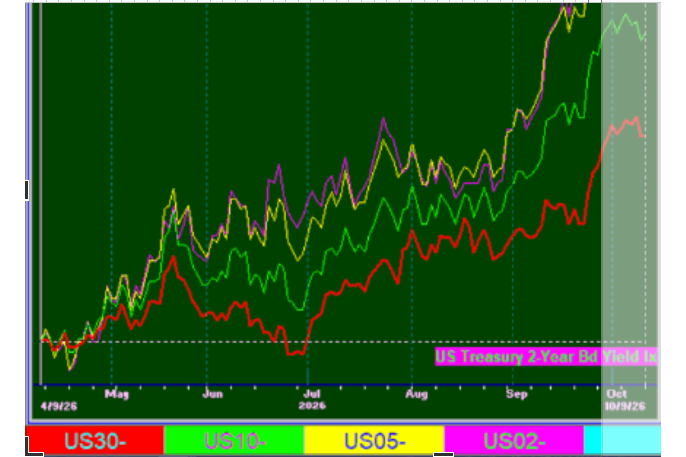
The average seasonal pattern turns positive next week so it is possible we have seen the worst of this decline. If that is the case, new lows will disappear dramatically. On the other hand, interest rates are rising, the yield curve is compressing and a bear market is long overdue.
I expect the major averages to be lower on Friday, October 12 than they were on Friday, October 5.
Comments
Log in or sign up to join the conversation.