

The good news is: The market is in good shape both seasonally and breadthwise. (That statement maybe the kiss of death.)
The Negatives
Same as last week, Nasdaq breadth indicators continue to lag behind the NYSE breadth indicators.
The Positives
The breadth indicators have been strengthening and the secondaries have been outperforming the blue chips.
The first chart covers the past 6 months showing the Nasdaq composite (OTC) in blue and a 40% trend (4 day EMA) of Nasdaq new highs divided by new highs + new lows (OTC HL Ratio), in red. Dashed vertical lines have been drawn on the 1st trading day of each month. Dashed horizontal lines have been drawn at 10% levels for the indicator; the line is solid at the 50%, neutral, level.
OTC HL Ratio rose to finish the week at a comfortable 70%
The next chart is similar to the one above except it shows the S&P 500 (SPX) in red and NY HL Ratio, in blue, has been calculated with NYSE data.
NY HL Ratio rose to finish the week at a sensational 91%. June 2009 was the last time the market began a sharp dive while this indicator was above 90%. Typically serious declines do not begin until NY HL Radio has dropped below 90% for a couple of weeks.
The next chart covers the past 6 months showing the OTC in blue and a 10% trend (19 day EMA) of Nasdaq new highs (OTC NH) in green.
OTC NH moved upward, but, for the very short term failed to confirm the upward move of the index.
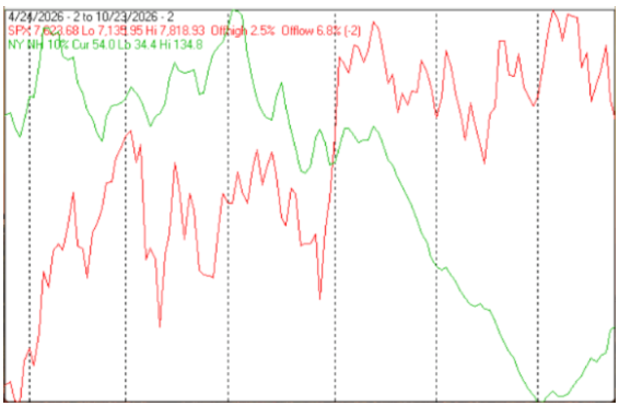
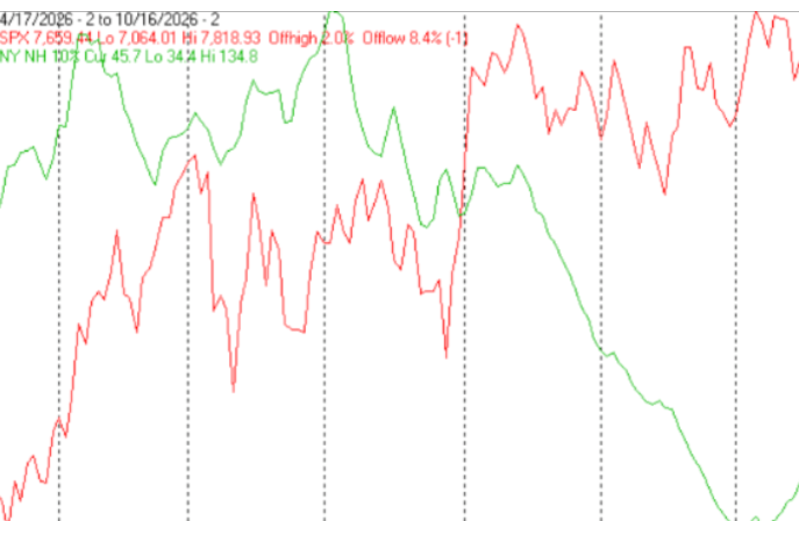
The next chart is similar to the one above, except, it shows the SPX in red and NY NH, in green has been calculated with NYSE data.
Thirty years ago I developed a timing program I called MIRAT. One of the rules was no selling allowed while this indicator was above 130.
NY NH confirmed Thursday’s high, but not Friday’s. This suggests the possibility of turbulence next week. The value of the indicator is 126.
Seasonality
Next week includes the 5 trading days prior to the 2nd Friday of April during the 3rd year of the Presidential Cycle. The tables below show the daily change, on a percentage basis for that period.
OTC data covers the period from 1963 to 2018 while SPX data runs from 1953 to 2018. There are summaries for both the 3rd year of the Presidential Cycle and all years combined. Prior to 1953, the market traded 6 days a week so that data has been ignored.
Returns for the coming week have been mixed and modest.
Report for the week before the 2nd Friday of April.
The number following the year is the position in the Presidential Cycle.
Daily returns from Monday to 2nd Friday.
OTC Presidential Year 3 (PY3)
Year Mon Tue Wed Thur Fri Totals
1963-3 0.43% -0.34% 0.03% -0.28% 0.25% 0.09%
1967-3 -0.74% -1.20% 0.29% 0.57% 0.30% -0.78%
1971-3 0.45% -0.02% 0.21% 0.56% 0.25% 1.45%
1975-3 -0.52% 0.26% 1.17% 0.48% 0.73% 2.10%
1979-3 -0.79% -0.17% 0.49% 0.20% 0.37% 0.10%
1983-3 1.01% 0.71% 1.17% 1.04% 1.00% 4.94%
1987-3 0.10% -0.86% 0.21% -0.67% -0.25% -1.47%
1991-3 -0.03% -0.64% -0.35% 1.74% 0.46% 1.19%
1995-3 -0.22% -0.61% -1.11% 0.30% 0.54% -1.10%
Avg 0.01% -0.31% 0.08% 0.52% 0.43% 0.73%
1999-3 0.22% -0.59% -2.95% 0.59% -1.51% -4.24%
2003-3 0.43% -0.47% -1.89% 0.65% -0.50% -1.77%
2007-3 1.06% -0.05% -0.26% -0.21% 0.84% 1.38%
2011-3 -0.01% 0.07% 0.31% -0.13% -0.56% -0.33%
2015-3 -0.15% -0.22% 0.68% -0.06% -1.52% -1.28%
Avg 0.31% -0.25% -0.82% 0.17% -0.65% -1.25%
OTC summary for PY3 1963 - 2015
Avg 0.09% -0.30% -0.14% 0.34% 0.03% 0.02%
Win% 50% 21% 64% 64% 64% 50%
OTC summary for all years 1963 - 2018
Avg 0.00% 0.00% 0.02% 0.13% -0.30% -0.15%
Win% 59% 54% 57% 55% 50% 59%
SPX PY3
Year Mon Tue Wed Thur Fri Totals
1955-3 0.27% 0.59% 0.13% 0.21% 0.45% 1.65%
1959-3 0.28% -0.21% -0.48% -0.07% 0.09% -0.39%
1963-3 0.47% 0.07% -0.32% -0.04% 0.49% 0.67%
1967-3 -1.25% 0.73% -0.11% 0.77% 1.08% 1.21%
1971-3 0.76% 0.10% 0.38% 0.15% -0.03% 1.36%
1975-3 -0.66% 0.80% 2.28% 1.12% 0.49% 4.04%
Avg -0.08% 0.30% 0.35% 0.38% 0.43% 1.38%
1979-3 -0.86% 0.12% 0.45% -0.41% -0.05% -0.75%
1983-3 1.50% 0.44% 0.61% 0.85% 0.40% 3.81%
1987-3 0.51% -1.74% 0.19% -1.48% -0.13% -2.64%
1991-3 0.88% -1.35% -0.11% 1.20% 0.73% 1.36%
1995-3 -0.61% -0.15% -0.09% 0.07% 0.63% -0.14%
Avg 0.28% -0.54% 0.21% 0.05% 0.32% 0.33%
1999-3 0.76% -0.65% -1.58% -0.42% -0.29% -2.19%
2003-3 0.12% -0.19% -1.40% 0.65% -0.38% -1.19%
2007-3 1.08% 0.20% 0.07% -0.12% 0.93% 2.16%
2011-3 0.03% -0.02% 0.22% -0.15% -0.40% -0.32%
2015-3 -0.46% 0.16% 0.51% -0.08% -1.13% -0.99%
Avg 0.31% -0.10% -0.44% -0.03% -0.26% -0.51%
SPX summary for PY3 1955 - 2015
Avg 0.18% -0.07% 0.05% 0.14% 0.18% 0.48%
Win% 69% 56% 56% 50% 56% 50%
SPX summary for all years 1953 - 2018
Avg 0.14% 0.10% 0.08% -0.02% -0.11% 0.19%
Win% 60% 56% 56% 53% 50% 56%
Conclusion
The market had another a good week.
Nasdaq breadth indicators continued to underperform the NYSE breadth indicators, but nothing alarming.
The Russell 2000 continued to outperform the SPX.
I expect the major averages to be higher on Friday, April 12 than they were on Friday, April 5.
Comments
Log in or sign up to join the conversation.