

The good news is: It looks like the decline of past 2 to 3 weeks ago is over.
The Negatives
Although mostly positive, Nasdaq breadth indicators have been weaker than NYSE breadth indicators for the past month.
The Positives
For the very short term, the pullback that began 3 weeks ago appears to have ended.
Most of the breadth indicators turned upward after a sharp dip on Monday.
The relative weakness of the Russell 2000 (R2K) compared to the S&P 500 (SPX) went away, let's hope that continues.
The first chart covers the past 6 months showing the Nasdaq composite (OTC) in blue and a 40% trend (4 day EMA) of NASDAQ new highs divided by new highs + new lows (OTC HL Ratio), in red. Dashed vertical lines have been drawn on the 1st trading day of each month. Dashed horizontal lines have been drawn at 10% levels for the indicator; the line is solid at the 50%, neutral, level.
OTC HL Ratio finished the week about where it began at a modestly positive 60%.
The next chart is similar to the one above except it shows the SPX in red and NY HL Ratio, in blue, has been calculated with NYSE data.
NY HL Ratio gained slightly finishing the volatile week at a strong 81%.
The next chart covers the past 6 months showing the OTC in blue and a 10% trend (19 day EMA) of NASDAQ new highs (OTC NH) in green.
OTC NH deteriorated last week, but, not badly enough to be frightening.
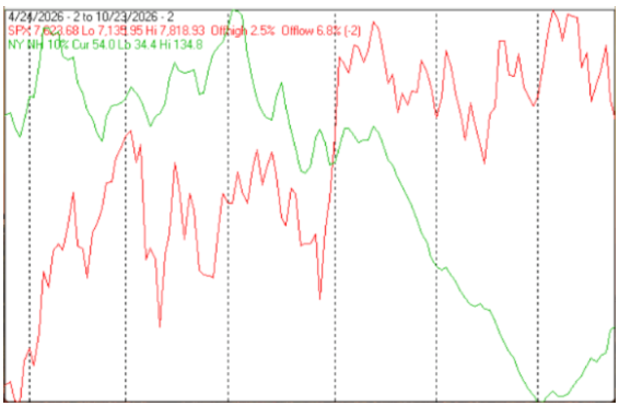
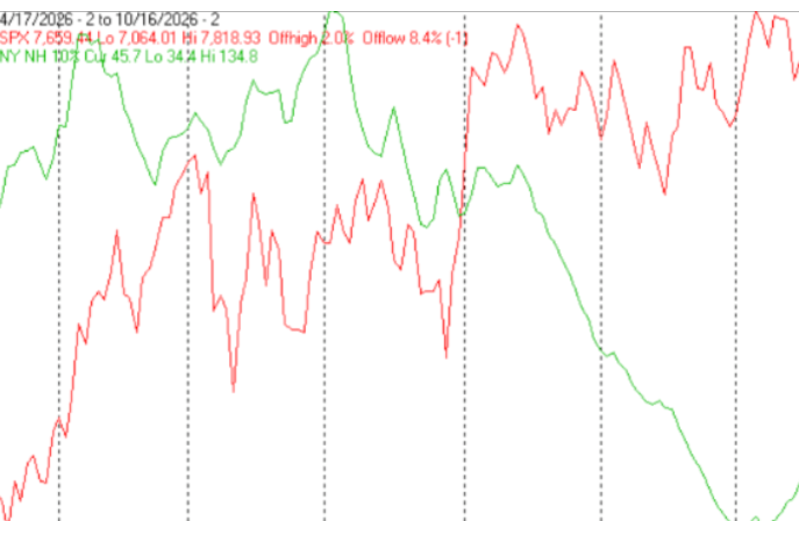
The next chart is similar to the one above, except, it shows the SPX in red and NY NH, in green has been calculated with NYSE data.
NY NH, the prettiest chart of the week.
Seasonality
Next week includes the first 5 trading days of April during the 3rd year of the Presidential Cycle. The tables below show the daily change, on a percentage basis for that period.
OTC data covers the period from 1963 to 2018 while SPX data runs from 1928 to 2018. There are summaries for both the 3rd year of the Presidential Cycle and all years combined.
Returns for the coming week have been positive by all measures and much stronger during the 3rd year of the Presidential Cycle than other years.
Report for the first 5 days of April.
The number following the year represents its position in the Presidential Cycle.
The number following the daily return represents the day of the week;
1 = Monday, 2 = Tuesday etc.
OTC Presidential Year 3 (PY3)
Day1 Day2 Day3 Day4 Day5 Totals
1963-3 0.13% 1 0.34% 2 0.28% 3 0.75% 4 0.19% 5 1.69%
1967-3 0.36% 1 -0.52% 2 0.06% 3 0.48% 4 0.69% 5 1.07%
1971-3 0.35% 4 0.49% 5 0.29% 1 0.36% 2 0.46% 3 1.96%
1975-3 -0.32% 2 0.27% 3 -0.89% 4 -0.29% 5 -0.52% 1 -1.75%
1979-3 -0.30% 1 0.74% 2 0.32% 3 0.47% 4 0.28% 5 1.50%
1983-3 -0.76% 1 0.04% 2 -0.88% 3 0.10% 4 0.51% 5 -0.99%
1987-3 -0.40% 3 0.87% 4 1.22% 5 0.10% 1 -0.86% 2 0.93%
1991-3 -0.30% 1 2.15% 2 0.78% 3 0.51% 4 -0.36% 5 2.79%
1995-3 0.10% 1 -0.53% 2 0.32% 3 -0.31% 4 0.11% 5 -0.31%
Avg -0.33% 0.65% 0.35% 0.17% -0.06% 0.78%
1999-3 1.30% 4 2.68% 1 0.12% 2 -0.73% 3 1.14% 4 4.50%
2003-3 0.53% 2 3.59% 3 -0.01% 4 -0.94% 5 0.43% 1 3.61%
2007-3 0.03% 1 1.16% 2 0.34% 3 0.51% 4 -0.09% 1 1.95%
2011-3 0.31% 5 -0.01% 1 0.07% 2 0.31% 3 -0.13% 4 0.54%
2015-3 -0.42% 3 0.14% 4 0.62% 1 -0.14% 2 0.83% 3 1.02%
Avg 0.35% 1.51% 0.23% -0.20% 0.44% 2.33%
OTC summary for PY3 1963 - 2015
Averages 0.04% 0.81% 0.19% 0.08% 0.19% 1.32%
% Winners 57% 79% 79% 64% 64% 79%
MDD 4/7/1975 1.74% -- 4/6/1983 1.60% -- 4/4/2003 .95%
OTC summary for all years 1963 - 2018
Averages -0.04% 0.20% 0.12% 0.16% -0.18% 0.26%
% Winners 52% 66% 68% 59% 48% 57%
MDD 4/4/2001 10.95% -- 4/4/2000 9.27% -- 4/5/2002 4.97%
SPX PY3
Day1 Day2 Day3 Day4 Day5 Totals
1931-3 -1.02% 3 -0.42% 4 1.34% 6 -1.02% 1 -1.33% 2 -2.46%
1935-3 0.83% 1 -0.47% 2 -0.24% 3 1.06% 4 2.45% 5 3.63%
1939-3 2.28% 6 0.27% 1 -2.13% 2 0.36% 3 -3.62% 4 -2.84%
1943-3 0.09% 4 -0.26% 5 0.17% 6 0.09% 1 1.47% 2 1.55%
1947-3 0.40% 2 -0.07% 3 -0.26% 4 -0.07% 6 -0.79% 1 -0.79%
1951-3 -0.37% 1 -0.28% 2 0.66% 3 1.36% 4 0.14% 5 1.50%
1955-3 1.01% 5 -0.32% 1 0.68% 2 0.24% 3 0.46% 4 2.07%
Avg 0.68% -0.13% -0.18% 0.40% -0.47% 0.30%
1959-3 0.45% 3 0.56% 4 0.79% 5 0.28% 1 -0.21% 2 1.86%
1963-3 0.42% 1 -0.01% 2 0.78% 3 0.73% 4 0.63% 5 2.54%
1967-3 -1.06% 1 -0.02% 2 0.64% 3 0.17% 4 -0.64% 5 -0.93%
1971-3 0.08% 4 0.17% 5 0.23% 1 0.71% 2 0.46% 3 1.66%
1975-3 -0.86% 2 -0.25% 3 -1.12% 4 -0.77% 5 -0.66% 1 -3.66%
Avg -0.20% 0.09% 0.26% 0.22% -0.08% 0.30%
1979-3 -0.68% 1 1.49% 2 0.24% 3 0.59% 4 -0.08% 5 1.57%
1983-3 0.04% 1 -0.74% 2 -0.56% 3 0.48% 4 0.72% 5 -0.06%
1987-3 0.24% 3 0.42% 4 2.31% 5 0.51% 1 -1.74% 2 1.74%
1991-3 -1.04% 1 2.21% 2 -0.15% 3 0.22% 4 -1.16% 5 0.07%
1995-3 0.23% 1 0.68% 2 0.07% 3 0.10% 4 0.07% 5 1.14%
Avg -0.24% 0.81% 0.38% 0.38% -0.44% 0.89%
1999-3 0.57% 4 2.12% 1 -0.24% 2 0.68% 3 1.29% 4 4.41%
2003-3 1.21% 2 2.61% 3 -0.51% 4 0.27% 5 0.12% 1 3.72%
2007-3 0.26% 1 0.93% 2 0.11% 3 0.30% 4 0.06% 1 1.66%
2011-3 0.50% 5 0.03% 1 -0.02% 2 0.22% 3 -0.15% 4 0.58%
2015-3 -0.40% 3 0.35% 4 0.66% 1 -0.21% 2 0.27% 3 0.68%
Avg 0.43% 1.21% 0.00% 0.25% 0.32% 2.21%
SPX summary for PY3 1931 - 2013
Averages 0.14% 0.41% 0.16% 0.29% -0.10% 0.89%
% Winners 68% 55% 59% 82% 55% 73%
MDD 4/6/1939 5.33% -- 4/7/1975 3.61% -- 4/7/1931 2.46%
SPX summary for all years 1928 - 2018
Averages 0.14% 0.20% 0.09% 0.16% -0.17% 0.41%
% Winners 62% 59% 54% 61% 51% 60%
MDD 4/6/1932 10.67% -- 4/6/1939 5.33% -- 4/4/2001 4.92%
April
Since 1963, over all years, the OTC in April has been up 66% of the time with an average gain of 1.5%. During the 3rd year of the Presidential Cycle April has been up 93% of the time with an average gain of 3.6%. The best April ever for the OTC was 2001 (+15.0%), the worst 1970 (-18.5%).
The average month has 21 trading days. The chart below has been calculated by averaging the daily percentage change for each of the 1st 11 trading days and each of the last 10. In months when there were more than 21 trading days some of the days in the middle were not counted. In months when there were less than 21 trading days some of the days in the middle of the month were counted twice. Dashed vertical lines have been drawn after the 1st trading day and at 5 trading day intervals after that. The line is solid on the 11th trading day, the dividing point.
In the chart below the blue line shows the average daily performance of the OTC in April over all years since 1963 in blue, while the black line shows the average during the 3rd. year of the Presidential Cycle over the same period.
Since 1928 the SPX has been up 64% of the time in April with an average gain of 1.3%. During the 3rd year of the Presidential Cycle the SPX has been up 82% of the time with an average gain of 2.5%. The best April ever for the SPX was 1933 (+42.2%) the worst 1932 (-20.2%).
The chart below is similar to the one above except it shows the average daily performance over all years since 1928 for the SPX in April in red and the average daily performance during the 3rd year of the Presidential Cycle, over the same period, in black.
Since 1979 the Russell 2000 (R2K) has been up 63% of the time in April with an average gain of 1.5%. During the 3rd year of the Presidential Cycle the R2K has been up 70% of the time with an average gain of 2.8%. The best April ever for the R2K, 2009 (+15.3%), the worst 2000 (-6.1%).
The chart below is similar to those above except it shows the average daily performance of the R2K, in April, over all years since 1979 in magenta and the average daily performance during the 3rd year of the Presidential Cycle in black.
Since 1885 the Dow Jones Industrial Average (DJIA) has been up 60% of the time in April with an average gain of 1.3%. During the 3rd year of the Presidential Cycle the DJIA has been up 76% of the time in April with an average gain of 2.9%. The best April ever for the DJIA 1933 (+40.2%), the worst 1932 (-23.4%).
The chart below is similar to those above except it shows the average daily performance during April, over all years in grey and the average performance during the 3rd year of the Presidential Cycle in black.
Conclusion
The market had a good week.
Nasdaq breadth indicators have been weaker than NYSE breadth indicators for about a month, but, at least they are positive.
The R2K was the strongest of the major price indicators last week, let’s hope that continues.
I expect the major averages to be higher on Friday, April 5 than they were on Friday, March 28.
Comments
Log in or sign up to join the conversation.