

The good news is that the NASDAQ composite (OTC) had its best first week of November ever, while the S&P 500 (SPX) had its best first week of November since 1931.The bad news is that the market is overbought.
The Negatives
The first chart covers the past six months, showing the OTC in blue and a 10% trend (19-day EMA) of NASDAQ new highs (OTC NH) in green. Dashed vertical lines have been drawn on the first trading day of each month. The OTC is only 1.3% off its all time high, while the OTC NH is coming up short.

The next chart is similar to the one above, except it covers the past year. The OTC NH has been lagging since the low last March and it is continuing to deteriorate.

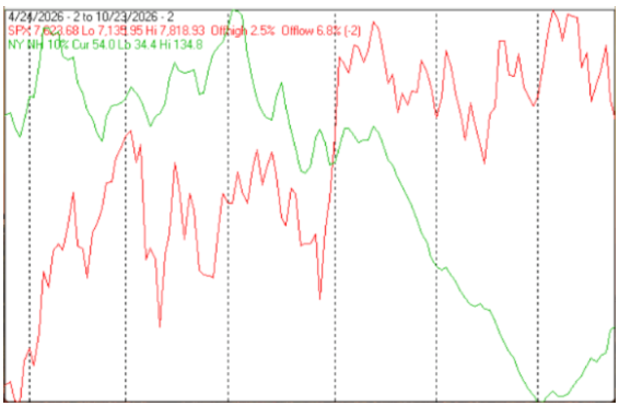
The next chart is similar to the first one, except it shows the SPX in red and the NY NH in green. The information has been calculated with NYSE data. The pattern is similar to the one present in the OTC chart.

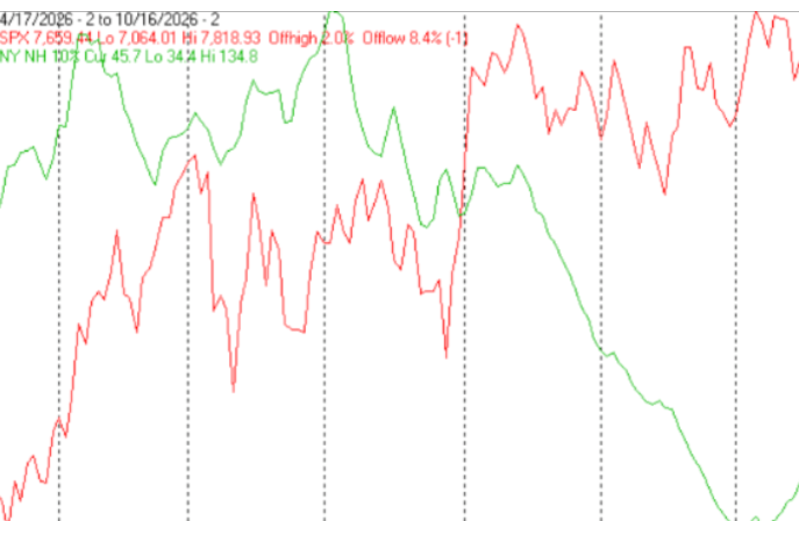
The next chart is similar to the second chart above, except it shows the SPX and the NY NH over the past year. Another similar pattern is present.

The lack of strength in the new high indicators indicates a progressive narrowing of leadership.
The Positives
New lows dropped back to non threatening levels last week.
The next chart covers the past six months, showing the SPX in red, and a 40% trend (four-day EMA) of NYSE new highs divided by new highs + new lows (NY HL Ratio) in blue. Dashed horizontal lines have been drawn at 10% levels for the indicator; the line is solidly at the 50%, neutral level. The NY HL Ratio recovered nicely to a comfortable 81%.

The next chart is similar to the one above, except it shows the OTC in blue and the OTC HL Ratio in red. The information has been calculated with NASDAQ data. The OTC HL Ratio also recovered nicely, finishing the week at 78%.

Seasonality
Next week includes the five trading days prior to the second Friday of November, all during the fourth year of the Presidential Cycle. The tables below show the daily change on a percentage basis for that period.
The OTC data covers the period from 1963 to 2019, while the SPX data runs from 1953 to 2019. There are summaries for both the fourth year of the Presidential Cycle, and all years combined. Prior to 1953, the market traded six days a week, so that data has been ignored.
Average returns for the coming week have been mixed and weaker during the fourth year of the Presidential Cycle than other years. The number following the year is the position in the Presidential Cycle.
OTC Presidential Year 4 (PY4)
- Year Mon Tue Wed Thur Fri Totals
- 1964-4 0.25% 0.25% -0.27% 0.16% 0.30% 0.68%
- 1968-4 -0.68% 0.00% -0.54% 0.06% -0.09% -1.25%
- 1972-4 0.18% 0.00% -0.39% -0.18% 0.23% -0.16%
- 1976-4 -0.82% -0.74% -0.30% 0.38% -0.06% -1.54%
- 1980-4 -0.21% 0.99% 1.42% 1.25% 0.75% 4.20%
- 1984-4 0.20% 0.86% -0.32% -0.10% 0.00% 0.64%
- 1988-4 -1.18% 0.62% -0.29% 0.17% -1.23% -1.91%
- 1992-4 0.85% 0.92% 1.14% -0.09% 0.44% 3.26%
- 1996-4 -0.11% 0.70% 1.37% 0.66% 0.27% 2.89%
- Avg -- -0.09% 0.82% 0.66% 0.38% 0.06% 1.82%
- 2000-4 -1.03% -0.01% -5.39% -0.97% -5.36% -12.75%
- 2004-4 0.02% 0.20% -0.43% 1.31% 1.17% 2.27%
- 2008-4 -1.86% -2.22% -5.17% 6.50% -5.00% -7.74%
- 2012-4 0.59% 0.41% -2.48% -1.42% 0.32% -2.58%
- 2016-4 2.37% 0.53% 1.11% -0.80% 0.54% 3.75%
- Avg -- 0.02% -0.22% -2.47% 0.92% -1.66% -3.41%
OTC summary for PY4 1964 - 2016
- Avg -- -0.10% 0.21% -0.75% 0.50% -0.59% -0.73%
- Win% -- 50% 75% 29% 57% 62% 50%
OTC summary for all years 1963 - 2019
- Avg -- 0.04% 0.14% -0.13% 0.11% -0.09% 0.06%
- Win% -- 51% 62% 54% 54% 61% 51%
SPX PY4
- Year Mon Tue Wed Thur Fri Totals
- 1956-4 1.32% 0.00% -1.03% -0.81% -0.83% -1.35%
- 1960-4 0.38% 0.00% 0.44% 1.41% -0.46% 1.76%
- 1964-4 -0.05% -0.41% 0.28% 0.13% 0.02% -0.02%
- 1968-4 0.04% 0.00% 0.16% 0.22% 0.43% 0.86%
- 1972-4 -0.21% 0.00% -0.55% 0.13% 0.20% -0.43%
- 1976-4 -1.21% -0.28% -0.51% 0.84% -0.40% -1.57%
- Avg -- -0.21% -0.35% -0.04% 0.55% -0.04% 0.12%
- 1980-4 0.23% 1.37% 2.54% 1.41% 0.48% 6.04%
- 1984-4 0.69% 1.09% -0.73% -0.29% -0.64% 0.12%
- 1988-4 -0.86% 0.45% -0.66% 0.13% -2.11% -3.05%
- 1992-4 0.24% 0.01% 0.86% 0.16% -0.10% 1.16%
- 1996-4 0.42% 1.05% 1.46% 0.42% 0.44% 3.79%
- Avg -- 0.15% 0.79% 0.69% 0.37% -0.39% 1.61%
- 2000-4 0.39% -0.02% -1.58% -0.65% -2.44% -4.30%
- 2004-4 -0.11% -0.07% -0.10% 0.91% 0.91% 1.54%
- 2008-4 -1.24% -2.20% -5.19% 6.92% -4.17% -5.88%
- 2012-4 0.22% 0.79% -2.37% -1.22% 0.17% -2.42%
- 2016-4 2.22% 0.38% 1.11% 0.20% -0.14% 3.76%
- Avg -- 0.29% -0.23% -1.63% 1.23% -1.13% -1.46%
SPX summary for PY4 1956 - 2016
- Avg -- 0.15% 0.18% -0.37% 0.62% -0.54% 0.00%
- Win% -- 63% 58% 44% 75% 44% 50%
SPX summary for all years 1953 - 2019
- Avg -- 0.03% 0.11% -0.05% 0.18% -0.05% 0.21%
- Win% -- 55% 52% 59% 57% 56% 57%
Conclusion
Last week, the market celebrated like it did when the election was won four years ago. The strongest sectors last week were precious metals (up from the bottom last week) and electronics. The weakest sectors were biotech (down from the top last week) and energy. I expect the major averages to be lower on Friday, November 13 than they were on Friday, November 6.
Comments
Log in or sign up to join the conversation.