

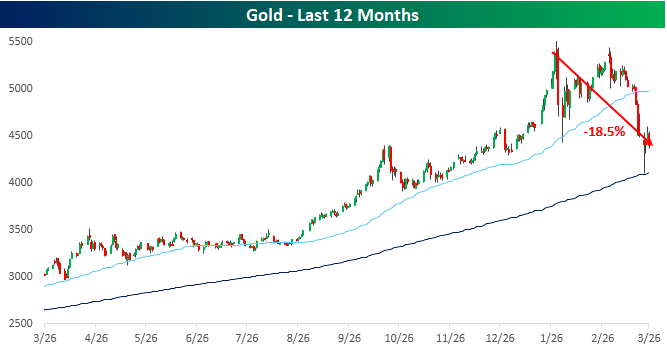
After bouncing yesterday, gold prices are declining again today, on pace for a one-day drop of over 3%. While today’s decline is not nearly enough for new lows on an intraday basis (it got down to the 200-DMA Monday), if gold closes at these levels, it will mark a new closing low for the current drawdown. That would take the peak-to-trough decline to 18.5% and very close to bear market levels (20%+ decline from a closing high without a 20%+ rally in between).
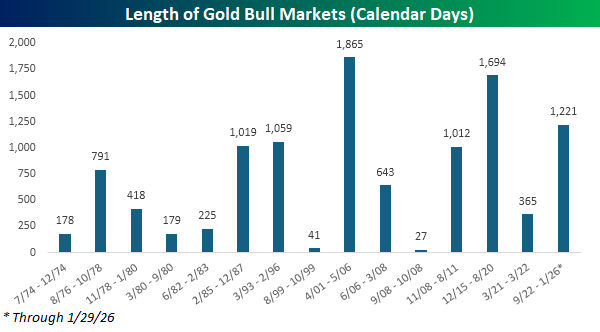
Bear markets haven’t been common for gold lately, as the current bull market began exactly three and a half years ago on 9/26/22. From that low through the closing high on 1/29/26, gold prices rallied 231.7%. In terms of magnitude, that would rank at the third longest since at least 1974, trailing only the 1,865-calendar-day bull market ending in May 2006 and the 1,694-day run ending in August 2020. For all 15 bull markets, the average length was 716 days, making the current one, if it turns out to have ended in January, 71% longer than average.
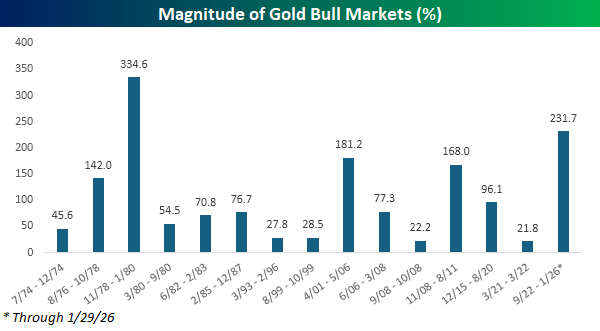
In terms of magnitude, the most recent bull market also ranks as one of the strongest. For all 15 bull markets since 1974, the average gain was 105%, or less than half of the gain during the current bull. In fact, the only bull market that experienced a larger gain was the 418-day bull market that ended in January 1980. In that 14-month rally, gold prices tripled from $191 up to $834 per ounce. Ironically, the level gold traded at when that bull market started is about the same as the amount by which gold prices are trading lower today!



Comments
Log in or sign up to join the conversation.