

The dollar has been declining over the last week and columns are abuzz about it's long retreat, but the stock market is still climbing. It is September 1, and while some already smell the scent of Autumn, others smell inflation in the air. Though declining stocks outpaced advancing issues 2 to 1 yesterday, the markets closed sideways, the S&P 500 at 3500, down 7.7 pts, the Dow Jones 28,430, down 224 pts, which is more than 3/4 of a percent, and the Nasdaq Composite 11,775, up 80 pts. This morning both the S&P and Dow futures are slightly green, while the Nasdaq 100 futures are up over 1%. The much anticipated Apple and Tesla stock splits resulted in gains for both companies with Apple (AAPL) closing at 129.04, up 3.39%, post split and Tesla (TSLA) closing at 498.32, up 12.57%, post split.
Jeffrey Snider in Fat Chance, Flat Phillips cuts to the chase about recent attempts by economists to explain changes in the "Philips curve" and why inflation is not rising as the economy gains traction.
According to some Cleveland Fed economists "With inflation having only modestly picked up in the past few years as the economy has become more robust, many believe the Phillips curve relationship has weakened, with the curve becoming flatter."

Snider explains: "If you start by blindly accepting the premise that the “economy has become more robust” but then realize it didn’t generate the usual level of inflation, you would have to go back and reverse engineer a whole bunch of weird, absurd actions and activities to unnaturally flatten a basic Economics curve. This is, of course, backwards.
There’s no reason to do this. Instead, the curve can remain the same because the results simply challenged – and refuted – your basic assumption: what if the economy hasn’t become more robust? Then you wouldn’t need to touch the curve at all."
So we may be in recovery from the March lows, but the economy is far from robust. Remember that is what people were saying pre-Covid.
But Cullen Roche in a TalkMarkets Editor's choice column, Lumbering Along, observes that the economy is heating up and bringing inflation in our and harm's way.
"Have you checked out lumber prices lately? Prices have TRIPLED since the March bottom. It’s one of the most interesting economic developments since the pandemic started. Out of curiosity I looked up the retail price of a generic whitewood 2X4 at Home Depot and the price has increased 50% since I purchased some in March, 2020...
I have to imagine that this is going to start causing some bumps in the construction industry in the coming years. As they say, the cure for high prices is…high prices.
As for inflation, this is obviously an extreme case, but as I’ve been noting, it’s likely that inflation is going to be jumping back above the Fed’s target in the coming years as aggregate demand has remained very robust and supply chains remain disrupted. Don’t be surprised if the Fed is backpedaling on some of its policies as we roll into late 2021 and 2022 and the recovery is very obviously full steam ahead."
Cullen may be on to something here. He also, touches on what's in store for stock prices (that falling dollar is an indicator of other things other than in and of itself).
"I just updated that figure (expectations for 10 year equity returns) and…we’re exactly back to 4% expected returns... there are many reasons NOT to be so cheery when it comes to stock market valuations. Yes, the market has correctly rebounded from what many incorrectly thought was going to be another Great Depression. But the strange thing about this exogenous shock is that it puts us essentially back on track for where we were pre-crisis. In other words, valuations are high, expectations are likely too high and so the prospects of future stock returns begin to look increasingly bleak…"
Check it out, it's a short and worthwhile read.
Last week I noted the changes in the Dow, with Tech stocks gaining more prominence. In Big Tech Makes The Nasdaq Respectable, a TalkMarkets exclusive, Michael Kahn notes that the largest companies in terms of market cap can be found on the Nasdaq.
"As of August 2020, there are four stocks in the U.S. market with capitalizations above $1 trillion: Microsoft (MSFT), Apple (AAPL), Amazon (AMZN) and Google (GOOGL). All four trade on the Nasdaq. Just for comparison, the largest non-Nasdaq stock in the Dow Jones Industrial Average is Johnson & Johnson (JNJ), with a market cap of $402 billion."
Khan concludes, " it's about time everyone really pays attention to what is going on there (on the Nasdaq)."
In Dollar Down, Everything Else Up, the team at Bespoke Investment Group, tell us that we "better spend that dollar in our pocket quickly, because it isn’t worth nearly as much as it was five months ago." The following two Bloomberg Dollar Index charts tell the story:
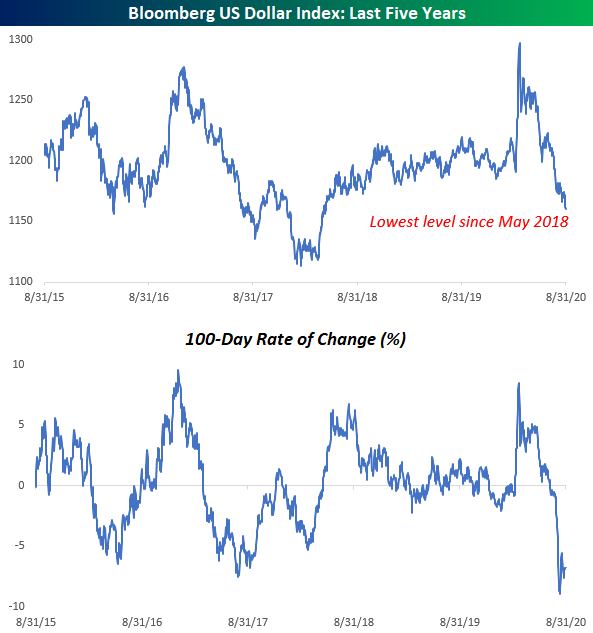
According to Bespoke Investments, "It was only a few months ago that investors were seeking shelter in the dollar at the onset of the COVID outbreak in the US, but once the Fed flooded the system with liquidity and subsequently pivoted to a much more dovish stance, that rush into the dollar has shifted to an exodus out of it. Earlier this month, the 100-day rate of change in the Bloomberg US Dollar Index (second chart) reached as low as negative 8.9% and still currently sits at -6.8%."
For the Fed it's beginning to be a case of, darned if you do and darned if you don't. I have a feeling we'll be revisiting this adage more than once in the weeks to come.
Geoff Bysshe in Best August Since 1986. Now What, notes that the SPY ETF (which is a way to trade the S&P 500 index), "ended its best August performance since 1986 with a market message that is well worth paying attention as soon as tomorrow and well into September. The SPY's 5-day up/down volume turned lower (Monday) as illustrated in the chart below. This is not a long-term negative, but it is a reason to at least expect a pause in the SPY, and as you can see from the other measures in this chart, this is not a very overbought level."
Here's the chart:

Bysshe says it is important to mention that, "the NASDAQ equivalent does NOT have the same pattern", (the QQQ ETF, for example).
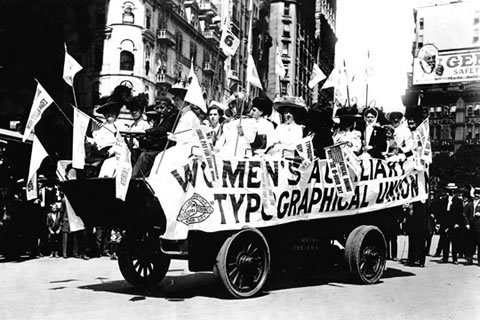
Labor Day will soon be upon us. It is worthy to reflect on what it is being celebrated. The US Department of Labor website notes the following:
"The first Monday in September, is a creation of the labor movement and is dedicated to the social and economic achievements of American workers. It constitutes a yearly national tribute to the contributions workers have made to the strength, prosperity, and well-being of our country."
See you next week.

Comments
Log in or sign up to join the conversation.