


Image: Bigstock
Tricky Summer Trading Persists
Between the U.S.-Iran war, the spike in oil, and the ebbs and flows of the AI trade, 2026 has been as hard a year to predict as any. First, the Iran war correction occurred. The major indices flushed 10% rapidly before climbing the proverbial “wall of worry” and storming back in a V-shaped fashion. Despite the turmoil and uncertainty, the S&P 500 Index is up double digits year-to-date.
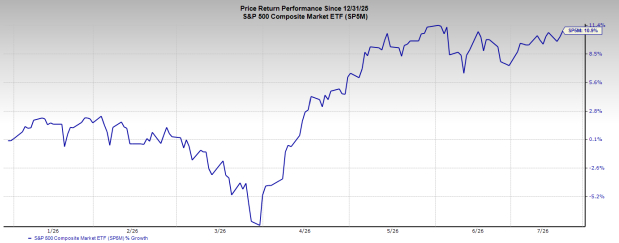
Image Source: Zacks Investment Research
Over the past two months, the S&P 500 and the major indices have digested gains in a seemingly constructive manner.
Tech Momentum Stocks Get Crushed
However, as is often the case, the major market indices do not always tell the full story. In fact, tech momentum stocks just had their worst 17-day unwind since the late 1990s!
Memory stocks, which had been leading the market, such as Micron (MU - Free Report), Western Digital (WDC - Free Report), and SanDisk (SNDK - Free Report), are each down 25% or more over the past month.
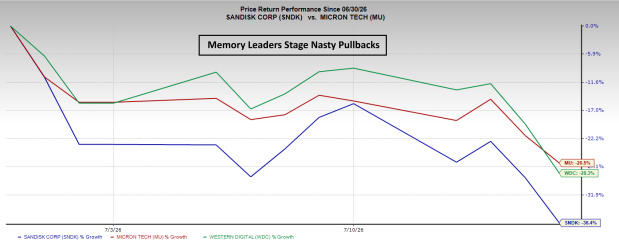
Image Source: Zacks Investment Research
The Market is Extremely Choppy
Meanwhile, although it appears that the major indices have simply been digesting strong first-half-of-the-year gains, the market has been volatile, fast-moving, and choppy. Just how volatile has it been? The Nasdaq 100 Index ETF (QQQ - Free Report) has finished up or down 1% or more in 21 of the past 25 sessions!
Survive the Chop: Live to Trade Another Day
There are market environments where “the fish jumps into your boat,” and then there are ones where investors are “picking up pennies in front of a steamroller.” The current market is the latter. I often warn clients that the trickiest and most dangerous markets are trendless, choppy markets. In a downtrend, at least an investor can be aware of the trend and get out. However, in a choppy market, amateur investors are often sucked into trades and suffer from “death by a thousand cuts.”
Below are three tips for navigating a choppy market:
1. Trade less or don’t trade at all: Unlike poker, Wall Street investors are not forced to throw in an ante. Instead, investors can patiently wait for their pitch.
2. Defer to higher time frames: Short-term charts can cause traders to make knee-jerk decisions that rarely end well. Instead, investors should defer to higher time frame charts like the weekly chart to help smooth out the noise and identify the prevailing trend.
3. Wait for a decisive breakout: When the S&P 500 breaks out to new highs, the trading typically becomes smoother as the overhead supply of sellers dries up. If you find yourself getting chopped up, waiting for a breakout could save you headaches.
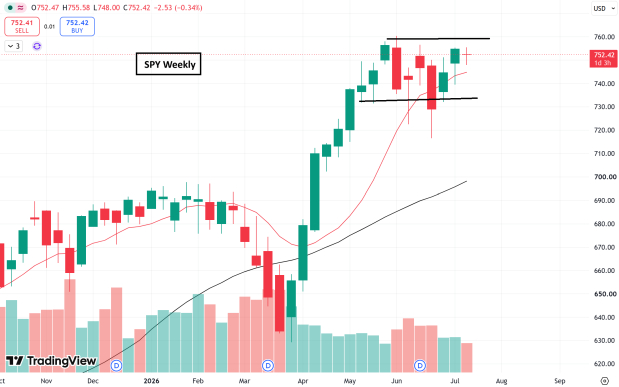
Image Source: TradingView
Remember, when the market speeds up, the best course of action for investors is to slow down.



Comments
Log in or sign up to join the conversation.