

This morning at fire training we did a complex water operation.
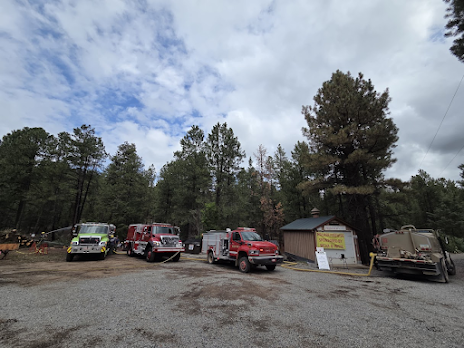
The scenario is a fire in the background. The green truck to the far left gets there first and starts spraying water. Then the red truck, second from the left, gets there and does two things: it sprays water on the fire and fills up the green truck. Then the second red truck, second from the right, gets there to spray water and fill up the other red truck. Finally, the water tender, the brown truck at the far right, shows up and fills up the second red truck.
It's not likely that we'd do this sort of operation with so many trucks, but two trucks and a water tender are plausible. The utility of the drill was that we learned how to manage two different PSIs for a couple of the trucks, one PSI coming in and one going out, and generally raised overall understanding of how the pumps work beyond the basics of just getting water flowing.
I think there is an analogy here to when we explore portfolio theory. Building out various types of all-weather, quadrant-inspired, and all the rest can offer some insight into how different asset classes and strategies might interact with each other. I use this process as a lab to reinforce ideas about funds I already use and as a way to learn about new funds.
Obviously I've incorporated AI into this process as a way to check that I am not loading up on one risk unknowingly. For example, loading up on several funds that all take credit risk would not be something I'd want to do.
On Friday night, I was playing around with these two portfolios. I read something that led to my trying to come up with a "Stop The Stock Market, I Want To Get Off" portfolio. I came up with a complex version and a simple version.
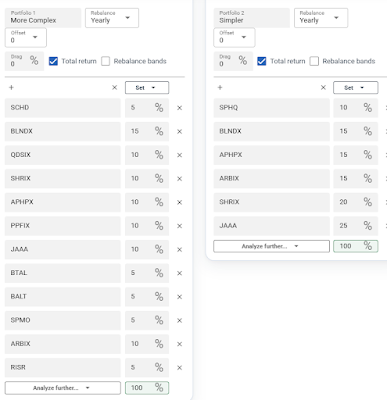
I plugged a slightly different version into Copilot, and it got most of the funds wrong. One time, Copilot said BLNDX was the best all-weather fund there is. Friday night, I thought it was a BlackRock (BLK) fund. For APHPX, it read the symbol wrong. I thought PPFIX was a PIMCO fund; it's not. It had the wrong AQR fund. I always have to tell it that SHRIX is a catastrophe bond, so it got that one right. And I thought BALT was also a BlackRock fund. Maybe it went out to happy hour and wasn't expecting to have to work.
Then I went to Claude. Claude got the funds right, but it made several assumptions that were more like incomplete observations than outright incorrect. It said that "APHPX and PPFIX share a family resemblance" and that they would probably react in the same negative manner to certain negative events like the Tariff Panic 15 months ago.
Me: Has there been an instance where APHPX and PPFIX reacted similarly in a bad way to the same adverse market event? APHPX and PPFIX are practically uncorrelated.
Claude: Good pushback to check empirically rather than just accept my "family resemblance" framing at face value — and the data mostly backs you up... the evidence supports your claim more than it supports my earlier "they're cousins" framing.
There were others. The point is that using AI should probably be an exchange, not just our taking in what it says. I asked what I thought were the obvious questions, but there were probably others that could have been asked too. AI is learning, but we need to learn too.
Here's how the two versions of the "Stop The Stock Market, I Want To Get Off" did in a short backtest.
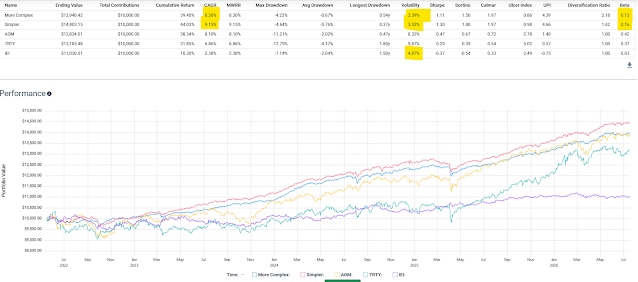
Neither the complex nor the simple version is going to keep up with 60/40 or the stock market, but they are both less volatile than the IEI, which is the 3-7 year treasury ETF, and I believe they are capable of compounding decently above the rate of price inflation. Lately, I've been digging into foundation allocations, and a frequent objective for foundation accounts is CPI plus 5%. We'll get into that more later this summer, but both the complex and simple versions are in the ballpark of CPI plus 5%. That outcome with a very low volatility would be interesting if it could be pulled off.


Comments
Log in or sign up to join the conversation.