


Stocks are rallying in response to Nvidia (NVDA) posting a beat-and-raise yesterday evening while signaling nosebleed level demand from customers that just can’t get enough of its high-grade semiconductor chips. The largest firm in the world by market cap lifted guidance to 70% revenue growth for fiscal year 2028, a monumental clip considering its scale and associated speed of expansion. The results and accompanied outlook are strengthening Wall Street’s confidence that the name hasn’t matured, and it’s contributing to a bullish view consistent with an extended runway ahead for AI infrastructure spending and adoption. But today’s equity advance is narrow, as tech is the sole sector in the green amidst the other 10 principal segments retreating. Still, the four major benchmarks are climbing with appreciation that is emblematic of the dominant role and concentration that technology sustains across the indices, although the Dow (DIA) and Russell (IWM) are rising only modestly because cyclical equities are extremely sensitive to tomorrow’s Jackson Hole speech from Fed Chair Kevin Warsh. Similarly, Treasuries and the greenback are right at their flatlines, as fixed-income and currency observers are waiting to see if the chief comes out hawkish, like he did in June, or dovish, as we saw in July. The side he chooses will be critical to this Friday’s market reaction, as an accommodative stance is poised to benefit risk assets and the short end of the yield curve, while punishing duration and the dollar. Elsewhere in trading, cryptocurrencies are back in their groove following certain analysts becoming nervous that bitcoin (BTC.X) may have approached resistance at 80k. It jumped near 81k earlier, while commodity costs are increasing broadly, including energy inputs, after investors realized that a price below $80 on WTI was probably too cheap in light of ongoing uncertainty with Washington and Tehran. Hedges are being dropped as premiums on volatility protection instruments fall; however, prediction markets are experiencing engagement.
Labor Market Stability Persists
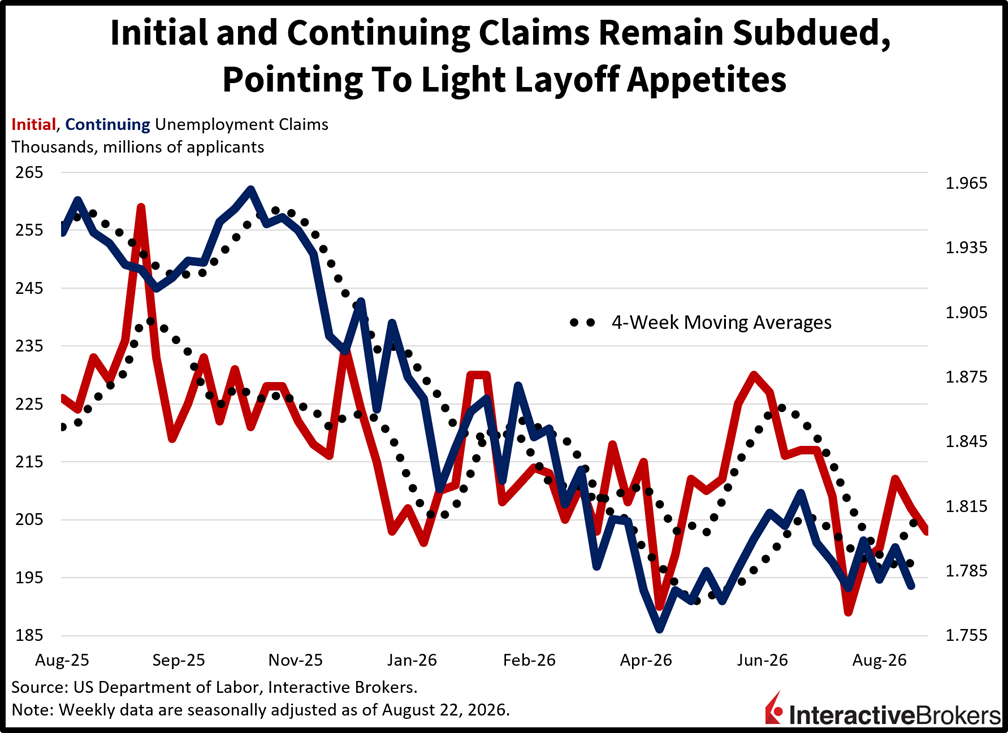
Unemployment claims continue to reflect labor market stability as applications declined in the past two weeks. Indeed, the initial and continuing segments both slipped to 203k and 1.778 million during the seven-day periods ended on August 22 for the former, and August 15 for the latter. The figures arrived beneath the median estimates of 208k and 1.79 million as well as the previously reported numbers of 207k and 1.796 million. Four-week moving averages rose slightly, however, from 204.25k and 1.788 million to 205.5k and 1.789 million.
US Goods Deficit Hit 16-Month Highs
The US goods trade deficit widened to a 16-month high in July as exports plunged for the third consecutive month while imported materials needed for the AI buildout surged in response to firms rushing to enhance their technological capabilities. The -$118.8 billion headline number was well beneath the -$99 billion expected and the -$101.41 billion from June.
Jackson Hole Will Be Pivotal
With the White House and Treasury pulling all kinds of levers to push yields down against the backdrop of the long-end jumping to a 19-year high earlier this month, the Federal Reserve’s current stance on monetary policy is pivotal. There’s certainly an angle for Chair Kevin Warsh to be increasingly patient with inflation after he presented an unwavering focus on tackling price pressures in June. Indeed, the chief could point to July job losses, contracting retail sales and slowing consumption as reasons to wait-and-see; however, if he’s perceived as using those data points to appease the administration and Wall Street, then the dollar and the extended maturities are poised to take a beating as currency watchers and bond vigilantes punish Washington and the central bank for failing to take budget deficits and elevated cost forces seriously enough. Striking a delicate even-handed posture of balancing the institution’s dual mandate while taking slowdown risk into consideration will be difficult for the leader’s inaugural Jackson Hole presentation, as many fixed-income participants are wondering what he’s waiting for to tighten via the rate or the balance sheet.
International Roundup
South Korea Hikes Key Rate and Upgrade Growth Outlook
The Bank of Kore hiked its key interest rate 25 basis to 3% this morning, its second consecutive meeting in which policymakers increased the organization’s key benchmark. Economists were somewhat divided between expecting either a pause or a lift after annualized core inflation increased from 2.4% in June to 2.5% last month. The decision is justified because inflation is likely to stay above the organization’s 2% goal for a considerable time, according to central bank Governor Shin Hyun-song. Indeed, the bank now expects overall inflation to average 2.7% this year. Some analysts, however, believed that policymakers should have allowed more time to assess the impact of the prior rate increase before making further changes. The bank also said it anticipates gross domestic product will expand 3.3% this year. It previously forecasted a 2.6% advancement. It also revised its 2027 growth rate from 2.1% to 2.9%.
Capex Falls In the Land Down Under
Total private capital expenditures in Australia fell 3.6% quarter over quarter during the April through June period with an 8.9% drop in equipment, plant and machinery leading the weakness and reversing from the 18.4% jump in the first quarter. Economists anticipated the headline would be up 0.8% following the first quarter’s 6.9% jump. Capital deployed for buildings and structures rose 2.1%, a reversal from the 3.3% dip in the preceding period, but it failed to entirely offset the decline in other areas.


Comments
Log in or sign up to join the conversation.