


I was chatting with a long-time investor the other day. He told me that he couldn’t afford to withdraw any of his investment with us. The capital gains tax would be prohibitive, he went on to explain. We both chuckled at this high-class problem. I told him that creating such golden handcuffs is part of our business model.
It’s easy to see how this situation arose. The five-year annual return through June on the American Energy Infrastructure Index (AEITR) is 21.0%, easily beating the S&P500 (SPY) at 12.9%. The ten-year AEITR is 13.4%, modestly behind the S&P500 at 15.1% over a period that includes the pandemic-induced swoon in the energy sector.
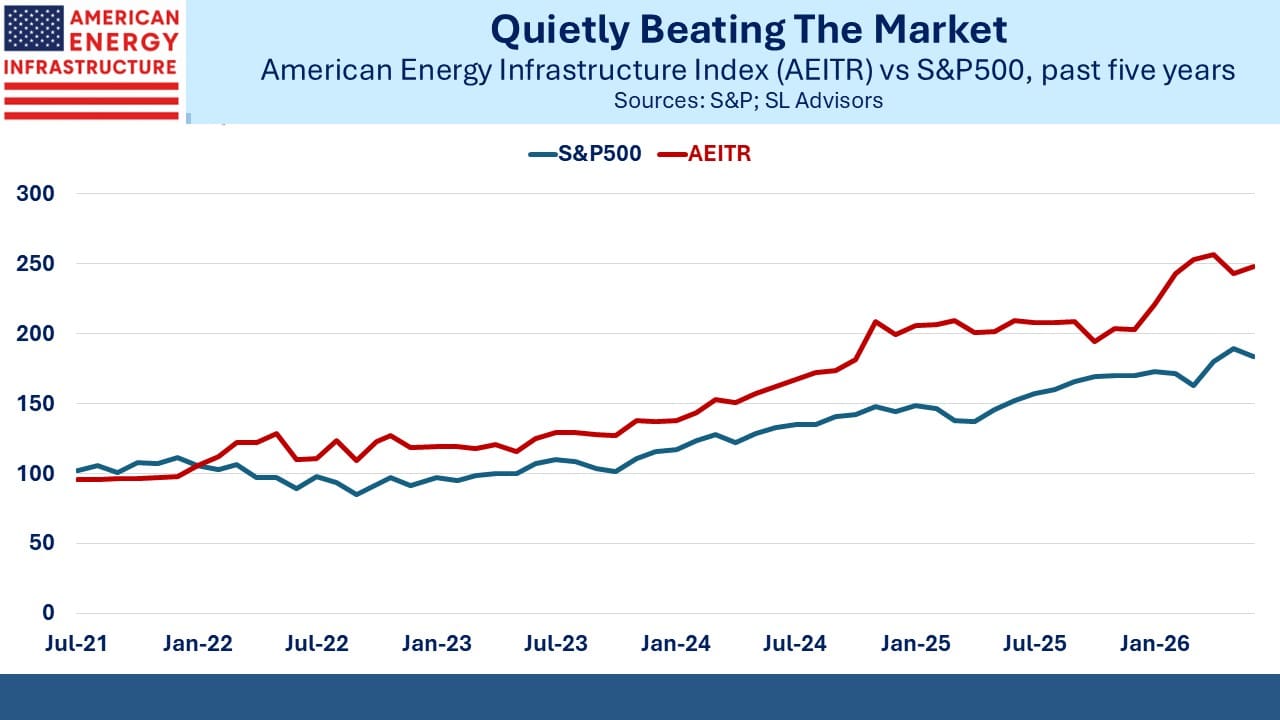
Moreover, the increasingly tech-heavy S&P500 looks more like a growth index, dominated as it is by hyperscalers spending hundreds of $BNs on data centers. Factset reports a 2Q blended earnings growth rate of 50.4%, double what was expected as recently as June 30th. 2027 earnings are expected to be +13% based on bottom-up forecasts. Talk of a bubble has moderated in response to such strong profit growth.
But it’s still a question for investors to ponder. The Shiller P/E Ratio, which uses ten-year trailing inflation-adjusted earnings, is at 42.39 just shy of its dot-com peak of 44.19, reached in November 1999. The strong profitability is driven by spending on AI. One company’s capex is another’s revenue.
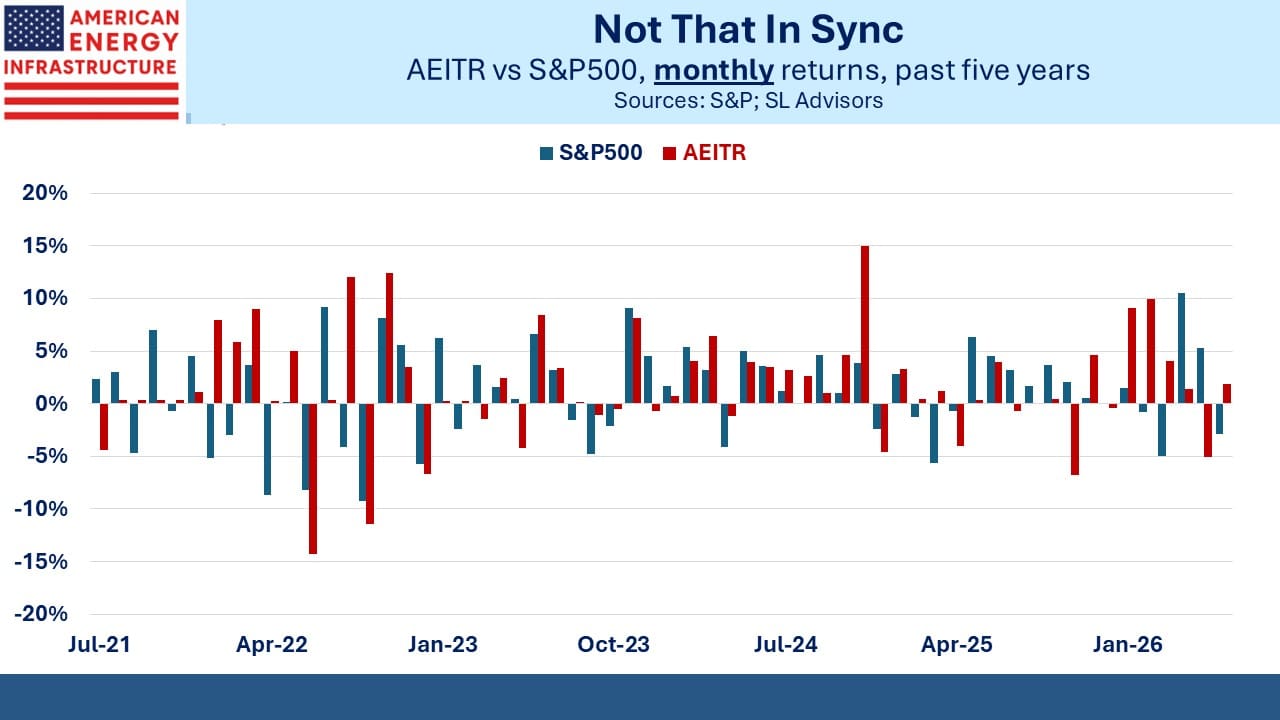
The midstream sector has different sensitivities than the overall market. Although there’s a robust AI growth story related to natural gas demand for power, near term cash flow generation remains the dominant metric that investors use. The AEITR has matched the S&P’s direction on only 38 of the past 60 months. The correlation is 0.34.
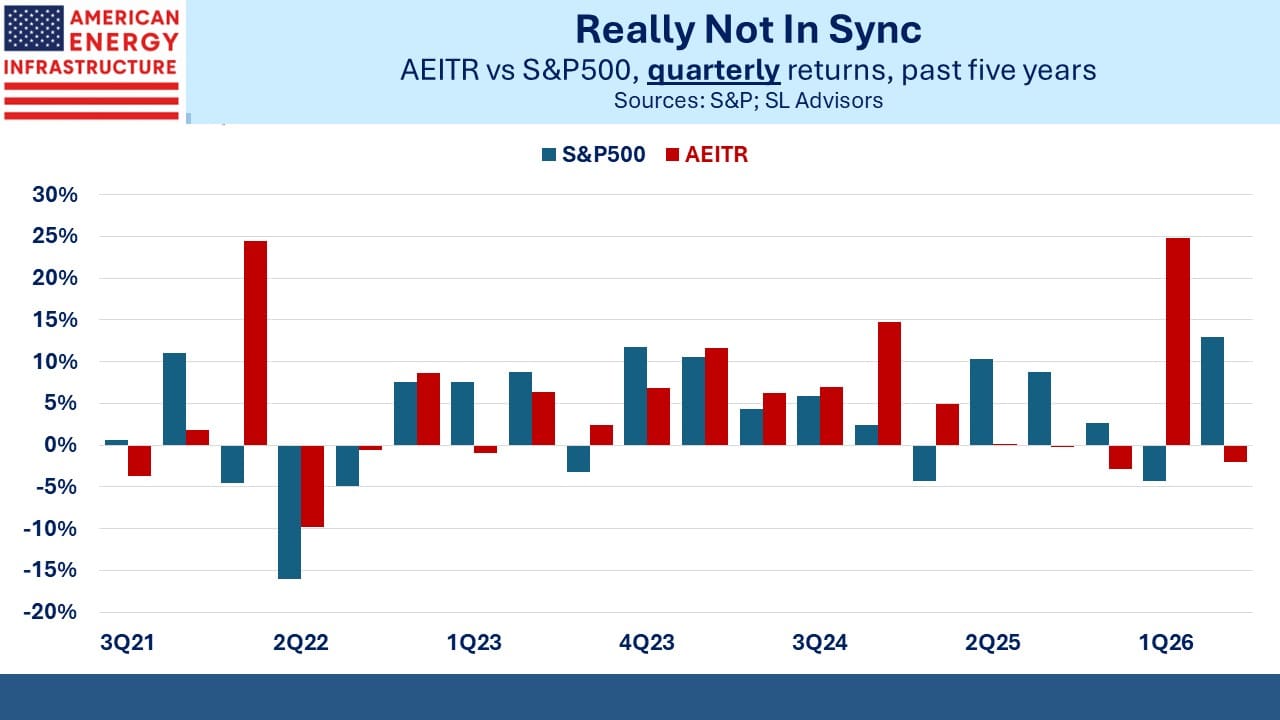
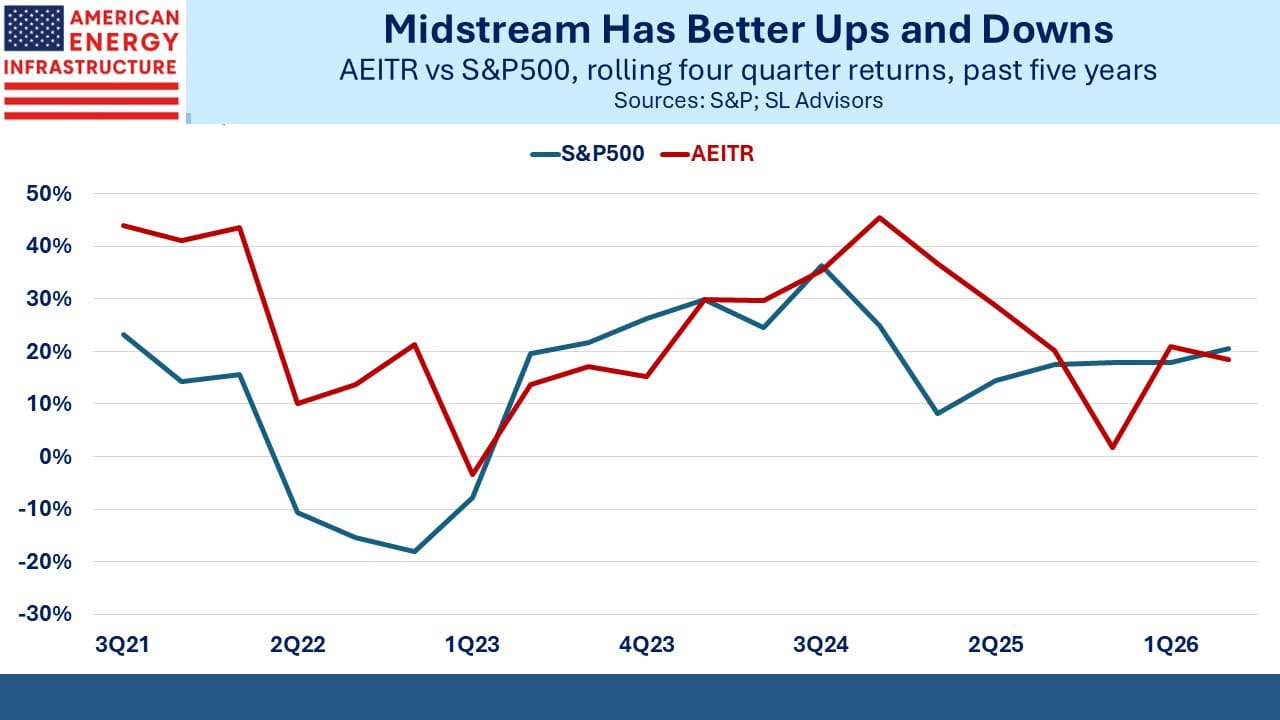
The quarterly data shows the complementarity of returns even more dramatically, with only 11 of the past 20 quarters’ returns having the same direction. The correlation is -.02. The rolling four quarter trailing return has been negative only once, in 1Q23 (-3.5%) compared to three for the S&P500 (1Q22-3Q22). A bad stock market has been worse than a bad run in midstream.
More recently, midstream was +24.7% in 1Q while the S&P500 was –4.3%. It’s worth noting that through February, just before we attacked Iran, the AEITR was +19.9%. The continued failure to reopen the Strait of Hormuz to shipping has been a big positive for US energy exports, but so far most of this year’s midstream return predates hostilities. In the 2Q the AEITR was –2.0% while the S&P500 was +13.0%. Both make money over longer periods, but conveniently their best times are often different.
This low correlation was most beneficial to investors in 2022 when inflation soared following the Biden administration’s profligacy in response to the pandemic. Midstream was +21% that year while the S&P500 was –18%.
Inflation has been 1% or more above the FOMC’s stated 2% target for the past five years. Whatever the Fed may intend, investors should assume higher than 2% in the future. Moreover, experienced inflation is assuredly above even 3% for the readers of this blog. Go back and look at your spending over the past couple of years. If it’s not up by at least 4% you most likely bought fewer goods and services. With income dispersion increasing, if your income is only increasing at the official inflation rate, you’ll find your standard of living is slipping.
Investors often ask what portion of their portfolio should be in midstream. A better approach over the past five years has been to turn this thinking on its head, and sprinkle a little S&P500 exposure into a midstream-dominant portfolio. It’s unconventional but fairly describes your blogger’s posture.
I was chatting about some of the long-run consequences of AI with a friend recently. We agreed that autonomous driving, and at some point aviation too, will prevail. Public acceptance will likely lag the safety of the technology. Around 40,000 people die in auto accidents annually, a figure society accepts as the result of approximately 40,000 unrelated but fatally flawed human actions. It’s around 1.2 deaths per 100 million Vehicle Miles Traveled (VMT). Autonomous vehicles will need to be an order of magnitude or two better – and they probably will be. I hope so. Driving is such a waste of time.
Another friend asserts that human doctors will eventually be fully replaced by AI. Many of us have likely consulted Dr Claude, perhaps using it to decide whether to see a doctor or to check his diagnosis and treatment. I think it’ll be a long time before a cancer patient favors AI over their human oncologist, even if the latter will be checking conclusions with her preferred AI model.
But it made me wonder where the threshold is for our children’s generation, a cohort more open to silicon solutions. The annual physical might be first – many may find it quite acceptable to receive an email assessing that their recent blood test and other vitals require no further follow-up. What about an annual visit to the dermatologist? What if you’re worried about a rash? The critical question is, what is the most worrying health condition for which an AI diagnosis of no further treatment needed would be acceptable to the next generation? Ask your children. If you learn anything interesting, let me know.


Comments
Log in or sign up to join the conversation.