

Spain leads in telecom infrastructure with extensive fibre and strong 5G. However, operators face weak margins. Sustaining investment requires improved returns. Easing regulation could boost profitability and support further network expansion.
Spain is a European telecom success story. It has leading infrastructure, with a dense fibre network and strong 5G coverage. But beneath the infrastructure success lies a weaker financial reality: operator margins are relatively low while revenue growth is lagging the broader economy. As telecom operators have to compete with other companies for capital, a healthy prospective return on network investment is needed to sustain Spain’s leadership. In our view, regulators should work to relax the policy framework, which would contribute to better profitability. This could propel further investment in Spanish telecom infrastructure.
Leading telecom networks in Spain
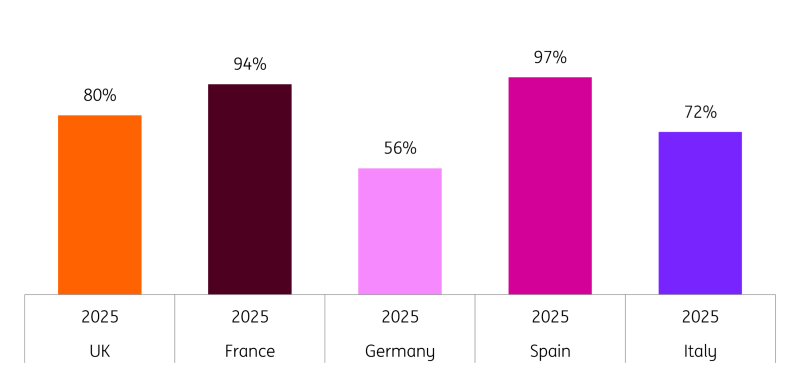
One of the first things that stands out when evaluating European telecom markets is Spain’s extensive fibre network. Spain was one of the first countries to start rolling out fibre across the country, and today, the percentage of homes passed with a fibre network is 97%, as can be seen in the figure below. Interestingly, this network rollout has largely been driven by private sector investment. The larger telecom network operators have spent billions upgrading their networks. To cover less densely populated areas, the industry has been able to rely on public subsidies from the ÚNICO-Banda Ancha programme. While private investment has been the main driver of the nationwide fibre rollout, government initiatives have played a targeted role in extending coverage and shaping the overall cost and return profile of the market. The infrastructure upgrade has been well received by users, with an impressive 93% of households passed with fibre choosing to use it.
Spain has a leading European fibre coverage rate
Excellent mobile networks
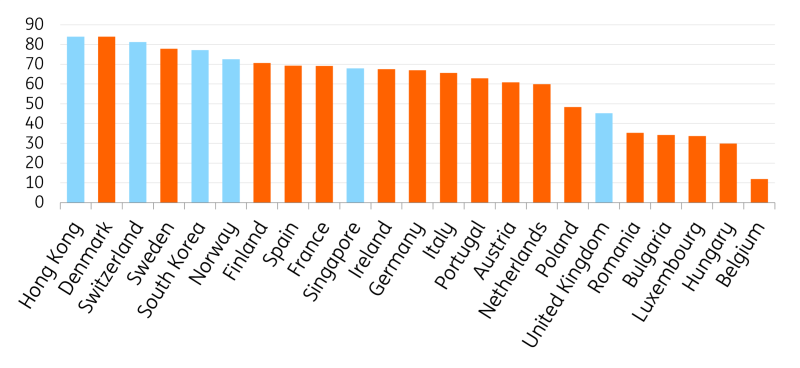
But it is not only Spain’s fibre networks that stand out; 5G coverage is also strong. According to Telefonica, its 5G network now reaches 95% of the population, while this figure is 90% for MasOrange. Also, the availability of 5G networks is excellent, by European standards. Research firm Ookla notes that Spanish users of a 5G handset have access to a 5G network 70.6% of the time – higher than in Italy, the Netherlands and the UK. This is a notable achievement given the geography of the Iberian Peninsula. However, availability is still not ubiquitous, with no 5G connection available in the remaining 29.4% of cases. Also note that, for example, Denmark, Switzerland and South Korea score higher on this metric. This strong infrastructure position reflects sustained investment and intense competition, which have helped to accelerate coverage but have also weighed on pricing power and returns.
5G network availability is key: Spain is leading many other European countries (%)
How profitable have investments been?
One challenge that could hinder Spain’s investment drive is that telecom operator profitability is lagging compared to leading European operators. High levels of network investment, combined with competitive pressure, appear to translate into lower margins, limiting operators’ ability to fully monetise their infrastructure leadership. As can be seen in the figure below, the Spanish EBITDAaL-margins of Telefonica, Vodafone and MasOrange are around 30-35%. This is below the margins of KPN, Orange France, Deutsche Telekom in Germany and Swisscom in Switzerland. This is an important figure as operators need good profitability to further drive their investments. In our view, the operating profitability of the Spanish telecom operators deserves greater attention from regulators, as this is what drives the sustainability of future investments.
EBITDAaL-margins in Spain look relatively low
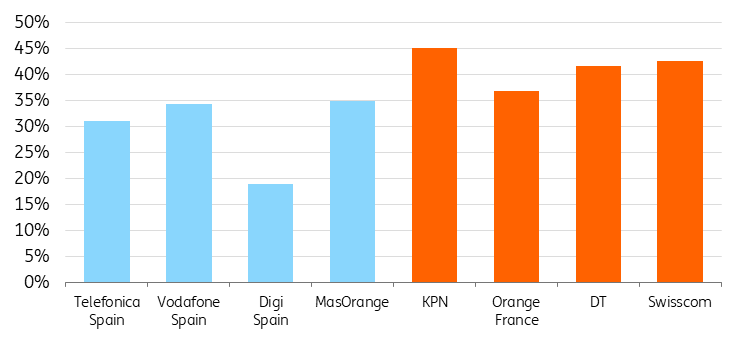
Data for FY25. Data for MasOrange based on 9M25 and approximated lease costs
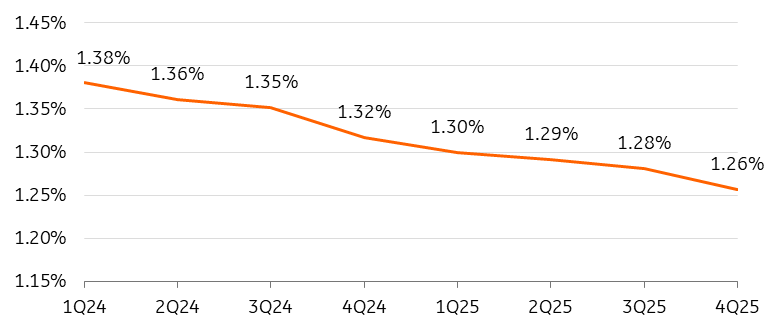
A similar observation can also be made when looking at the revenue share of telecom operators compared to Spanish GDP. According to data from Analysys Mason, the revenue share to GDP of telecom services has declined in Spain from 1.38% to 1.26%. This shows that Spanish users get better value for money every year, but potentially not the most modern infrastructure, such as the US or China employs.
Spanish telecom revenues are not growing as a share of GDP
This is also evident when looking at the speeds achieved on a mobile network in Spain. The average download speed is below 100Mbit/s, which ranks below speeds achieved in the United States, Denmark, and the Netherlands.
Spain's 5G network needs further investments
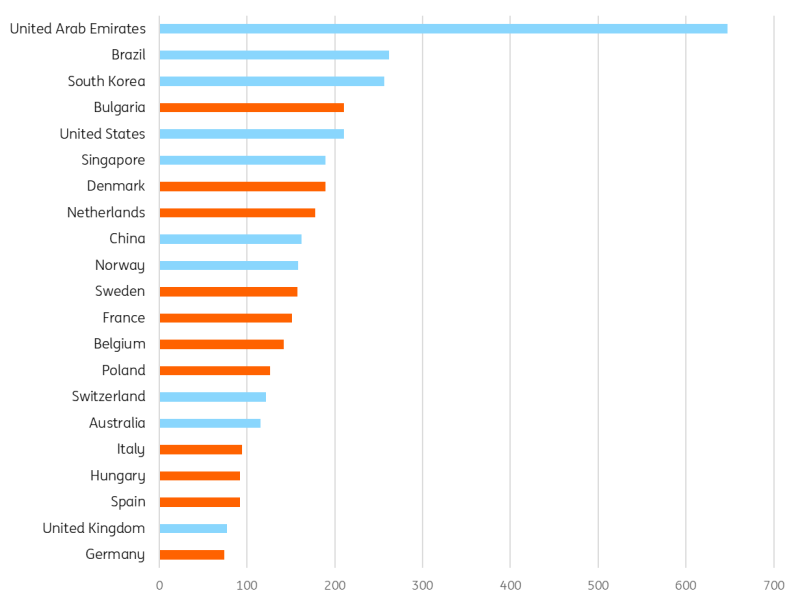
Median mobile download speeds per country (Mbps)
Upgrade to 5G SA is coming, but there is work to be done
5G is therefore quickly becoming the norm in many countries. However, a 5G connection does not imply that the core network is fully upgraded to the latest 5G standards. An end-to-end 5G network, called 5G standalone, or 5G SA, operates with a fully modernised back-end infrastructure. This enables fast speeds and lower network latency. Such a modern network will also enable new services that depend on high data throughput, speed, or low latency. As can be seen in the chart below, Austria and Spain are the European countries that lead the deployment of 5G SA. In the chart, the 5G SA sample share is shown, measuring the percentage of all Ookla 5G speed tests run on an independent 5G network core (without relying on 4G infrastructure). This indicates how widely 5G SA is adopted. An interesting observation is also that some other important countries, like the US and China are really moving ahead of Europe. Europe therefore needs to accelerate investment.
Spain and Austria lead Europe in 5G SA deployment
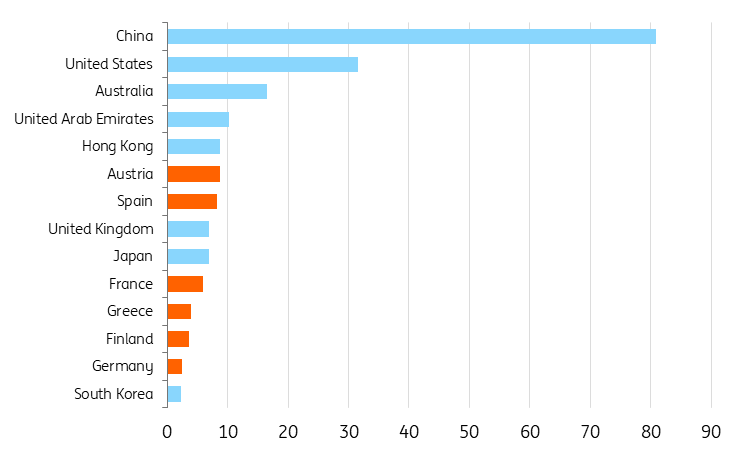
5G SA sample share in 4Q25 (%)
Coverage in rural areas needs an upgrade, while networks can be congested
The pressure on returns may also constrain reinvestment capacity over time, helping to explain emerging signs of congestion and choke points in network performance. Apart from challenges with mobile download speeds, the capacity of Spanish mobile networks looks somewhat stretched. According to Ookla, the Spanish mobile market is Europe’s most congested mobile market during peak use in the evening. The researchers found a decline in average speed by 66% during peak hours (1Q26). Meanwhile, network latency increases by 60%. This implies that operators have work to do to upgrade capacity.
Another challenge comes from the deployment of 5G mobile networks in rural areas. As the regulator CNMC notes, only 82.2% of rural areas have at least one 5G network, while this holds for 96% of urban municipalities. Consumer choice is also limited in these areas, as there are three 5G networks in only 15.4% of rural municipalities. Further investment in Spain’s mobile infrastructure is therefore needed, and this will also be done through the help of public funds. However, we expect private markets to also contribute to these initiatives, especially if the profitability of the overall market were to increase.
Strong networks but weak returns threaten future investment
Spain’s telecom sector is a clear infrastructure leader, but it does not combine this with strong economics. Strong fibre and 5G coverage have been achieved at the cost of weaker margins and pricing power, raising questions about the sustainability of future investment. Without a shift in the policy framework to support returns, Spain risks underinvesting in the next phase of network upgrades, from capacity expansion to 5G standalone. Addressing this imbalance will be key to maintaining its leadership position, raising the question of whether greater in-market consolidation could play a role in restoring profitability.



Comments
Log in or sign up to join the conversation.