

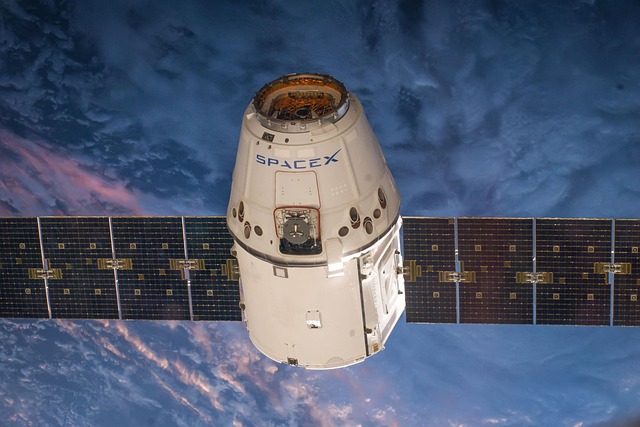
SpaceX (SPCX) has quickly become the most talked-about stock in the market following its highly anticipated IPO. After years of private market speculation, investors finally have the opportunity to invest directly in one of the world's most influential technology companies.
As one of the largest IPOs in history, SpaceX has generated enormous attention from both institutional and retail investors. Social media is flooded with discussions about the stock, headlines continue to dominate financial news, and many investors are asking the same question: "Should I buy now before it goes even higher?"
Part of the excitement comes from the fact that SpaceX is no longer simply a rocket company. Today, the business operates across space transportation, satellite communications, internet infrastructure, artificial intelligence, and emerging orbital technologies. Through ventures such as Starlink and Starship, SpaceX is positioning itself at the intersection of several powerful long-term growth themes, including space exploration, global connectivity, cloud computing, AI, and next-generation infrastructure.
Investor enthusiasm has been driven not only by SpaceX's dominant position within the space industry but also by the potential future opportunities surrounding Starlink, Starship, artificial intelligence, and even the possibility of orbital data centres. For many investors, SpaceX represents a rare opportunity to gain exposure to multiple disruptive technologies through a single company.
But after five trading days, the initial excitement has begun to settle and the market is starting to reveal its first clues. Is this the beginning of a long-term growth story worth owning for years to come, or are investors simply experiencing IPO-driven FOMO? Let's take a closer look at what the fundamentals, sentiment, and technical analysis are telling us after SpaceX's first week as a publicly traded company.
Fundamentals
SpaceX is a vertically integrated leader in space transportation, communications, and emerging infrastructure, with more than 80% global market share of mass delivered to orbit and a significant cost advantage driven by its reusable rocket technology. Its Falcon 9 platform has established a strong competitive moat, allowing the company to launch payloads at a scale, frequency, and cost that few competitors can match.
One of SpaceX's most important growth drivers is Starlink, its global satellite internet network. Starlink is rapidly becoming a major cash-generating business and is expected to drive substantial revenue, profitability, and cash flow growth in the coming years. Management expects Starlink's growing profitability to help fund future investments across the broader business, including Starship development and emerging infrastructure projects.
Looking ahead, the successful scaling of Starship could significantly strengthen SpaceX's competitive advantage. The next-generation launch platform has the potential to further reduce launch costs, increase payload capacity, improve Starlink economics, and unlock entirely new commercial opportunities across communications, logistics, manufacturing, orbital infrastructure, and potentially space-based data centres. While these opportunities could be transformational, investors should recognise that many of these future revenue streams remain highly speculative and will require successful execution over many years.
The company is also investing aggressively in artificial intelligence. Recently, SpaceX announced plans to acquire AI coding platform Cursor in a deal valued at approximately $60 billion. Management believes the acquisition will help accelerate the development of Grok and strengthen the company's enterprise AI capabilities. Combined with investments in xAI, cloud computing, and future orbital computing initiatives, SpaceX is positioning itself as more than a space company, with ambitions to become a global internet, cloud, AI, and infrastructure provider.
Financially, SpaceX remains in a heavy investment phase. While the company carries elevated debt levels, growing profitability from Starlink, anticipated IPO proceeds, and leadership across multiple high-growth industries provide a strong foundation for future expansion. However, current valuations appear to assume successful execution across many of SpaceX's ambitious projects, including rapid Starship scaling, AI monetisation, and commercialization of orbital infrastructure. As a result, execution risk remains one of the key factors investors should monitor.
Technical
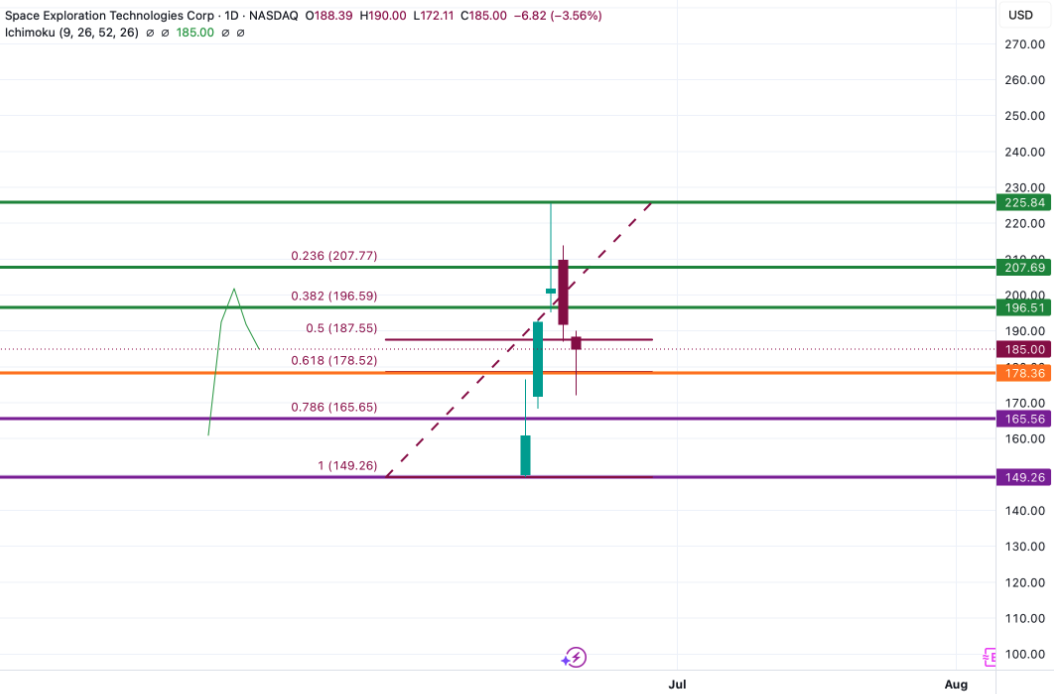
On the daily chart:
Strong bullish momentum immediately following the IPO
A bearish engulfing pattern has recently formed
Typical post-IPO volatility may continue as price discovery unfolds
On the daily chart, we can see that investor enthusiasm was extremely strong during the first few trading sessions following the IPO. Buyers aggressively pushed the stock higher, resulting in a new high of approximately 225.64 shortly after listing.
However, a bearish engulfing pattern has now formed after the 4th day of trading. A bearish engulfing pattern occurs when a large bearish candle completely engulfs the body of the previous bullish candle. This pattern often signals that sellers have temporarily gained control of price action and can be an early warning sign that bullish momentum is weakening. While a bearish engulfing pattern does not guarantee a decline, traders often view it as a potential indication of a pullback, consolidation, or trend reversal.
It is also important to remember that newly listed IPOs often experience significant volatility during their first few weeks or months of trading. A common IPO pattern involves strong initial enthusiasm and momentum buying, followed by a pullback as early investors take profits and the market begins establishing a more realistic valuation. This process is often referred to as "price discovery" and can result in substantial swings in both directions before a longer-term trend emerges.
For SpaceX, the recent bearish engulfing pattern may simply represent a normal phase within this post-IPO price discovery process. However, if selling pressure continues, investors may look toward lower support levels before considering new positions.
BL ideas
178.36 (High Fill Probability)
165.56 (Moderate Fill Probability)
149.26 (Low Fill Probability)
PT ideas
196.51 (High Fill Probability)
207.69 (Moderate Fill Probability)
225.84 (Low Fill Probability)
Risk Level: High
SpaceX remains a high-risk growth stock. While the company benefits from market leadership in space transportation, growing Starlink profitability, AI expansion initiatives, and significant long-term growth opportunities, investors should recognise that the company is still executing on several ambitious projects that may take years to fully commercialise.
Key risks include execution challenges in Starship development, slower-than-expected growth in Starlink, increased competition in the AI and cloud computing markets, regulatory hurdles, and the possibility that future growth initiatives fail to meet current market expectations. Investors should also expect elevated share price volatility due to the company's recent IPO and ongoing price discovery.
This is not financial advice. Always align your investment decisions with your personal risk tolerance, financial goals, your Freedom Number, and your Investment Policy Statement.
Summary
SpaceX has evolved far beyond its origins as a space launch company and is increasingly positioning itself as a diversified technology and infrastructure business with exposure to several major long-term growth themes. Through its leadership in reusable rocket technology, the rapidly expanding Starlink ecosystem, the development of Starship, and growing investments in artificial intelligence, the company is building a platform that could influence industries ranging from communications and cloud computing to logistics, connectivity, and orbital infrastructure. Combined with Starlink's growing profitability and continued AI expansion, SpaceX has multiple potential pathways for long-term growth.
However, investors should remain mindful that space remains an emerging industry with significant technological, regulatory, and execution risks. Many of SpaceX's most exciting opportunities may take years to fully commercialise, and as a newly listed company, the stock is also likely to experience the heightened volatility often associated with IPOs. Strong early enthusiasm is frequently followed by periods of profit-taking, price discovery, and valuation reassessment before a longer-term trend emerges.
Investors should also consider the potential influence of Elon Musk on market sentiment. Similar to Tesla (TSLA), SpaceX may become a sentiment-driven stock where share pricessz movements are influenced not only by company fundamentals but also by investor reactions to Musk's public comments, business decisions, and broader market perception. While SpaceX remains one of the most compelling growth stories in the market today, investors should be prepared for both significant opportunities and significant volatility along the way.

Comments
Log in or sign up to join the conversation.