


The S&P 500 (Index: SPX) dropped almost 1.4% from its previous week's close to wrap up the trading week ending on Friday, 21 August 2026 at 7,678.76.
Rising bond yields was perhaps the biggest driver of stock prices during the week, which comes as the U.S. government is increasingly having to compete with Big Tech to borrow money as the company's seeking to build out the infrastructure to support the expansion of Artificial Intelligence (AI) systems are borrowing big to do it.
One outcome of that dynamic is expectations of higher interest rates. The CME Group's FedWatch Tool projections of the expected future for how the Fed will set the Federal Funds Rate changed little in the past week. It anticipates a 60% chance the Fed will act to hike this core interest rate to a target range of 3.75-4.00% on 28 October (2026-Q4), while giving a much stronger 98% chance this rate will be in effect on 9 December (2026-Q4). Beyond that, the FedWatch Tool now anticipates another quarter point rate hike on 28 April (2027-Q2).
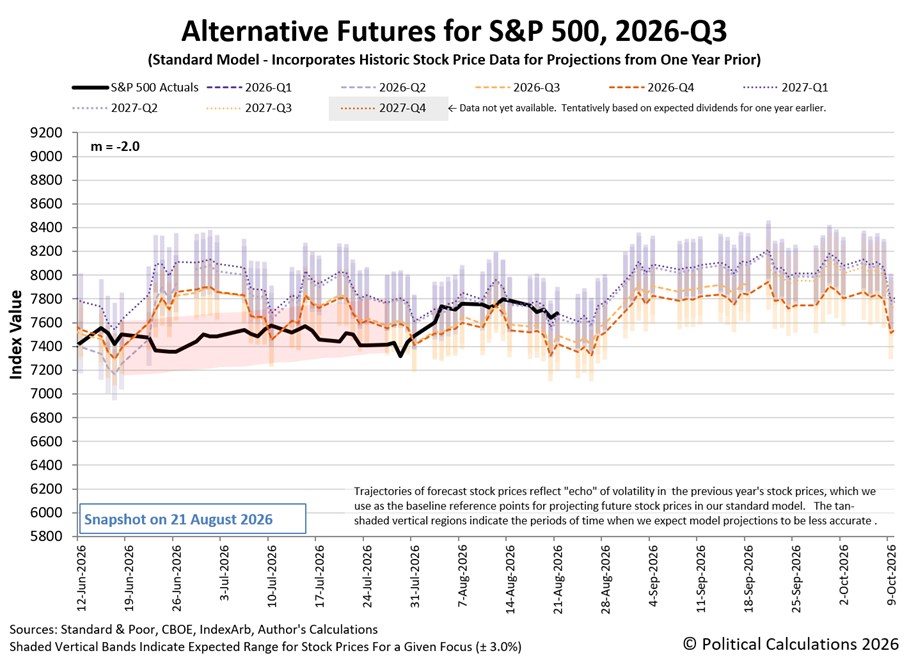
Meanwhile, stock prices behaved almost exactly as would be expected if investors were tightly focusing on 2027-Q1 as they set the level of the week's stock prices. The latest update of the alternative futures chart shows that outcome as the S&P 500's trajectory closely paced the dividend futures-based model's projection associated with investors fixing their attention on the distant future quarter of 2027-Q1.
Investors had quite a lot of other new information to absorb during the trading week. Here is the summary of the week's market-moving headlines:
Monday, 17 August 2026
Signs and portents for the U.S. economy:
Economists predict Fed minions to leave interest rates unchanged in rest of 2026:
Bigger trouble, stimulus developing in China:
Bigger trouble developing in Japan, BOJ minions catch a break in effort to prop up Japan's currency:
Bigger trouble developing in Eurozone:
ECB minions say AI stocks are due for a fall:
Wall Street finished lower as investors look ahead to retail earnings
Tuesday, 18 August 2026
Signs and portents for the U.S. economy:
Fed minions say their monetary policy is "accommodative":
Bigger trouble, stimulus developing in China:
Bigger trouble developing in Japan:
Bigger trouble developing… everywhere:
Wall Street finished in the red as attention remains on the Middle East
Wednesday, 19 August 2026
Signs and portents for the U.S. economy:
Fed minions worried about inflation back in July 2026, just realized increase in productivity blunted it:
Bigger trouble developing in China:
Bigger trouble developing in Japan:
Wall Street ended higher, and yields dipped after the latest Treasury Department announcement
Thursday, 20 August 2026
Signs and portents for the U.S. economy:
Fed minion says they're not sure how Fed will set U.S. interest rates in September 2026:
Bigger trouble developing in and out of China:
BOJ minions / Bigger trouble developing in Japan:
Bigger trouble developing in the Eurozone:
Wall Street ended lower as Walmart dragged down retail and oil climbed
Friday, 21 August 2026
Signs and portents for the U.S. economy:
Fed minions try not to upset their real boss:
BOJ minions potentially planning rate hikes up through July 2027:
Bigger trouble developing in Eurozone (hawkish ECB minions):
The Atlanta Fed's GDPNow tool anticipates +4.0% real GDP growth for the U.S. economy in 2026-Q3, dipping from the +4.3% annualized growth it projected a week earlier.
Comments
Log in or sign up to join the conversation.