

The S&P 500 (Index: SPX) dropped 1.9%, or 125.73 points, below its previous week's close to end the third trading week of March 2026 at 6,506.46. The index is nearly 6.8% below its 28 January 2026 record high close of 6,978.59.
The escalation of oil and gas prices resulting from the Islamic Republic of Iran's efforts to shutter oil container ship traffic through the Strait of Hormuz continued to set the big economic stories of the week. Oil prices rose during the week, reaching over $150 per barrel in the eastern Asian nations that receive the bulk of their oil supplies by sea from Persian Gulf nations.
Oil prices elsewhere have risen, but not by as much. In the U.S., West Texas Intermediate oil spot prices ended the week below $100 per barrel, or around $30 per barrel higher than in February 2026. This surge is expected to add inflationary pressures to the U.S. economy, which led to the biggest market-moving headline of the week that was. Rate cuts by the Federal Reserve are no longer on the table for 2026.
The CME Group's FedWatch Tool no longer projects any interest rate cuts through the end of 2026, which it now gives a 0% probability of occurring. Instead, the tool indicates a low probability of rate hikes, giving a 32% probability of a quarter point rate hike in the Federal Funds Rate being announced after the Fed's Open Market Committee meets on 28 October (2026-Q4).
Investors responded by sending stock prices lower, especially after the Fed acted to hold rates steady at the end of its two-day meeting on Wednesday, 18 March 2026. The latest update of the alternative futures chart puts the trajectory of the S&P 500 below the redzone forecast range we added several weeks ago, which is now pulling double-duty as a working counterfactual for indicating where the S&P 500 would be if not for the geopolitical event of the Iran war.
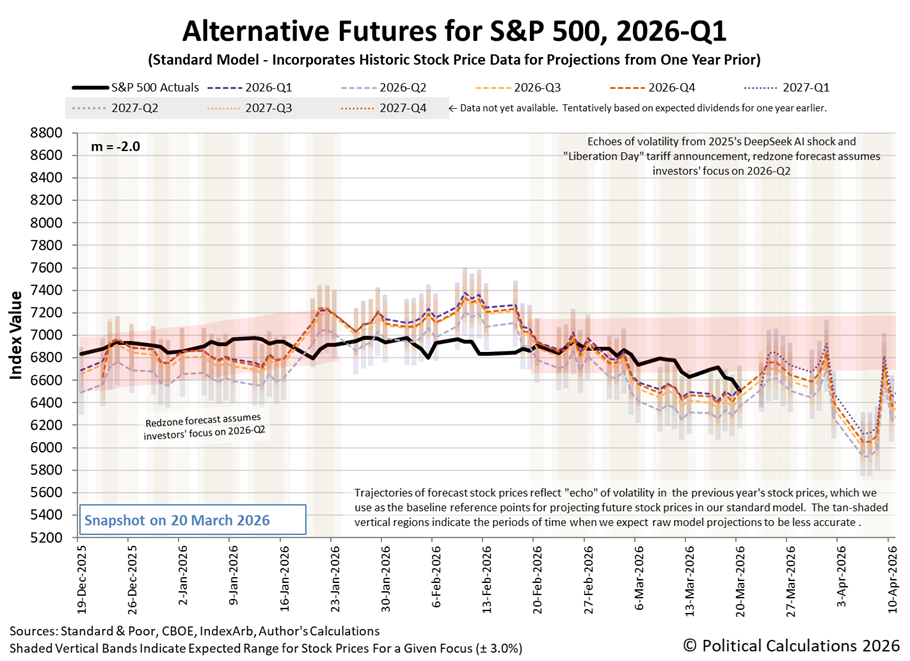
Using the mid-point of the redzone forecast range as a counterfactual reference, we find the S&P 500 ended the week of trading on 20 March 2026 about six percent below where it would have been in the absence of the event.
Here are the week's market-moving headlines, which prominently features the volatility of oil prices and the change in investor expectations for Federal Reserve rate cuts in 2026:
Monday, 16 March 2026
Signs and portents for the U.S. economy:
Fed minions trying to cope with foggy crystal ball:
Bigger trouble still lurking in China:
BOJ minions waver on plan for interest rate hikes:
ECB minions excited to participate in meeting of central bankers to address surge in oil prices:
Tuesday, 17 March 2026
Signs and portents for the U.S. economy:
Fed minions starting to realize how badly they let Bidenflation get out of control, expected to keep rates steady:
Bigger trouble, stimulus developing in China:
Chief BOJ minion obsessed with trying to generate wage-price inflation cycle in Japan:
Badly informed Eurozone politics infects ECB minions' succession:
U.S. stocks extend gains as investors expect no change to interest rates
Wednesday, 18 March 2026
Signs and portents for the U.S. economy:
Before: Fed minions expected to hold rates steady, then do as they were expected:
After: Fed does the expected, chief Fed minion says he won't be forced out despite blowing out budget for Fed building renovation:
ECB minions say it's no time to ease bank rules:
Wall Street snaps winning streak as Fed keeps rates unchanged, inflation fears loom
Thursday, 19 March 2026
Signs and portents for the U.S. economy:
Bigger trouble, lesser stimulus developing in China:
BOJ minions' plans to hike Japan's interest rates thwarted by Iran war:
ECB minions hold Eurozone interest rates steady, staring to think their perfect monetary policy might need rate hike to fight oil price inflation:
Wall Street ends in the red for a second day as inflation fears take center stage
Friday, 20 March 2026
Signs and portents for the U.S. economy:
Fed minions trying to learn from worst bank failure in years, having trouble reading monetary needs of U.S. economy:
Bigger trouble developing in China:
Other central banks starting to think about rate hikes:
ECB minions say they will keep their perfect monetary policy for Eurozone and won't change it unless they must:
U.S. stocks end lower for a fourth consecutive week as Iran war concerns loom over sentiment
The Atlanta Fed's GDPNow tool forecast of real GDP growth in 2026-Q1 fell to +2.3%, rebounding from the +2.7% growth anticipated a week earlier.
Comments
Log in or sign up to join the conversation.