


We're in Tucson this week, and on Wednesday afternoon I went to pick up some garden tools that my wife found on Facebook Marketplace, $20 for more than we needed, not too shabby.
The seller lives in a 55 and older mobile home park closer to the middle of town from where we live. The place was immaculate; it looked to be about half occupied, not sure if that is because it's still warm here or some other reason. Naturally, I got curious about the actual dollars and cents.
As is common, residents own the house but lease the lot.
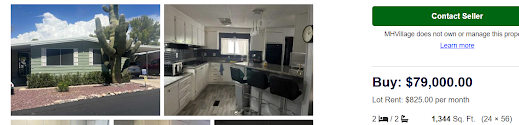
That price is toward the lower end; the upper end was $160,000-$180,000, and there were a handful closer to just $40,000. Gemini said the rent for the lot ranged from $658-$717, which must be a dated number versus the $825 in the picture. All-in utilities range from about $150 in the less hot months to about $350 in summer months. Insurance runs about $1000/yr and taxes (for the house, not the lot) are about $200/yr. So all in, after buying the house, it might be about $13500/yr or $1125/mo.
Regardless of who may or may not be interested in this situation, it is relatively affordable. For anyone unable to accumulate a meaningful retirement but who bought a house could downsize into something like this and have a usable piece of money left over after selling and buying into the property I visited. As a primary residence, it is not a lavish circumstance, but it is a workable outcome.
It is also an inexpensive way to snowbird. Someone in South Dakota might want to take a chunk out of their winters without actually moving away. There are plenty of ways to snowbird, of course. In a recent blog post, we cited someone who got an Airbnb for an entire month, which is probably less expensive than buying one of the mobile homes we're talking about, which is cheaper than buying a regular house in a neighborhood.
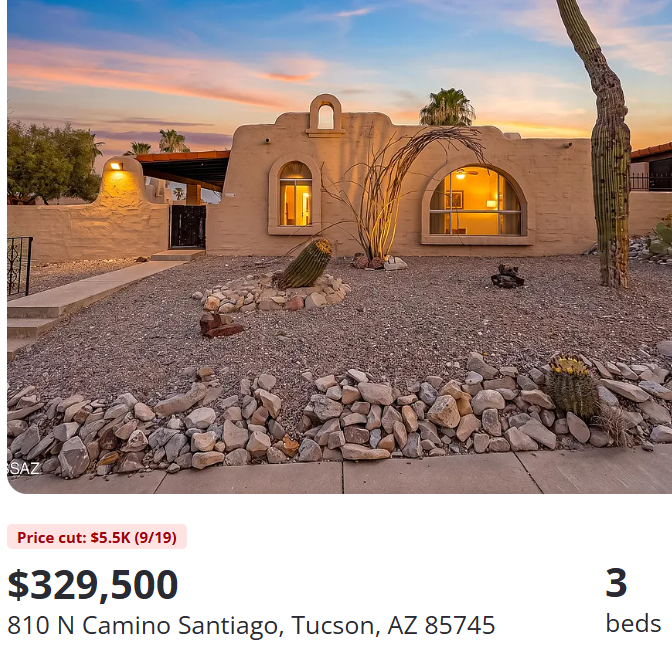
My wife and I probably have our retirement sorted out, which I am grateful for, but plenty of people will have to figure it out and make some difficult choices. Mobile home communities like the one I visited can solve problems.
Speaking of solving problems, I sat in on a webinar for the Northern Trust (NTRS) distributing ladder ETFs. We've looked at them before. There are two versions: one that pays tax-free income by owning muni bonds and the other protects against inflation with TIPS. The way these work, if you buy one that matures in 2036, so ten years from now, it pays out 1/10th of the NAV every year plus a little interest. In the final year, the fund pays out its final 1/10th of the original investment and then closes.
We've looked at these in the context of a bridging strategy. Someone who is today 65 might use one of these as a way to hold off taking money from their IRA until RMDs start in 2036, when they are 75.
We've looked at putting together a bunch of very high-yield products with different types of risks to do something similar but hopefully end up with some money leftover. Going all in on the 2036 TIPS Distributing Ladder (TIPF) means you have nothing leftover in ten years. Owning ten or 12 very high-yielding with disparate risks has a reasonable chance of not completely depleting, but that is aggressive. A strategy of half in TIPF and half in a very high-yield portfolio would be safer.
None of that is new, though, from our previous conversations about these funds. The one new thing I pulled from the webinar was pretty much a throwaway line that wasn't followed up on. Yes, bridging seems to be the primary use for these, but Chris Huemmer from Northern Trust made a comment about using the 2056 TIPS version for something like property tax. The symbol for that fund is TIPH, and it matures in 2056. Each year it will pay out 1/30 of the original investment amount plus a little interest.
Our property tax in Walker is around $2000/yr. In theory, $60.000 invested in TIPH would cover our property taxes until I am 90. Property tax is one of the higher dollar items people have to deal with, but it does not inflate the way health insurance premiums do, or, over the last few years, the way home insurance premiums have inflated. We probably need equity exposure to keep up with healthcare costs and now homeowners insurance, but this angle on property tax is interesting and new to me, even if I am the last to know.



Comments
Log in or sign up to join the conversation.