

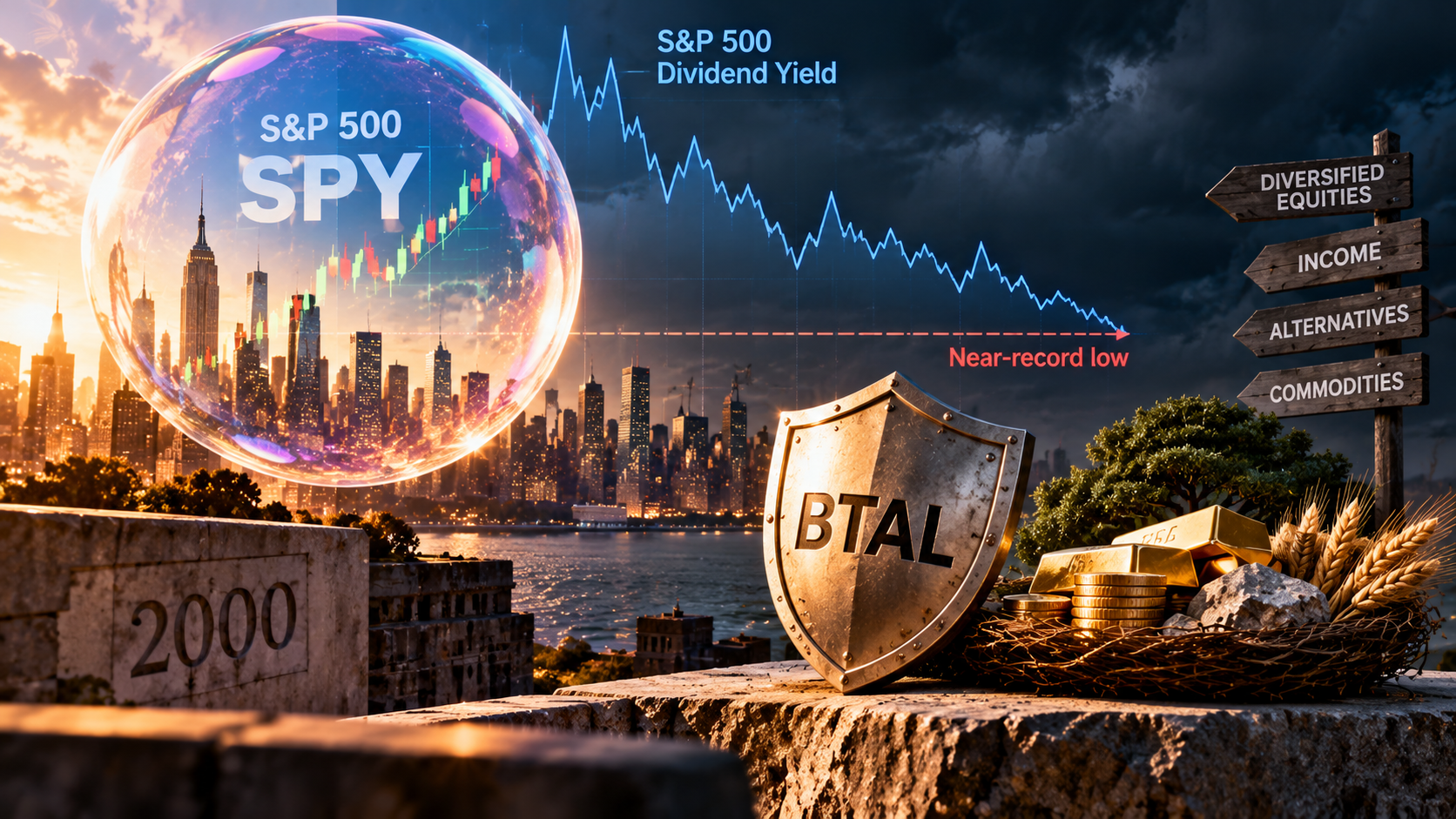
Barron's looked at the close to all-time low yield of the S&P 500 at just over 1%. The last time it was that low was September 2000. This sort of valuation measure matters for understanding the landscape but isn't very helpful for timing. When the next bear market starts, chances are the dividend yield for the index will be similarly low to what it is now and will be a great hindsight tool for people who will say they correctly called the bear market.
In reality, maybe the next bear market already started, or maybe it won't start for months or even several years. I obviously have no idea which is why I try to position a little bit of the portfolio to have some anti-fragile traits even while stocks are going up. BTAL tends to benefit from stock market disorder (using disorder as a synonym for panic-inducing decline), and there are some others, of course.
If the question is whether an all-time low in SPX dividend yield means a bear market is coming, but there's no way to know beyond a guess when it will start, our answer here drifts to having exposures to things that can benefit, as I just mentioned, as well as things that just go about their business no matter what is going on. I think catastrophe bonds are one example of that category, various forms of arbitrage, and long/short too.
It's a mistake, though, to completely bail out of equities. If you just dial it down and that turns out to be a tactical mistake, you still get some equity growth as opposed to none. To Barron's point, I do think yield or "yield," as the case may be, is important. If an equity sleeve, whether a percentage close to normal or not, can provide growth, peeling out an income stream that is independent of the growth can help offset equity declines and volatility.
Of course, that last sentence is the argument for owning bonds in the traditional sense, but as we talk about ad nauseam, traditional bonds don't reliably get it done anymore.
Part of the solution could be a small slice of a levered equity fund, which is an idea we play around with sometimes, but those funds have their obstacles and risks. We just looked at the Calamos Autocallable Growth ETFs (CAGE). The issue there is the need to constantly change how much leverage there is to maintain the volatility target. Something like ProShares 2X S&P 500 (SSO) can track twice the S&P 500... except when it doesn't....but also if the S&P 500 500 drops 40%, causing about an 80% drop in SSO, it could have a path problem digging out of the 80% hole depending on the nature of the recovery. We also recently looked at WTLS from WisdomTree, which is 90% simple beta and 90% equity long/short. It's been a while since we checked in on the Miller Value Partners Leveraged ETF (MVPL), but that could be a way to capture this effect; it toggles between simple S&P 500 exposure and 2X exposure based on technical indicators. It will be in the 2X fund most of the time because the equity market goes up most of the time.

Since inception, MVPL has compounded at 28.15% versus 29.94% for SSO and 18.85% for SPY. A lot of the gap to SSO is the fee, but you can see from the drawdown chart that it probably had unlevered exposure for at least some of the Tariff Panic. I think there will eventually be a way to leverage up with fewer structural risks than the current crop of funds, but we'll see.
We've had better luck sorting through the fixed income substitute and alternative spaces. A new fund for us from the RCM report I referenced yesterday is the Victory Pioneer Multi Asset Income Fund (PMFYX). It really is multi-asset.
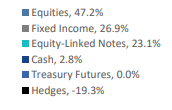
It says equities, but really it's dividend equities. "Equity-linked notes" is interesting; that's pretty close to being an autocallable sleeve. It may be structured notes, which are very similar; an easy way to think of it is that autocallable funds give daily liquidity to the structured note world.
It's not all sunshine and roses for PMFYX, but you can see the yield has been pretty high in most years. Gemini said it is mostly economic yield as opposed to capital gains, and Yahoo Finance seems to corroborate that.
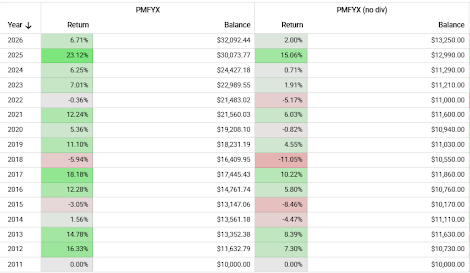
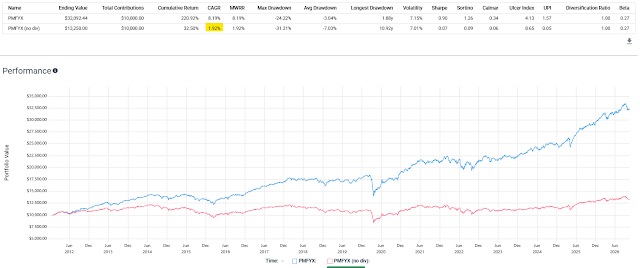
There's not much CAGR left over after taking the distributions out, which is why I don't think you should bail on equities. Let that give the portfolio growth when it can; PMFYX isn't going to do that.
So putting this together without the leverage component;
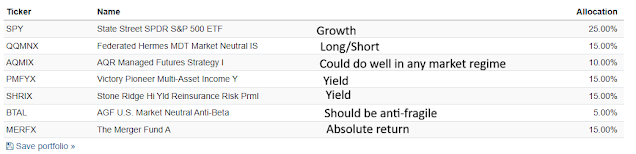
The following starts with $800,000 and takes out $12,500 per quarter, which is obviously quite high.
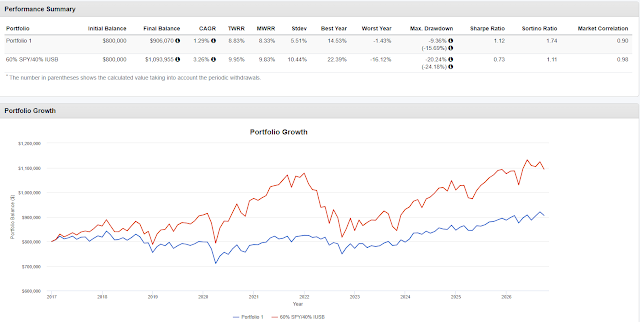
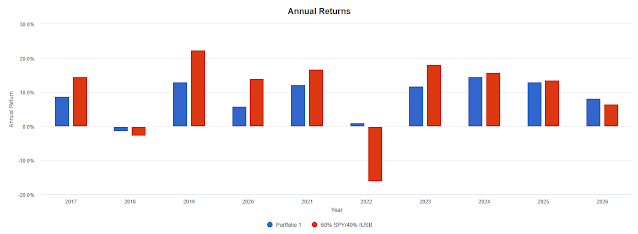
The return of Portfolio 1 absolutely lagged behind 60/40, but the ride was much smoother, and part of this project is to address whether the record low in equity dividend yields is a harbinger of a bear market. Portfolio 1's total return was pretty close to 60/40 despite having less than half the equity exposure; Portfolio 1's beta was 0.31. If a bear market does start and equities get killed, Portfolio 1 has a decent shot of going down less.
This is a very differentiated portfolio, and as we've looked at countless times with countless versions of this same idea, actually living with differentiation can be very difficult.



Comments
Log in or sign up to join the conversation.