

A year ago, nobody cared about silver. That’s exactly why it worked. Today, everyone is watching it and that’s exactly why it feels harder.
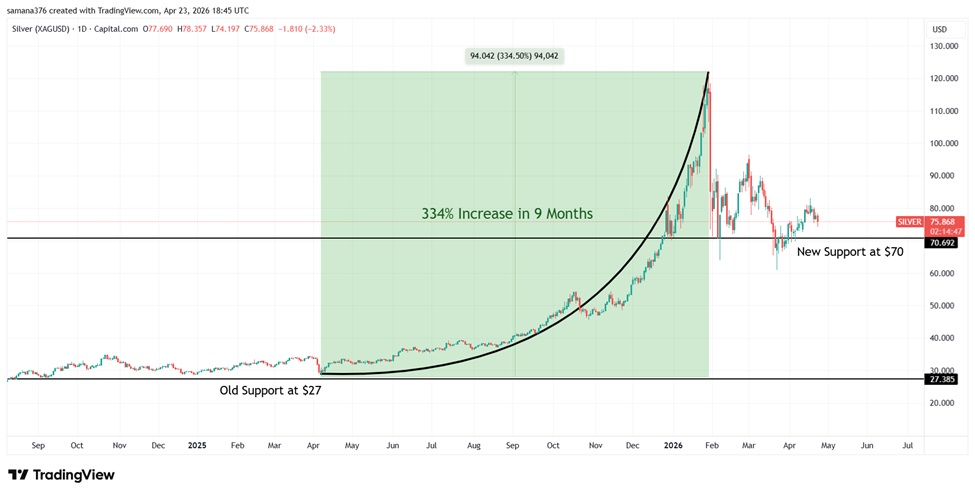
Silver didn’t give many second chances last year. It moved from $28 to $121 in nine months, and most investors fell into one of three categories: too early, too late, or not in at all. Now it’s back near critical support, sitting in that uncomfortable middle where conviction is low and opinions are split. That’s usually where the next big move starts or where people get it completely wrong again.
If you held silver through last year’s run, this article matters. If you missed it and are wondering whether the opportunity is gone, this matters even more.
What Powered the Original Silver Surge in 2025?
To understand where silver could go next, you have to look at how it reached $121 in the first place. Because it wasn’t one single factor. It was multiple forces hitting at the same time.
1- Extreme Gold Silver Ratio
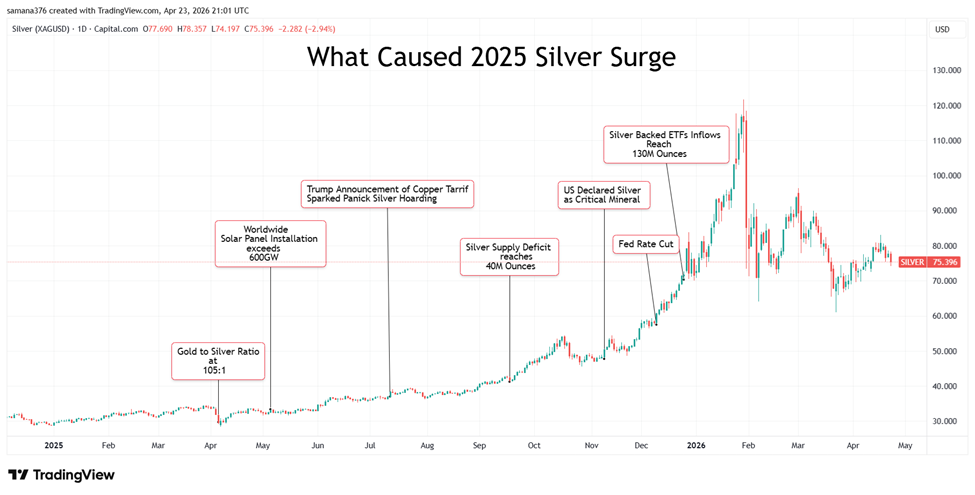
It started with something most investors had stopped paying attention to the gold-to-silver ratio. In April 2025, it reached 103-to-1. That’s an extreme level by any historical standard. At that point, silver wasn’t just cheap. It was deeply undervalued compared to gold. That imbalance caught the attention of macro funds and momentum traders, and buying started to build.
But valuation alone doesn’t create a 334% rally. What made this move different was timing. Everything lined up together.
2- 5 Year Straight Supply Deficit
Silver had already been running a supply deficit for five straight years. It means, more silver was being consumed globally than mined. At the same time, demand was accelerating.
3- Solar Consumption
Solar panels alone consumed 243.7 million ounces in 2024. Electric vehicles added steady demand, using 25 to 50 grams per unit. Meanwhile, AI data centers and semiconductors were pulling in more silver as well. This wasn’t speculative demand. These were real industrial use cases expanding at scale.
4- US Policy Shift
Then came a key policy shift. The US government officially declared silver a critical mineral. That move changed how institutions looked at the metal. It signaled that silver wasn’t just another commodity, rather, it was part of a strategic supply chain. That tends to attract long-term capital, not just short-term trades.
5- Silver ETF Craze
The financial side amplified everything. Silver-backed ETFs absorbed 130 million ounces throughout 2025. At the same time, tariff concerns around Trump’s trade agenda triggered physical hoarding. Companies started stockpiling silver in US vaults. That drained liquidity from the London spot market and pushed borrowing costs higher.
6- Fed Rate Cuts
By the time the Federal Reserve stepped in with rate cuts in December 2025, the setup was already tight. Lower rates made silver more attractive because it doesn’t offer yield. On the day of that cut, silver touched $70. Within weeks, it accelerated to $93 by January 14, and then $121.64 by January 29.
Nine months. A full re-rating of the metal.
Where Silver Stands Right Now
After a move like that, a correction was always expected. Silver pulled back and found support around $65. Since March, the $70 level has been tested multiple times, and held.
But what’s happening now isn’t as simple as “the rally is over” or “this is just a dip.”
This week Silver is down but over the previous four weeks, silver actually climbed 17.81%. That recovery wasn’t random. It was driven by specific events.
· On April 8th, Trump announced a surprise Iran ceasefire. Oil dropped 14% in a single day. The dollar weakened. Silver responded immediately, jumping 5.7% to $77. The reason is straightforward, lower oil reduces inflation pressure, which makes rate cuts more likely. That’s supportive for silver.
· Between April 13 and 16, the dollar continued to weaken as courts rolled back parts of Trump’s tariff policy. The US also opened a $166 billion refund portal for importers, signaling that trade tensions were easing. Silver pushed toward $80 during that window.
Then the momentum shifted.
· On April 20th, the US Navy seized Iranian-flagged vessels in the Gulf of Oman. That raised concerns about the stability of the ceasefire. Silver slipped 1.36%. The next day, Fed chair nominee Kevin Warsh signaled a preference for a smaller balance sheet during his Senate hearing. That came across as hawkish. Silver dropped another 3.81% to $75.
· By April 22nd, the US-Iran ceasefire was extended again, and silver bounced 1.34% back to $78.
If you step back, a pattern becomes clear. Silver right now is reacting most strongly to two things, oil-related geopolitics and Federal Reserve expectations. Everything else is secondary in the short term.
2025 vs 2026: What Has Changed and What Hasn’t
A lot of the current narrative focuses on what silver no longer has then it had previous year. The Fed isn’t cutting rates aggressively this year. The valuation gap isn’t extreme anymore. And this means that the easy part of the rally is behind us.
However, the physical and structural foundation of silver hasn’t weakened. In fact, in several areas, it has become tighter.
This is where investors need to separate the story from the trade. The macro picture has become more uncertain. But the underlying supply-demand dynamics are still strong.
Factor | April 2025 | April 2026 | Verdict |
Supply Deficit | 40.3 Moz (5th year) | 46.3 Moz (6th year) | Stronger |
COMEX Liquidity | Building stress | 13.4% Coverage | Stronger |
Solar/EV Demand | 180 Moz (Solar) | 600 GW Projected | Stronger |
Gold-Silver Ratio | 103:1 (Extreme) | ~62:1 (Average) | Weaker |
US Iran Geopolitics | Not a factor | Active war/ceasefire | New Risk/Reward |
Warsh as Fed Chair | Not a factor | Hawkish nominee, | New Risk |
Dollar Weakness | Beginning to weaken | Broad weakness | Similar |
Fed Rate Cycle | Actively Cutting | Frozen with no cuts expected | Weaker |
What Factors Still Supports Silver?
Some factors from previous year are still in play like:
1- 6 Year Supply Deficit
Silver is now heading into its sixth consecutive year of deficit. In 2026, the shortfall is expected to reach 46.3 million ounces. That means, once again, the world will consume more silver than it produces.
And this isn’t something that can be fixed quickly.
Around 75% of global silver supply comes as a by-product of mining other metals like copper, zinc, and lead. So even if silver prices rise, production doesn’t automatically increase. Mining companies are making decisions based on those primary metals, not silver.
On top of that, new dedicated silver mining projects take 10 to 15 years to come online. So the supply constraint is not short-term. It’s structural.
2- Strong Industrial Demand
Solar installations are expected to exceed 600 GW again in 2026, growing another 15–20%. Each gigawatt requires about 20 tonnes of silver. Electric vehicles continue to add steady demand. These are not projections based on optimism. These are already built into global supply chains.
3- COMEX Inventory
Current inventory sits around 80 million ounces, while open interest is near 570.9 million ounces. That means only about 13.9% of paper claims are backed by physical silver. For investors, this is a key structural risk. If delivery demand rises, the system doesn’t have enough physical metal to meet it.
4- China Stockpiles
More than 100 million ounces have moved into ETFs due to tariff concerns and export restrictions. Total silver holdings now sit near 844 million ounces, up 18% year-over-year. That’s silver being locked away, not circulating.
5- Shanghai Price Premium
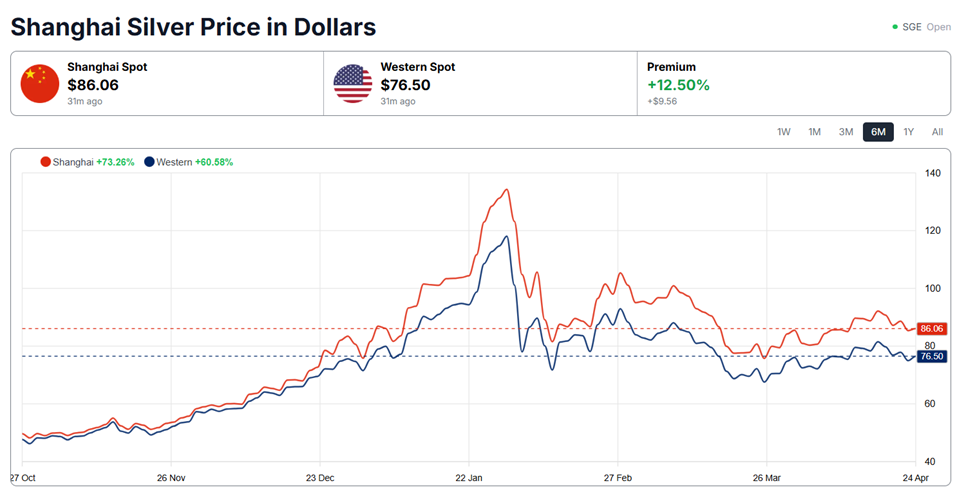
At the same time, prices on the Shanghai Futures Exchange are trading at a 12–13% premium to global benchmarks. That’s a direct signal that physical silver is tight on the ground.
What is Holding Silver Back - The Risks
The bullish case is strong, but it’s not the full picture.
1- Fed’s Changed Stance
The biggest difference compared to last year is the Federal Reserve.
In 2025, the Fed was cutting rates. Right now, rates are sitting between 3.50% and 3.75%, and markets are not expecting cuts anytime soon. The March 19 FOMC meeting made that clear and silver dropped after that massively.
That reaction tells you everything about how rate-sensitive silver is.
2- Kevin Warsh
Kevin Warsh adds another layer of uncertainty. His early signals lean hawkish. If he continues in that direction once he becomes Fed chair, the rate-cut tailwind may not return in time to support another major rally.
3- Gold Silver Ratio is not extreme anymore
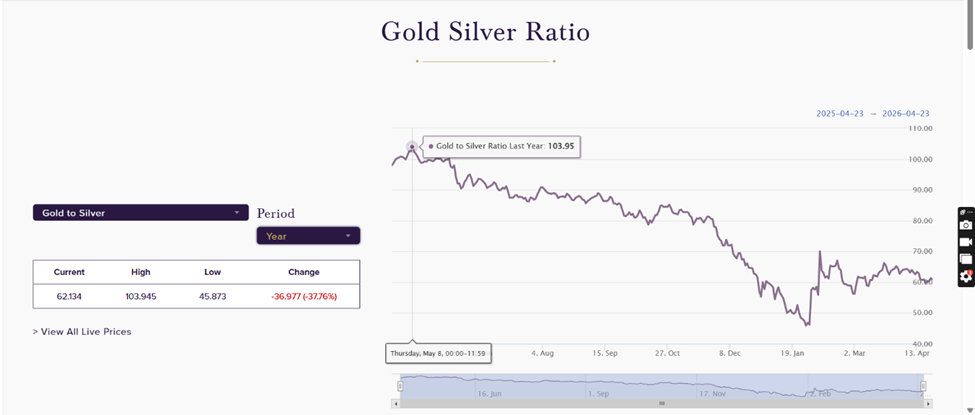
The gold-to-silver ratio is also no longer extreme. It has dropped from 103-to-1 to around 62-to-1. That’s still above the long-term average of 40–60, but the deep undervaluation that drove capital into silver last year is mostly gone.
4- US-Iran War
Geopolitics is another wildcard. If the Iran ceasefire breaks down, oil could move back above $100. That would push inflation higher, drive bond yields toward the 4.3–4.4% range, strengthen the dollar, and create sustained pressure on silver.
This chain reaction doesn’t take long to play out.
Can Silver Repeat Its 2025 Move?
An interesting thing to notice in XAGUSD charts is that previous rally started in April 2025. And now, once again, it is April 2026. Also, the price is moving a slight above the new support of $70 just like it was moving back in 2025 above old support of $27.
If we assume a similar chart pattern to last year, silver could theoretically reach $160 by January 2027. However, such repetition is highly unlikely. Because, markets rarely move in the exact same way twice.
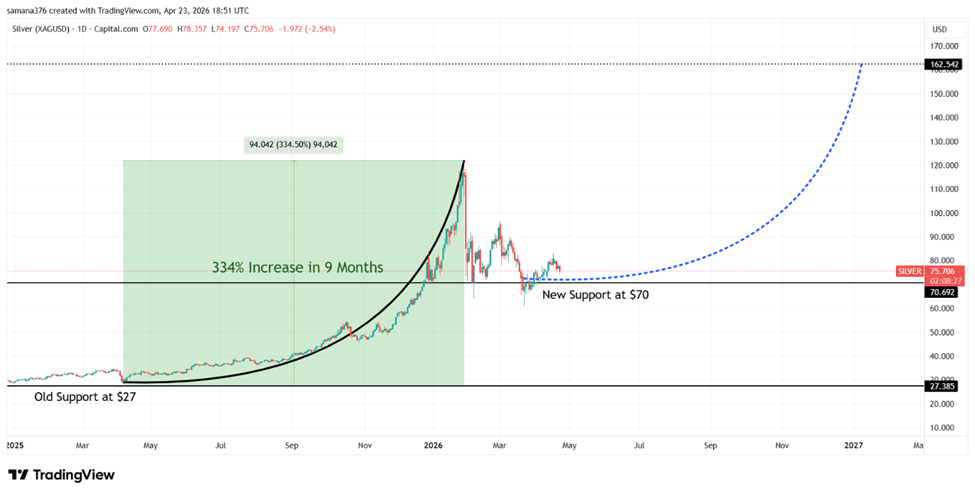
Now if we compare the price surge only, then a straight repeat of 334% this year from $74.90 would take silver above $330. Honestly, that’s not realistic either. It would push silver into an extreme valuation relative to gold.
However a move back toward and possibly beyond the $121 high? That’s still within reach.
Institutional targets also support that view. Citigroup is targeting $110 for the second half of 2026. Deutsche Bank sees $100 as achievable. Bank of America’s bull case goes as high as $309 if physical shortages become severe.
For that upside to play out, two things need to align.
· First, the Iran ceasefire needs to hold long enough to keep oil under control. That reduces inflation pressure and opens the door for rate cuts.
· Second, the Fed needs to shift, either through softer language from Warsh or an actual policy change.
If both happen, the macro headwinds fade. At that point, the structural story like supply deficits, tight inventories, strong industrial demand, takes over.
On the other hand, the downside scenario is simpler.
If the ceasefire collapses, oil spikes, Warsh stays hawkish, and bond yields rise, silver could break below $70 and revisit the $60–65 range.
The most likely outcome sits between these extremes. A gradual move within the $75–95 range through mid-2026, with the next major trend depending on Fed signals.
What Investors Should Focus on Right Now
If you’re watching silver closely, two variables matter more than anything else.
1. Oil prices. Oil is the link between geopolitics and inflation. When oil drops, inflation pressure eases, and silver benefits. When oil spikes, the opposite happens.
2. Federal Reserve direction. With Powell expected to exit in May 2026, whatever comes next will shape silver’s path quickly. We’ve already seen how fast the metal reacts to policy signals.
3. There’s also one key technical level $70.
This level has held multiple times since February. As long as it holds, the broader structure remains intact. If it breaks with strong volume, the setup changes, and it’s worth reassessing positions rather than averaging down.
For a simple framework: if oil stays contained, $70 holds, and the Fed remains even slightly open to cuts, the structure supports staying in or building a position. If two of those three fail, risk increases quickly.
Summing Up
The drivers behind last year’s rally haven’t disappeared. In many cases, they’ve become stronger.
What has changed is the starting point. Silver is no longer coming from $28. The valuation gap has narrowed. The Fed is no longer easing. And new risks have entered the picture.
That doesn’t end the story. It just makes it more complex.
For investors, that means one thing, this is no longer a simple momentum trade. It’s a market that requires attention to both fundamentals and macro signals.
The structure is still there. The physical market is tight. And when clarity comes on the macro side, silver won’t wait.
The real question is simple. Are you positioned before the move or reacting after it?

Comments
Log in or sign up to join the conversation.