

Currently, gold is trading at $4,507 per ounce, 20% below the all-time high of $5,595 it hit just four months ago. A war is live in the Middle East. US-Iran ceasefire talks have stalled again. And the metal the entire world was trained to reach for in exactly this kind of moment simply isn't performing. If you're still running the "crisis = buy gold" playbook, the price chart is telling you something you need to hear.
So before jumping to conclusions, it’s important to understand what the price is actually reflecting right now.
What the Price Is Actually Telling You Right Now
On January 29, gold peaked at $5,595, a breathless run fuelled by speculative capital piling in alongside institutional buyers. Then on February 28, US and Israeli forces struck Iran. By any traditional measure, that was gold's moment. Instead, gold fell 14.5% through March, worse than the FTSE All-World (–9%), worse than the S&P 500 (–7.8%), worse than Treasuries (–3.6%). The supposed protector was the worst performer in the room.
And importantly, this divergence is where the real story begins.
Today, with ceasefire talks broken down again, gold remains pinned below $4,510. The structural trap was already explained in my previous analysis, which states that the elevated inflation expectations from surging oil have pushed yields higher, kept the USD firm, and prompted markets to price in a Fed hike in late 2026.
A non-yielding asset in a rising-rate environment doesn't catch bids, even during a war. That's not bad luck. That's a design flaw in how most investors use gold as a hedge.
In other words, the macro environment is no longer working in gold’s favour the way many still assume it does.
"Traders are still anchored to an outdated playbook. The COVID crisis drove markets for five years until 2025. Now, in 2026, the rest of the decade will be shaped by Energy. Those who fail to recognise that shift will be dangerously late."
— LARS HANSEN, HEAD OF RESEARCH, THE GOLD & SILVER CLUB (VIA FXSTREET, MARCH 2026)
Three Assets Are Stepping Into Gold's Role
Building on that shift, gold's failure isn't happening in isolation. While it fell, three assets were busy doing what gold was supposed to do — and investors paying attention rotated accordingly.
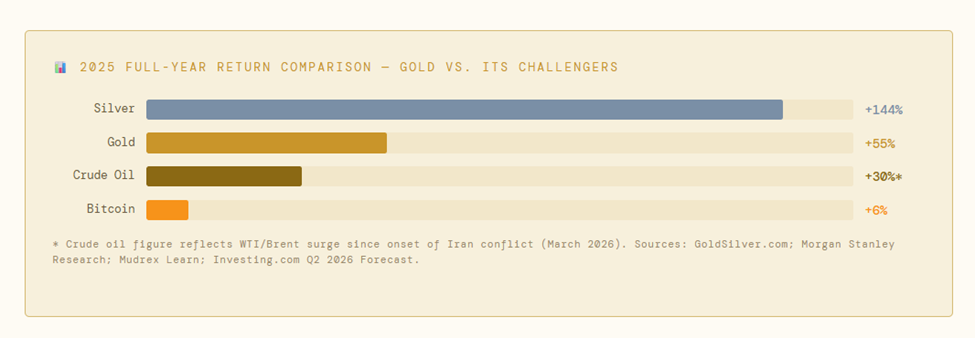
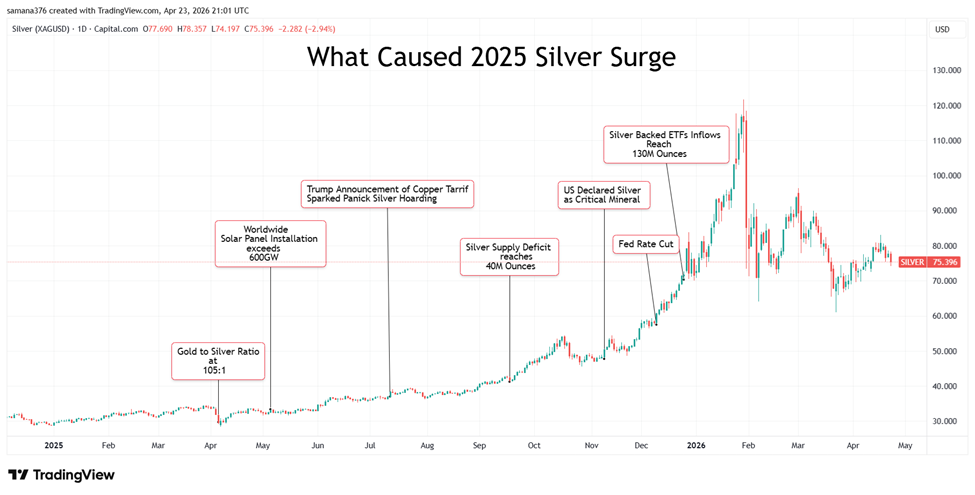
Taking this further, Silver is the most interesting play in the precious metal space. This 144% increase compared to gold's 55% gain has something that gold simply cannot match—double demand from monetary buyers and industrial end-users. EVs use 67–79% more silver per unit than combustion cars. Solar, AI data centres, 5G infrastructure — none of these slow down because markets get nervous. As the gold/silver ratio approaches the long run average of 60:1, the silver opportunity, while not the screaming buy it was at 104:1, is still significantly better than the opportunity that gold provides, which is dependent on fear.
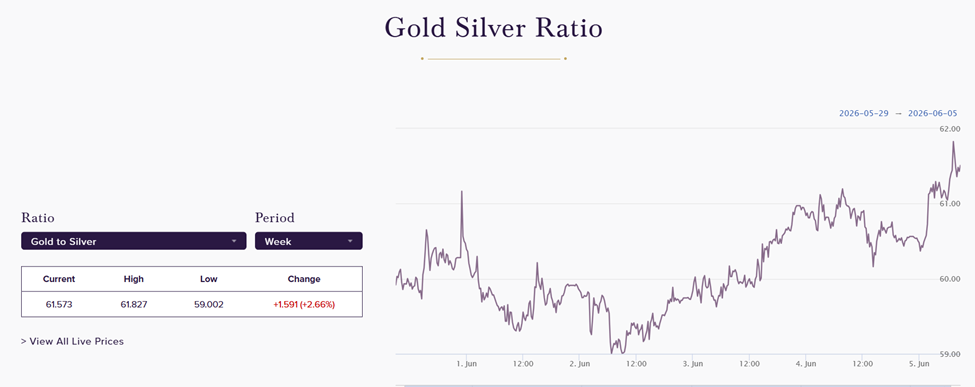
Image Source: https://www.chards.co.uk/gold-silver-ratio
This is where the divergence between fear-driven assets and utility-driven assets becomes clearer.
Crude oil did something revealing during the Iran conflict: it thrived on the same shock that crushed gold. Energy security retook the top spot as a geopolitical risk frame, and both WTI and Brent rose around 30% to $116 a barrel. Today, in a world where the Strait of Hormuz can be weaponized and investment upstream is structurally reduced, oil is starting to act as a store of geopolitical value, which it never was. For investors in areas where energy price fluctuations exist, not taking advantage of this rotation is a true portfolio risk.
So in contrast to gold, energy is now absorbing the very risk premium gold once dominated.
Bitcoin isn't taking the place of gold, it's competing with it for the same capital. According to JPMorgan, IBIT's inflows since 2024 are around twice as large as GLD's. When gold ETFs saw a $3 billion single-day outflow in March, the largest in two years, Bitcoin ETF inflows turned positive the same week. Fidelity Digital Assets explicitly pointed to this in their 2026 outlook, stating that the recent surge in gold is actually a “late phase of its leadership cycle” and that Bitcoin could be “ready to take the baton” from it. That's not fringe crypto commentary. That's a big institutional allocator indicating rotation.
And that rotation is already visible in the flows, not just narratives.
The Preference Shift Is Already Happening — Are You Positioned for It?
The flows agree with the price action. Gold ETFs attracted a record $19 billion in January 2026, which was due to institutional investors, not retail investors. Despite that record-breaking beginning, the March battle wrought havoc on leveraged positions, and YTD ETF holdings slipped below January 1 levels. Old school speculators, who used to follow the trends of SPACs and meme stocks, now went back to gold, and that sounds bullish until you understand that their main role is to add volatility rather than support. Retail investors are often last to see the flush when institutional and speculative layers unwind simultaneously.
And as a result, positioning has become more fragile than it appears on the surface.
The more significant change is in the conceptual domain. The tried-and-tested advice of "buy gold when things go wrong" is being replaced with more accurate terminology. In the words of a recent analysis: “Gold is the solution to slow-blow, systemic risks—dollar debasement, sovereign debt trends, financial system distress.” Oil absorbs supply-chain ruptures. When policy loosens and inflation expectations rise, bitcoin gathers capital. Silver not only reflects monetary demand, but also industrial demand. Anyone who invests without determining what type of risk they are hedging and in what asset to hedge it is not diversified. They don't have enough time.
So the framework itself is shifting from a single-asset hedge to a multi-asset risk map.
Why the Counterargument — And Why It Doesn't Change Your Positioning
The bull case for gold deserves a hearing: central banks are still buying, the de-dollarisation thesis is intact, and both Morgan Stanley ($5,200) and J.P. Morgan ($6,300) have bullish year-end targets. That is all correct. But central banks are multi-decade strategic buyers — they're not managing your retirement account. The People's Bank of China added 160,000 troy ounces in March, gold's worst month in years. Sovereigns used the dip. This is a different investing strategy from an active trader who owns gold as a geopolitical hedge.
So while the narrative remains intact, the participant mix matters more than the headline targets.
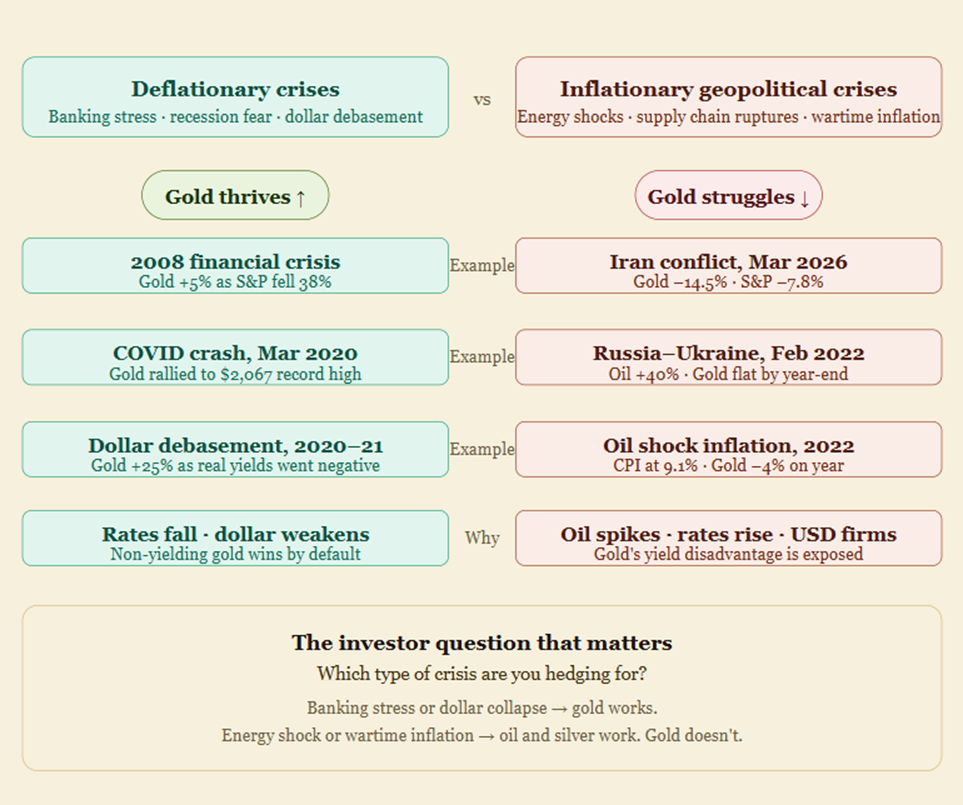
The pattern that has been repeated is: gold does well during the banking stress/recession fear/dollar debasement periods of deflation. And, it struggles in inflationary geopolitical crises, energy shocks, supply chain ruptures, wartime inflation, precisely the environment we're navigating right now.
Therefore, knowing what kind of crisis you're hedging isn't a classroom exercise, it is what will make or break your hedge when you need it.
And this distinction is what separates accurate hedging from misplaced protection.
Gold Is Still Relevant. But It's Not Enough Anymore.
Gold has not lost its identity as a safe haven, but it has lost its claim to being the only safe haven. The Iran conflict was a live stress-test, and the hedge failed in exactly the scenario investors feared most. That changes how you should size and complement it.
Put simply, diversification of hedges now matters more than conviction in a single one.
If you're an all-gold portfolio and you don't have anything else as your defensive layer, you have a blind spot to the inflationary geopolitical shock. Include energy exposure (equities, energy ETFs or futures) to address the possibility of supply chain failures and a rise in energy prices. That is not a guess. It's the scenario that just played out.
If you are silver and underweight, then it is the most obvious area you need to fill. Silver has a bull case as well, thanks to the industrial demand floor brought by EVs, solar, and AI infrastructure, which is something that doesn't rely solely on fear that isn't found in gold.
On Bitcoin: institutional adoption through ETFs is structural, not cyclical. It doesn't have to be a "safe haven" to qualify as an institutionalizing asset that is becoming a non-sovereign store of value. Watch the inflow data, not the price narrative.
The question was never whether to own gold. It's whether gold alone is still an adequate answer. With the evidence in hand in 2026, it clearly isn’t.


Comments
Log in or sign up to join the conversation.