

Bespoke had a short blog post about rebalancing plain vanilla 60/40 portfolios. It noted that with no rebalancing, a portfolio implemented at 60/40 right after the financial crisis would now be 92/8, which represents massive outperformance by equities. Yes, equities will outperform the vast majority of the time and probably by a lot, but I think they were saying the result that took 60/40 to 92/8 was especially strong for equities.
Always remember that nothing lasts forever, though. There’s an old saying that the market exists to cause the most amount of pain for the most number of investors, and if that’s the case, the over-exposure to stocks is bound to cause a lot of pain when the trend of the last 17+ years comes to an end.
They closed out the post with a warning about mean reversion.
Testfol.io says that for the last 17 years, the S&P 500 as represented by the SPY ETF has compounded at 14.83% compared to 10.87% for SPY's entire 33-year history. So yeah, equities have been on a heater. They might mean revert, or not; there's no way to know. We've devoted some time lately to gameplanning if there is some sort of mean reversion, but we've talked in terms of a lost decade for equities, but it's the same idea.
I don't want to try to guess what or when, just be ready if.
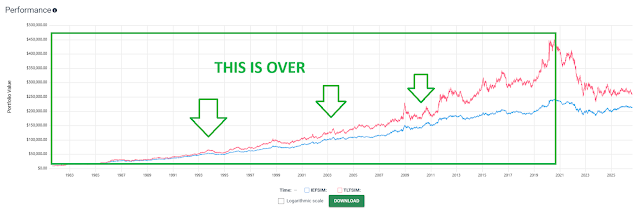
It's not clear that Bespoke is saying to rebalance into bonds, but I think Morningstar is saying that here. It's a remarkably shortsighted piece from Morningstar. The basic argument is that bonds can help you lose less. Ok, maybe there's something to that, and maybe that's good enough, but they cite a lot of backward-looking data that includes decades of unrepeatable bond market performance. It literally cannot be repeated, which incorrectly skews their premise. There might be a way to make their point with data that's actually useful, or not I don't know but wow, it misses badly.
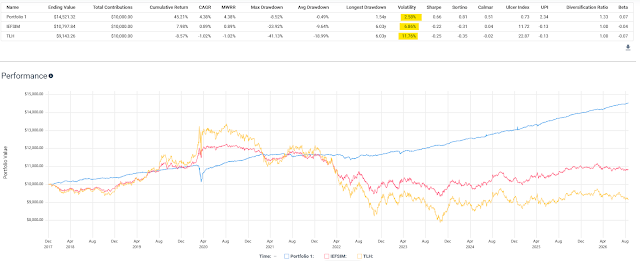
I've posted essentially that same chart many times and asked, what do you want your equity offset, bonds in Morningstar's context, to look like? There are countless alts and combinations of alts to get a result that is similar to the blue line in the above chart.
One question we've been trying to answer is whether a small allocation to autocallable funds should be part of the solution for offsetting equity volatility, adding yield, or both.

Those are what I believe are the three oldest funds in the space. I highlighted the volatility numbers. SBAR and XV are pretty close to TLT by that measure but with much more yield. Yes, the total return numbers stand out too, but if equities revert to some mean, then I would expect that column to be less impressive. If the equity market doesn't implode, then the autocallable funds will still pay out, but keeping up with their distributions might be more difficult.
As more of these hit the market, we can learn a little more about them. Based on the following, on a day when the S&P 500 was down 69 basis points, there was plenty of downside sensitivity.
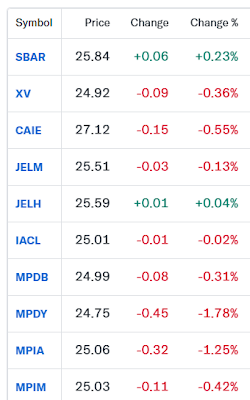
IACL just started trading today, and the last four listed started trading last week. I have no idea yet whether I will ever use an autocallable fund, but I think it is a mistake for advisors to not make some effort to try to understand them.
If you are considering them, I would suggest a small allocation, using different fund providers and making sure you're not duplicating the counterparty banks.

Comments
Log in or sign up to join the conversation.