

Stock markets in India trimmed some of their morning losses and are now trading slightly lower amid weak global cues and as Rupee hit its record low against the dollar. Losses are largely seen in bank stocks and PSU stocks.
The BSE Sensex is trading down by 140 points and the NSE Nifty is trading down by 40 points. Meanwhile, the BSE Mid Cap index is trading down by 0.2% while, the BSE Small Cap index is trading down by 0.4%.
In news from the engineering sector. As per an article in a leading financial daily, Larsen & Toubro's (L&T) construction arm, L&T Construction's Buildings & Factories Business has bagged an Engineering, Procurement and Construction (EPC) order worth Rs 30.3 billion from GMR Hyderabad International Airport (GHIAL).
The scope of work includes execution and implementation of EPC for expansion of the Terminal Building and Airside Infrastructure Works at the Rajiv Gandhi International Airport, Hyderabad in the state of Telangana.
The expansion will increase the airport's capacity to handle 34 million passengers per annum (MPPA). L&T had earlier constructed the existing Hyderabad International Airport.
Notably, diversification continues to help L&T negotiate and get better terms and margins for projects. Apparently, this is because it is less desperate to win orders as compared to a company which are present in only a couple of sectors. Its reputation, extensive technical prowess, and large skilled workforce have enabled L&T to command a certain premium from customers and vendors alike.
To know more about the company, you can access to L&T's latest result analysis and L&T's 2017-18 Annual Report Analysis on our website. Whether, a further addition to these new projects provides a cushion to its profitability will be an interesting thing to watch out for going forward.
At the time of writing, L&T share price was trading up by 0.4%.
In the news from the economy. The Indian rupee weakened to a record low against US dollar today, tracking broader weakness in other emerging market currencies, due to concerns of a spill-over from a crisis-hit Turkey.
Investors preferred safe-havens such as the US dollar and the yen after a plunge in the Turkish lira sent all emerging market currencies sharply lower. The lira has fallen about 45% against the greenback this year on worries over Turkish President Tayyip Erdogan's increasing control of the economy and a deepening diplomatic rift with the United States.
The rupee tumbled further on buying of the American currency by banks and importers. Meanwhile, traders are also cautious ahead of Consumer Price Index-based (CPI) inflation data for June due later today.
The partially convertible currency is currently trading at 69.45, weaker by 62 paise from its previous close of 68.83 on Friday. The currency touched a high and low of 69.6200 and 68.4175 respectively.
The reference rate for the dollar stood at 68.95 and for Euro stood at 78.99 on 10 August 2018. While the RBI's reference rate for the Yen stood at 62.15, the reference rate for the Great Britain Pound (GBP) stood at 88.19. The reference rates are based on 12-noon rates of a few select banks in Mumbai.
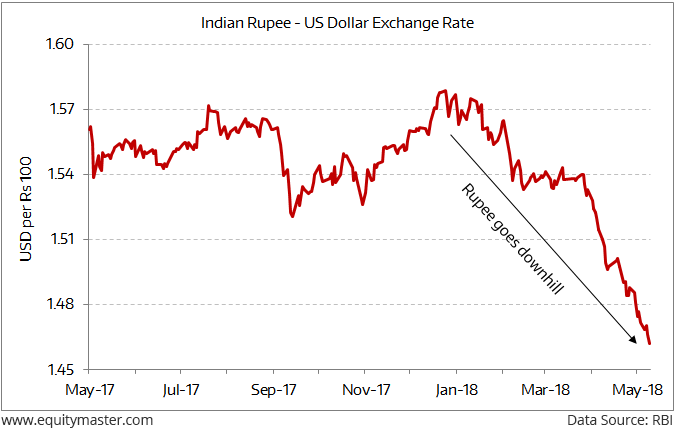
Note that the rupee has been witnessing selling pressure against the US dollar since the start of this calendar year. This is evident from the chart below, which shows the quantum of US dollars a 100-rupee note can buy and how this rate has been declining over the past few months:
Indian Rupee in a Steep Decline
What does the fall in rupee mean for the Indian economy?
A depreciation in rupee means importers buying goods and services at a higher rate than earlier. This doesn't bode well for a developing economy that relies heavily on imports.
Also, India imports most of its oil requirements. So, a fall in rupee leads to a consequent rise in the import bill. The depreciation of the rupee will also add to crude oil's rising cost.
On the corporate side, companies who have taken foreign loans from abroad will be impacted. The repayment obligations in terms of principal and interest will rise, leading to a dent in the cash flows and financials.
Further, companies who import a majority of their raw material requirements will get impacted provided they have not hedged their foreign currency exposure.
Looking at the brighter side, rupee depreciation brings a cheer on the exports front.
A depreciating rupee will provide a much-needed cushion to falling exports. However, a falling rupee will not be the only factor to boost exports. There are certain structural issues too which the government needs to address.

Comments
Log in or sign up to join the conversation.