

After opening the day in green, share markets in India are trading on a volatile note and are presently trading above the dotted line. Sectoral indices are trading on a mixed note, with stocks in the IT sector and stocks in the pharma sector witnessing maximum buying interest.
The BSE Sensex is trading up by 70 points (up 0.2%) and the NSE Nifty is trading up by 6 points (up 0.1%). Meanwhile, the BSE Mid Cap index is trading down by 0.8%, while the BSE Small Cap index is trading down by 1.8%. The rupee is trading at 72.56 to the US$.
In news from the IPO space. State-owned railways engineering and construction firm Ircon International made a tepid debut on the bourses today and opened the day down 11.2% from its issue price.
The Rs 4.7-billion initial public offer was subscribed 9.9 times during 17-19 September 2018. The issue price was fixed at higher end of price band of Rs 470-475 per share.
After RITES, this was the second stock market listing by a PSU in 2018-19. As a part of its disinvestment plans, the government sold around 10% stake in Ircon to raise around Rs 4.7 billion.
What if one had invested in all the IPOs? How have the IPOs performed in the previous year? And, have they outperformed the indices?
According to an article in Business Standard, an investor who bet on the 33 IPOs of 2017 (on a weighted average basis) has seen the value of investment rise by 17%. However, compared to broad market indices, the underperformance is a bitter disappointment.
Below chart clearly shows the underperformance of IPOs.
IPOs Underperform Broad Market Indices
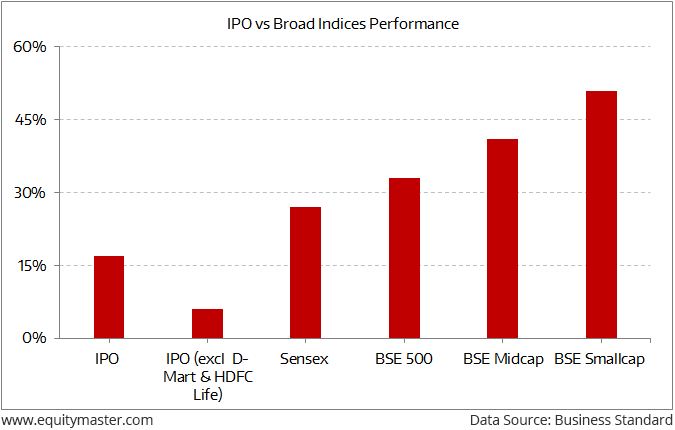
Interestingly, if you take the Avenue Supermarts (D-mart) and HDFC Life out of the equation from the IPOs above, the gains drop to a meager 6%. Compared to this, the Sensex has gained 27%, while the small-cap index surged more than 50%.
What is the reason for this underperformance?
One of the key reasons IPOs have touched the altitude is due to a surge in the Indian equity market backed by liquidity and increasing investor demand for financial assets. Private equity investors and promoters took advantage of the absurd demand and came out with sky-rocket valuations. This is what we call a valuation bubble in the IPO market.
In our previous edition, we categorically stated:
- "With greed hypnotizing most folks, it is time for retail investors to exercise caution. While this does not mean that you should avoid IPOs lock, stock, and barrel; just ensure you do not end up paying higher valuations for a company that is yet to establish its worth".
During such times, it is imperative to be critically selective when investing in IPOs. Carefully analyze each company for its own merits and don't give in to the hype surrounding the public offering.
That's Ankit Shah's approach at Equitymaster Insider. He keeps an eagle-eye on the developments in the IPO space and updates his readers on the big-ticket IPOs.
Ankit and his team of researchers constantly reference this handbook on investing in IPOs. You can download a copy for yourself. It is free. Just click here.
Moving on to news from stocks in the power sector. Tata Power share price and HPCL share price are in focus today after the two companies entered into a Memorandum of Understanding (MoU) for setting up electric vehicle (EV) charging stations.
Tata Power and HPCL, through have agreed to collaborate in planning, development and operation of charging infrastructure for electric vehicles (e-cars, e-rickshaws, e-bikes, e-buses, etc), at suitable locations across India.
A major impediment to electric vehicles adoption is the range anxiety which needs to be addressed through establishment of nationwide charging infrastructure. A robust network of charging stations is very critical for market acceptability of EVs which will also ensure last mile connectivity.
Currently, electric vehicle sales are low in India, rising 37.5% to 22,000 units in the year ended 31 March 2016 from 16,000 in 2014-15. Only 2,000 of these were cars and other four-wheelers, according to automobile lobby group Society of Indian Automobile Manufacturers (Siam).
The government wants to see 6 million electric and hybrid vehicles on Indian roads by 2020 under the National Electric Mobility Mission Plan 2020.
The government is targeting to have all cars propelled by electric engine by 2030. The target is more daunting than in many advanced countries.
According to the industry, the 2030 target would require eight to ten times the global stock of such vehicles. India would need to sell more than 10 million electric cars in 2030, compared to 5,000 electric vehicles India had on the road in 2016.
As you can see from the chart above, India is barely visible compared to other developed countries when it comes to battery cars.
As an article in Business Standard suggests, such a big jump in scale for the auto industry in 13 years seems difficult. The basic infrastructure is missing. There are not enough charging stations. For this massive shift, the charging stations will need to be as ubiquitous as petrol pumps.
Another issue is the price of the lithium ion battery, which constitutes 30% to 40% of the cost of the car. For this plan to succeed, the price of the battery needs to come down.
The auto industry is already facing regulatory headwinds. The shift from BS-IV emission norms to BS-VI has been two years ahead of schedule without an intermediate stage. The government, if it is serious about such ambitious targets, should offer the necessary infrastructure support and do its bit for a smooth transition.



Comments
Log in or sign up to join the conversation.