

Indian share markets have recovered early morning losses and are presently trading marginally lower amid weak global cues.
Barring automobile sector and telecom sector, all sectoral indices are trading on a negative note with stocks in the metal sector and realty sector witnessing maximum selling pressure.
The BSE Sensex is trading down by 69 points while the NSE Nifty is trading down by 28 points. The BSE Mid Cap index is trading down by 0.3% and the BSE Small Cap index is trading down by 0.8%.
The rupee is trading at 69.40 against the US$.
The domestic currency opened lower by 20 paise at 69.25 against the US dollar. Yesterday, the rupee fell 27 paise to close at a near five-week low of 69.05 against the US dollar amid heavy selling in domestic equities.
Forex traders said market sentiment took a hit after the US announced additional 10% tariff on US$ 300 billion in Chinese goods.
Speaking of currencies, Vijay Bhambwani, editor of Weekly Cash Alerts, tells you the main reasons why not to trade commodities and currencies the same way you would trade equities. Here's an excerpt of what he wrote...
- Currencies are traded in pairs and the most liquid is the USDINR. Currencies are traded in four decimal points just as bonds are. The international derivative trader's association has indicated that forex may be traded in 6 decimals in the coming few years.
It takes months sometimes for the currency pair to pass the next round figure, say from 70 to 71.
Can you really trade commodities and currencies alike or for that matter, equities and currencies alike? Definitely not!
Market participants are tracking ITC share price, BEML share price, Exide Industries share price, and State Bank of India (SBI) share price as these companies are set to announce their June quarter (Q1FY20) results later today.
In news from the banking space, a foreign investor in the Indian property market, Ocean Deity Investment Holdings has alleged in a complaint to Reserve Bank of India (RBI) that Yes Bank and HDIL have moved funds to evergreen loans.
As per an article in The Economic Times, Ocean Deity is understood to have drawn RBI's attention to a series of fund transfers between March 2014 and March 2016 which showed that soon after Yes Bank disbursed a loan tranche to Mack Star, almost the entire amount was simultaneously transferred to accounts maintained by HDIL group companies with Yes Bank.
Here's an excerpt from the article:
- Ocean Deity told RBI that while Rs 1.4 billion was lent and transferred through such transactions between 2014 and 2016, there was a similar pattern of transaction, involving Rs 0.6 billion in multiple instalments, in 2011 and 2012.
There were cases where money moved to the loan escrow account maintained by Privilege Power & Infrastructure Pvt Ltd (an HDIL group company) with Yes Bank, and the current account of Sapphire Land Development with the same private lender.
Denying the allegations, Managing Director of HDIL, Sarang Wadhawan said the company or its subsidiaries are not aware of any entity named Ocean Deity Investments or its dealings with Mack Star.
Ocean Deity also pointed out to RBI that as per the Articles of Association of the JV, the company was barred from borrowing without the approval of the majority shareholder.
The offshore investor has alleged that the primary objective was ever-greening of loans to certain HDIL entities and it was orchestrated by the private lender.
Yes Bank share price is presently trading up by 2%.
Speaking of the banking sector, in one of the editions of The 5 Minute WrapUp Tanushree Banerjee shares an interesting observation she is witnessing in this space.
Here's what she wrote...
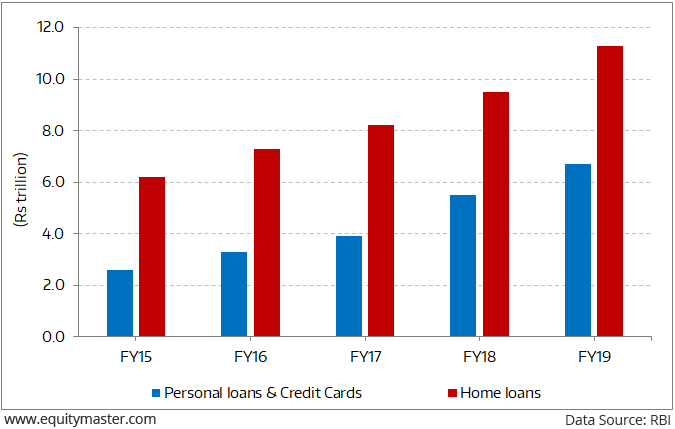
- After the IL&FS debacle, the NBFC sector is in a liquidity crisis. The housing finance regulator, National Housing Bank, has also restrained some entities from lending.
So, the quantum of funds as well as the cost of loans have both shot up.
Smaller public sector banks are struggling to keep themselves afloat.
The few good quality private sector banks are only lending to retail clients, most cautiously.
This is evident in the chart below:
Banks are Lending Only to the Aam Aadmi
No wonder funding to corporates for capex has come to a standstill.
Amid this it is difficult to expect Indian companies to increase their capacities. Thus, their earnings may not grow at a fast clip.
And sooner than later their valuations will also succumb to a reality check.
Moving on to news from the automobile sector, shares of Ashok Leyland hit an over 5-year low to trade at Rs 61 per share, slipping 12% intra-day, as analysts remained cautious on the company's medium-term outlook for the domestic medium and heavy commercial vehicle industry.
The company's net profit dropped 45% to Rs 2.3 billion in Q1FY20 from Rs 4.2 billion reported in the corresponding quarter of the last year.
Revenues declined by 9% to Rs 56.8 billion from Rs 62.6 billion year-on-year (YoY).
Meanwhile, the company's sales continued to slide in July 2019. The total sales fell by 28% YoY to 10,927 units in July 2019 over July 2018, whereas the total domestic sales fell by 29% to 10,101 units in July 2019 over the same month in the previous year.
Note that, automobile sales have fallen every month for almost a year now, except for October when the numbers were flat. In June nine out of India's 11 main passenger vehicle makers reported a double-digit decline in sales.
Comments
Log in or sign up to join the conversation.