

After opening the day in red, Share markets in India have continued the downtrend and are presently trading deep in red. Sectoral indices are trading on a negative note, with stocks in the metal sector and stocks in the banking sector witnessing maximum buying interest.
The BSE Sensex is trading down by 250 points (down 0.7%) and the NSE Nifty is trading down 82 points (down 0.8%). Meanwhile, the BSE Mid Cap index is trading down by 0.8%, while the BSE Small Cap index is trading down by 0.4%. The rupee is trading at 64.54 to the US$.
In the news from the IPO space. The initial public offering (IPO) of HG Infra Engineering Ltd was subscribed by over 44%, the second day of the share sale.
The IPO is set to raise over Rs 4.6 billion from the proceeds.
The portion reserved for institutional investors was subscribed 7% and that of retail investors 84%.
HG Infra's shares have been priced in a band of Rs 263-270 per share. The IPO will close today.
The initial share sale of HG Infra comprises a fresh issue of shares of Rs 3 billion and an offer for sale of 6 million shares by the promoters of the company.
At the upper end of the price band, the share sale will fetch the promoters about Rs 1.6 billion. Proceeds from the fresh issue will be used for buying equipment, repayment of debt and meeting general corporate expenses.
Speaking of IPOs, the demand for IPO's had reached sky-high levels last year.
Poor IPO Returns Post Listing
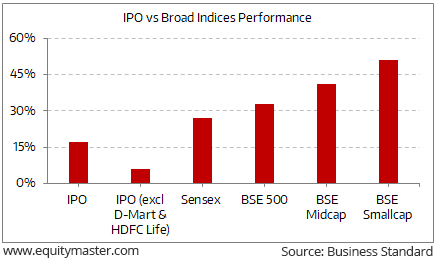
One shall note that, more than 70% of the IPOs listed in 2007 and 2008 are in the red, even today when the Sensex is at an all-time high. But it doesn't make sense to completely ignore this space. The IPO space has also given us names like Maruti, TCS, and Jubilant Foodworks Ltd (with returns over 4,000%, 1,000%, and 500% respectively) that have created immense wealth for shareholders.
For the retail investor, it is very important to ignore the noise and focus on the fundamental and valuations on the table. And more often than not, this approach works much better than following the herd.
A merit-based selection primarily including valuation, business, and management quality is the logical way to go about investing in IPOs. If it means going against the herd, so be it. And going by recent past, this strategy has been proven to be successful more often than not.
In news from the manufacturing sector. Indian manufacturing activity lost momentum in February. The sector which showed signs of rebounding in January grew sluggishly in February as new orders eased and weighed on output after manufacturers raised prices at the fastest pace in a year.
According to the Nikkei Purchasing Managers' Index (PMI) survey by Markit, India's manufacturing activity lost steam in February and slumped to a four-month low.
The PMI is the reading of the country's manufacturing sector output and is updated monthly. A reading above 50 indicates expansion, while any score below the mark denotes contraction.
PMI in February stood at 52.1, declining from the 53.4 reading in January. Both purchasing activity and pre-production inventories decreased due to subdued demand. However, despite the slow pace of growth, PMI in February held above the 50 mark that separates growth from contraction for the seventh consecutive month.
The report said that this suggests retail inflation could continue to pick up over coming months, pressuring the Reserve Bank of India (RBI) to raise interest rates despite concerns that tighter policy could weigh on economic growth.
On the price front, input cost pressures rose at the fastest pace since February 2017. Subsequently, firms reportedly raised their output prices to pass on greater cost burden to clients and protect their profit margins.
The data comes as the Reserve Bank of India's (RBI's) Monetary Policy Committee kept interest rates unchanged this month and as minutes of the February RBI meeting released last week showed policymakers were increasingly worried about accelerating inflation.
While retail inflation eased in January from a 17-month high in the prior month, price rises are still above the RBI's medium-term target of 4 percent on rising energy costs and expectations for an increase in rural spending by the government.
The latest PMI data suggests risks for inflation remain on the upside.



Comments
Log in or sign up to join the conversation.