

Share markets in India have erased early gains but are still trading on a positive note.
The BSE Sensex gained over 450 points in early trade today and is presently trading up by 181 points, up 0.5%, at 34,900 levels.
Meanwhile, the NSE Nifty is trading up by 58 points.
The BSE Mid Cap index is trading up by 1.4%. The BSE Small-Cap index is trading up by 1.1%.
On the sectoral front, gains are largely seen in the pharma sector and finance sector.
IT stocks, on the other hand, are witnessing selling pressure.
The rupee is trading at 76.13 against the US$.
Gold prices are trading up by 0.5% at Rs 48,161 per 10 grams.
Market participants are tracking Glenmark Pharma share price. Shares of the company zoomed 35% today after it became the first Indian company to secure drug regulator's nod on manufacturing and marketing the antiviral drug, Favipiravir in India.
The Drug Controller General of India (DCGI) granted Glenmark Pharma the permission to manufacture and market Favipiravir for restricted emergency use in mild to moderate cases.
Favipiravir, which has been approved in Japan since 2014 for the treatment of novel or re-emerging influenza virus infections, has shown clinical improvement of up to 88% in mild to moderate Covid-19 cases, the company stated.
In news from the banking sector, ICICI Bank and State Bank of India (SBI) are among the top buzzing stocks today.
ICICI Bank has sold 1.5% stake in its life insurance arm ICICI Prudential Life Insurance for Rs 8.4 billion.
Reportedly, this was done to strengthen the bank's balance sheet in light of the pandemic that is expected to worsen the bad loans problem of the banks.
In Q4FY20, for bad loans and coronavirus-related disruptions, the bank has made provisions of Rs 59.7 billion, up 9% from Rs 54.5 billion in Q4FY19.
Compared to the previous quarter's figure of Rs 20.8 billion, provisions were up almost 186%.
This is the second such transaction conducted by the bank to strengthen its balance sheet. Last week, the private lender sold 3.96% stake in its general insurance arm, ICICI Lombard, for Rs 22.5 billion.
The bank has now raised Rs 30.9 billion by selling stake in its life and general insurance subsidiaries.
Recently, State Bank of India (SBI) also divested some part of its stake in its listed life insurance arm SBI Life Insurance for Rs 15.2 billion.
UK's Standard Life also sold 1.3% stake in HDFC Life Insurance.
According to rating agency India Ratings, the stress emerging from severe economic shock caused by steps to contain Covid-19 pandemic may drive total slippages of up to Rs 5.5 trillion in the country in FY21.
The corporates side may see slippages to the tune of Rs 3.4 trillion and non-corporates comprising retail, farming, and MSME, may account for about Rs 2.1 trillion stressed loans.
In other news, SBI chairman Rajnish Kumar assured shareholders that the likely job cuts and salary reductions in the wake of the Covid-19 pandemic will leave a 'relatively low level' of stress on the bank as the proportion of business from government and the quasi-government sector is high.
In a letter to the bank's shareholders, Kumar exuded confidence that despite economic headwinds, the robust performance achieved by the country's largest lender in 2019-20 will continue in the current financial year.
SBI registered its highest ever yearly net profit in 2019-20 at Rs 144.9 billion. The net profit was Rs 8.6 billion during 2018-19.
Speaking of the banking sector, it is interesting to note that public sector banks (PSBs) have struggled due to rising NPAs.
NBFCs have struggled after the IL&FS crisis and are wary to lend.
However, there has been a silver lining in this mess. i.e. the increased market share of private sector banks. This is evident in the chart below:
India's Credit Shift Megatrend
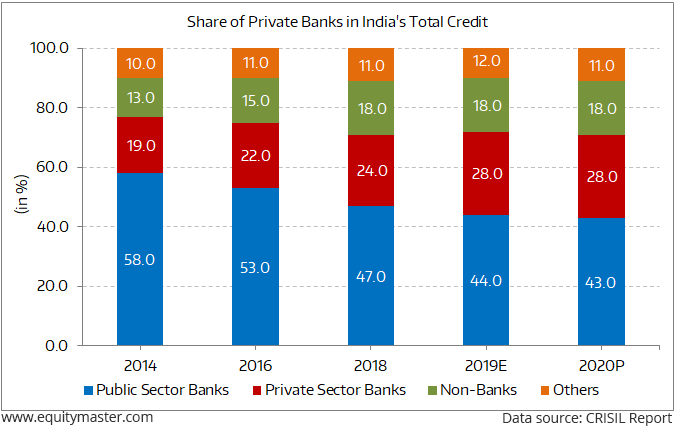
Since 2014, private banks have consistently gained market share mainly at the expense of PSU banks.
With PSU banks still struggling to get out of their NPA mess, this trend is set to continue.
I recently reached out to Tanushree Banerjee, who is closely tracking the banking sector in the current scenario. Here's her view on the sector...
- The Covid-19 lockdown has hit cash flows of both individual borrowers and corporates. This, in turn, will impact their loan repayment capability.
The RBI's repo rate cut came as a temporary lifeline for Indian companies with debt on books. It will offer both companies and retail borrowers some breather. If banks use this phase judiciously, it may save the NPA ratios from worsening significantly.
However, only the banks that have adequate capital and provisioning cushion may be able to tide over the economic crisis. Eventually, another round of consolidation in private sector banks, like the one after 2002, cannot be ruled out.
Tanushree's latest StockSelect recommendation is one such midcap bank.



Comments
Log in or sign up to join the conversation.