

Although the benchmark indices opened lower, they traded negatively throughout the session and ultimately closed red.
Indian equity benchmarks, Sensex and Nifty50, losses to the second session as investors worried that the continued blockade at the Strait of Hormuz would deepen the energy supply crisis.
At the closing bell, the BSE Sensex closed lower by 852 points (down 1%)
Meanwhile, the NSE Nifty closed 205 points lower (down 0.8%)
Bharti Airtel, Sun Pharma, Bharat Elec among the top gainers today.
Trent, Tech Mahindra, and HDFC Bank, on the other hand, were among the top losers today.
The GIFT Nifty was trading at 24,147 lower by 216 points at the time of writing.
The BSE 150 Midcap index is trading 0.3% lower, and the BSE 250 SmallCap index is trading 0.4% lower.
Sectoral indices were trading mixed today, with stocks in the healthcare sector and the power sector witnessing buying. Meanwhile, stocks in the banking sector and real estate sector witnessed selling pressure.
The rupee is trading at Rs 94.1 against the US$.
Gold prices for the latest contract on MCX are trading 0.4% lower at Rs 1,51,920 per 10 grams.
Meanwhile, silver prices were trading 2.4% lower at 2,42,200 per 1 kg.
Four reasons why Indian share markets are falling:
#1 Banking and Big Stocks Falling
Banking stocks like HDFC Bank and ICICI Bank have fallen, which dragged down the overall market because these companies carry a lot of weight in indices like Sensex and Nifty. Along with banks, other big companies and auto stocks also declined. Investors are selling these heavyweights to book profits due to ongoing global uncertainties.
#2 Crude Oil Prices Rising Again
Crude oil prices have gone above $100 per barrel due to rising tensions between the US and Iran. Higher oil prices increase expenses for countries like India that import oil. This creates pressure on the economy and weakens overall market sentiment.
#3 Uncertainty Around US-Iran Situation
There is still no clear outcome in the US-Iran conflict, even though a ceasefire has been extended. Peace talks remain uncertain and delayed, with no proper timeline. This lack of clarity is making investors cautious about the market's near-term direction.
#4 Foreign Investors Selling Stocks
Foreign institutional investors (FIIs) have started selling Indian stocks again after briefly buying earlier. They are mainly selling large-cap stocks, which is putting pressure on the main indices. However, they are still investing in some mid and small cap stocks, helping those segments perform better.
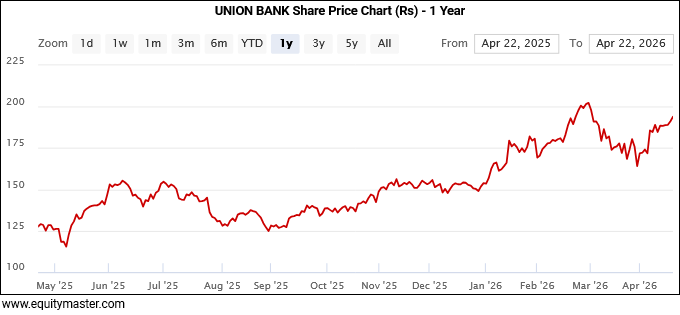
Union Bank Q4 FY26 Results
Shares of Union Bank came into focus after the company reported its Q4 FY26 results.
Net interest income (NII) came in at around Rs 94.06 bn, down 1.14% year-on-year from Rs 95.14 bn, but slightly up 0.84% quarter-on-quarter. The bank's net interest margin (NIM) declined to 2.64% from 2.76% in the previous quarter.
Operating profit stood at about Rs 79.55 bn, growing to just 3.3% year-on-year, mainly due to a sharp 61.4% fall in treasury income, which dropped to Rs 6.36 bn.
Asset quality improved, with gross NPAs declining to around Rs 304.01 bn from Rs 311.21 bn in the December 2025 quarter and from Rs 353.50 bn a year ago.
Union Bank of India reported a net profit of about Rs 53.16 bn in Q4FY26, which was almost flat compared to Rs 50.17 bn in the previous quarter. On a yearly basis, profit rose 6.6% from Rs 49.85 bn in Q4FY25.
Oracle Financial Services Q4 FY26 Results
Shares of Oracle Financial Services came into focus after the company reported its Q4 FY26 results.
Revenue for the quarter stood at around Rs 20.65 bn, rising 20% year-on-year and 5% sequentially.
The products segment generated revenue of Rs 18.71 bn, up 21%, while the services segment contributed Rs 1.94 bn, growing 11%.
The company reported a net profit of about Rs 8.42 bn in Q4, marking a 30% increase from Rs 6.44 bn a year ago. On a quarter-on-quarter basis, profits grew strongly by 38%.
The board also announced a second interim dividend of Rs 270 per equity share (face value Rs 5) for FY26, with the record date set for 7 May 2026.
Oracle Financial Services is a global leader in financial services software and operates as a majority-owned subsidiary of Oracle Corporation.



Comments
Log in or sign up to join the conversation.