

Although the benchmark indices opened lower, they traded negatively throughout the session and ultimately closed red.
Indian equity benchmarks, Sensex and Nifty50, ended sharply lower as the prolonged US-Iran conflict deepened the gas supply crunch.
At the closing bell, the BSE Sensex closed lower by 1,470 points (down 1.9%)
Meanwhile, the NSE Nifty closed 488 points lower (down 0.9%)
HUL, Bhati Airtel are among the top gainers today.
Tata Steel, Bharat Elec, and M&M, on the other hand, were among the top losers today.
The GIFT Nifty was trading at 23,202, lower by 515 points at the time of writing.
The Nifty Midcap 100 index is trading 2.6% lower, and the Nifty Smallcap 250 index is trading 2.6 % lower.
Sectoral indices are trading negatively today, with stocks in the auto sector and banking sector witnessing selling pressure.
The rupee is trading at Rs 92.17 against the US$.
Gold prices for the latest contract on MCX are trading 0.4% lower at Rs 159,529 per gram.
Meanwhile, silver prices were trading 1.5% lower at 2,63,992 per 1 kg.
Six reasons why Indian share markets are falling:
#1 Crude Oil Surge:
Crude oil prices rose after Iranian strikes on two oil tankers increased fears of supply disruption through the Strait of Hormuz, with Brent crude trading around USD 100.5 per barrel. Higher oil prices are negative for India as they increase the import bill, fuel inflation and may hurt corporate earnings and market sentiment.
#2 Weak Global Cues:
Global markets remained under pressure due to rising geopolitical tensions, with major Asian indices and US markets ending lower. Analysts said uncertainty from the West Asian conflict and high oil prices are keeping investors cautious.
#3 Persistent FII Selling:
Foreign Institutional Investors continued to sell Indian equities, offloading shares worth ?7,049.87 crore on Thursday. In March so far, FIIs have sold stocks worth more than ?39,000 crore, adding pressure on the market.
#4 Rupee at Record Low:
The Indian rupee weakened to a record low of 92.37 against the US dollar on Friday amid high crude oil prices and continued FII outflows. A weaker rupee raises import costs, especially for crude oil, which can increase inflation.
#5 US Fed Policy Outlook:
Investors are awaiting the US Federal Reserve's policy decision on March 17, where rates are expected to remain unchanged. However, markets will closely watch the Fed's economic outlook and inflation projections amid rising energy prices.
#6 Selling in Bank, Auto Shares:
Banking stocks saw heavy selling with PSU banks leading the losses, pushing the Bank Nifty index lower. Auto stocks also declined for the second straight session as rising crude prices and supply concerns weighed on the sector.
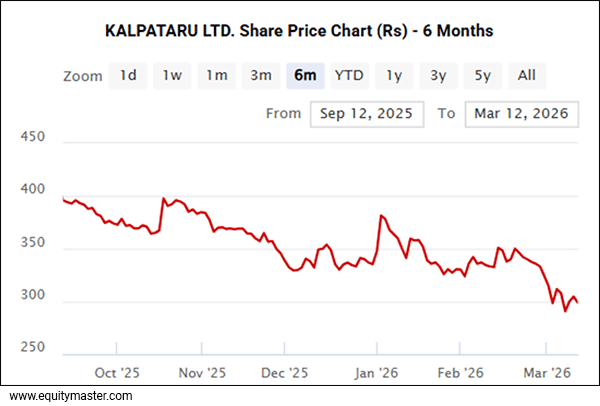
Kalpataru Shares Rise on Mumbai Redevelopment Deal
Shares of real estate developer Kalpataru came into focus after the company announced signing a new redevelopment project in Andheri West, Mumbai.
The project covers about 3 acres of land and has a potential carpet area of around 0.4 million square feet, with an estimated Gross Development Value (GDV) of nearly Rs 14 billion (bn).
The company said the project is situated in Andheri West, one of Mumbai's well-developed residential and commercial areas, which offers strong connectivity and a well-established social infrastructure. The locality has reputable schools and colleges, healthcare facilities, shopping centers, entertainment options, and major business hubs nearby.
Kalpataru stated that redevelopment will strengthen its project pipeline and align with its strategy to focus on redevelopment opportunities in the Mumbai Metropolitan Region. The fully residential project will feature modern homes designed for contemporary living, with a focus on sustainability, amenities, and convenient connectivity.
Balaji Amines Shares Slip on Ammonia Disruption
Shares of Balaji Amines came into focus after the company informed them that it is facing a sharp disruption in the procurement of ammonia, a key raw material, after the ongoing war in West Asia disrupted global shipping and supply chains and led some suppliers to invoke force majeure.
In its disclosure, the company said the ongoing conflict has severely disrupted global logistics networks, with some key raw material suppliers declaring force majeure, meaning they are unable to fulfil their supply commitments. This has affected the availability of liquefied natural gas (LNG), which is an important raw material used to produce ammonia. As a result, several ammonia manufacturers have indicated that they are currently unable to supply the product.
Balaji Amines said it is facing major logistics challenges in sourcing ammonia, which is a key input used to manufacture methylamines, ethylamines, and related derivatives



Comments
Log in or sign up to join the conversation.