

Share markets in India have extended early gains and are presently trading on a strong note. All sectoral indices are trading on a positive note with stocks in the telecom sector, metal sector and realty sector witnessing maximum buying interest.
The BSE Sensex is trading up by 338 points (up 0.8%), while the NSE Nifty is trading up by 104 points (up 0.9%). The BSE Mid Cap index and the BSE Small Cap index are trading up by 0.8% and 0.5%, respectively.
Speaking of the Indian share markets, how expensive is the Sensex at current levels? What has the trend been in recent years?
It would be interesting to see how the valuation of the index has moved over the last five years.
The chart below maps the price to earnings ratio of the Sensex from October 2014 to now.
How Pricey Is the Sensex Now?
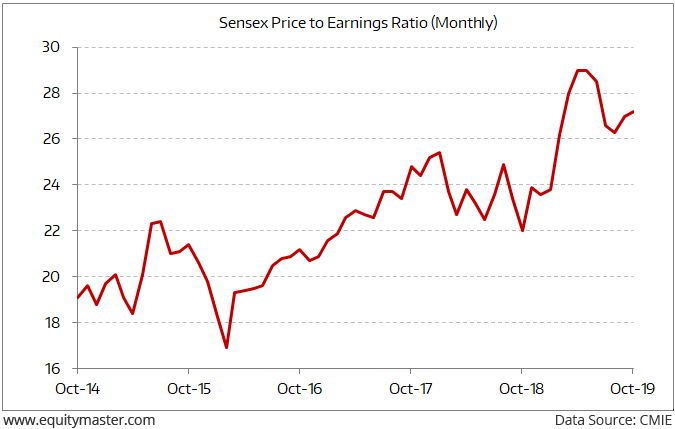
So, before taking the current market bullishness for granted, do weigh in the fact that the Sensex is quite expensively priced.
In news from the currencies space, the rupee is presently trading at 71.63 against the US$.
The domestic currency is trading on a flat note today as traders await gross domestic product (GDP) data and developments in US-China trade talks.
The dollar and export-focused currencies edged higher today on broadly upbeat headlines about US-China trade talks, while the pound climbed on hopes of an imminent Brexit and an end to years of political paralysis.
Sustained foreign fund inflows supported the local currency. Foreign money once again made its way into Indian equities.
Foreign portfolio investors (FPIs) infused a net Rs 177.3 billion into the Indian markets in November so far amid encouraging domestic and global cues.
Data showed that overseas investors pumped in a net sum of Rs 175.5 billion into equities and Rs 1.8 billion in the debt segment.
FPIs were net buyers in the preceding two months as well. They infused a net Rs 164.6 billion in October and Rs 65.6 billion in September.
Note that the rupee had dropped to 72.24 against the US$ earlier this month, a whisker away from a nine-month low of 72.41 set in September.
Selling pressure was seen due to escalating levels of public debt and a credit crunch among NBFCs.
Moving on to news from the banking sector, the Reserve Bank of India (RBI) has asked Yes Bank to re-examine the "fit and proper" status of the lender's audit committee chairman Uttam Prakash Agarwal after it was found that he had failed to disclose details of criminal cases filed against him.
In an email addressed to the private lender's chairman, RBI said that the bank must re-examine the fit and proper status of Agarwal. Based on the re-examination, the decision taken by the board of the bank be advised to the department of banking regulation.
In November 2018, Yes Bank received a whistleblower complaint questioning Agarwal's status. The complaint was received soon after he was appointed as an independent director during the tenure of co-founder and former MD Rana Kapoor.
As per an article in a leading financial daily, Agarwal had contested Maharashtra assembly polls as a Shiv Sena candidate in 2014. At that time, he had disclosed that there were criminal cases against him under IPC 406, 420, 504 and 34, all of which are charges related to cheating and criminal breach of trust.
As per the RBI's criteria, directors on bank boards have to disclose several details, including if there are any criminal proceedings pending or commenced or resulting in conviction in the past.
Yes Bank has sought external opinion from a law firm and a senior retired judge, both of whom concluded that Agarwal has suppressed material information before being appointed.
However, Agarwal claimed to the board that this was just an omission and that all cases pending against him were civil in nature and had been dismissed in 2015 itself.
How this development pans out remains to be seen. Meanwhile, we will keep you updated on the latest developments from this space.


Comments
Log in or sign up to join the conversation.