

Share markets in India are presently trading on a negative note. Sectoral indices are trading on a mixed note with stocks in the energy sector, automobile sector, and IT sector witnessing maximum selling pressure, while realty stocks are witnessing buying interest.
The BSE Sensex is trading down by 152 points while the NSE Nifty is trading down by 49 points. The BSE MidCap index is trading up by 0.2% and the BSE SmallCap index is trading up by 0.1%.
The rupee is trading at 71.43 against the US$.
The domestic currency hit a near one-month low today, tracking its Asian peers which fell on fresh doubts over US-China trade deal.
Asian currencies fell after US President Donald Trump said on Friday that the US government has not agreed to roll back all tariffs with China.
The rupee opened at 71.34 per dollar and touched a low of 71.38, a level last seen on 17 October.
According to a Reuters poll, a slowing domestic economy will prevent rupee from recouping this year's losses against the dollar in 2020, with optimism around an easing in the US-China trade dispute not enough to give it a further boost.
The domestic unit had touched a low of 72.40 per dollar on September 4. Since then, it has recovered nearly 2% amid hopes of a possible trade deal between the world's two largest economies.
Speaking of currencies, Vijay Bhambwani, editor of Weekly Cash Alerts, tells you the main reasons why not to trade commodities and currencies the same way you would trade equities. Here's an excerpt of what he wrote...
- Currencies are traded in pairs and the most liquid is the USDINR. Currencies are traded in four decimal points just as bonds are. The international derivative trader's association has indicated that forex may be traded in 6 decimals in the coming few years.
It takes months sometimes for the currency pair to pass the next round figure, say from 70 to 71.
Can you really trade commodities and currencies alike or for that matter, equities and currencies alike? Definitely not!
To know more, you can read Vijay's entire article here: Is Trading in Equities, Commodities, and Currencies the Same?
In news from the auto ancillaries sector, shares of Amara Raja Batteries climbed 7% in early trade today after the company reported 370 bps improvement in EBITDA (earnings before interest, tax, depreciation and amortization) margin at 17.2% in the September 2019 quarter (Q2FY20).
The company reported its highest-ever net profit of Rs 2.2 billion, up 82% on a year-on-year (YoY) basis. Profit before tax (PBT) increased 25% (YoY) at Rs 2.3 billion during the quarter.
However, operational revenue declined 3% to Rs 17 billion on YoY basis.
Both, the automotive and industry battery businesses recorded healthy volume growth during the quarter barring automotive OE segment.
The management said the demand for Amaron, and Power Zone brands registered significant uptick in replacement market in four-wheeler as well as two-wheeler segments.
Amara Raja Batteries' share price is presently trading up by 7.4%.
To know more, you can read Amara Raja's Q2FY20 result analysis on our website.
In other news, Bharat Forge share price is in focus today.
On Friday, shares of Bharat Forge slipped 8% after the company's consolidated PBT declined 27% YoY to Rs 2.5 billion in Q2FY20 due to de-growth in revenue.
EBITDA margin contracted 690 bps at 14.7% from 21.6% in the year ago quarter.
The management described the quarter gone by as "the toughest in this decade." They added that weak end-demand across sectors due to the sluggish macroeconomic environment in India led to the continuous decline in the demand.
Speaking of the slowdown in the auto sector, it is interesting to note that despite the slowdown, the sales volume of electric vehicles (EVs) are growing at a robust pace.
Have a look at the chart below:
Electric Vehicle Sales on a High Growth Trajectory!
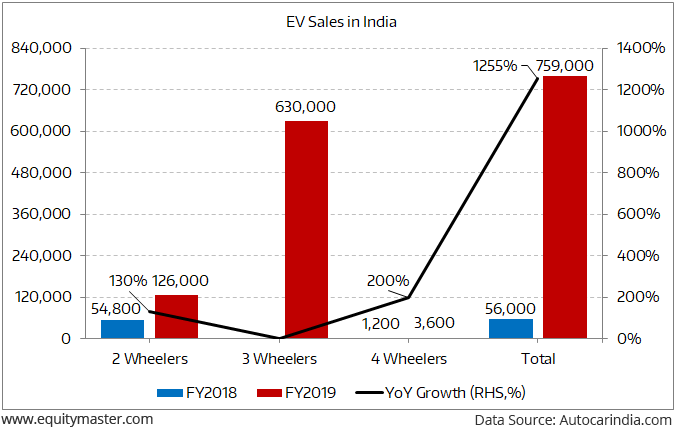
Electric-2 wheelers sales volume registered 130% YoY growth in FY19. 4-wheeler EVs grew by 200% YoY.
Similarly, electric three-wheelers reported the highest sales volume of 630,000 units. It is important to note that the electric three-wheeler industry has been growing without government support.
The base is quite low compared to the internal combustion engine (ICE) vehicle sales. However, you cannot ignore the growing momentum in EV sales.
The recently announced government incentives will give a further boost to EV sales.
The coming one year will be a real test for India's auto companies.
It will also tell us if this slowdown is temporary or if there has been a structural change in the sector.
In our view, companies in the sector adapting their business models to the rapidly changing environment will survive and thrive.



Comments
Log in or sign up to join the conversation.