

Asian shares are higher today as Japanese and Hong Kong shares show gains. The Nikkei 225 is up 0.4% while the Hang Seng is up 1.2%. The Shanghai Composite is trading up by 0.9%. US stocks climbed on Monday, led by shares of technology companies. However, the gains were limited as President Donald Trump indicated that a decision was imminent on whether the US would decertify a 2015 Iran nuclear pact.
Back home, India share markets opened the day marginally higher. The BSE Sensex is trading up by 66 points while the NSE Nifty is trading up by 15 points. The BSE Mid Cap index is trading down by 0.1%, while the BSE Small Cap index has opened the day up by 0.1%.
Sectoral indices have opened the day on a mixed note with banking stocks and healthcare stocks witnessing maximum buying interest. IT stocks and consumer durables stocks have opened the day in red. The rupee is trading at 67.26 to the US$.
From the banking space, ICICI Bank share price will be in focus today as the bank reported a 50% drop in its fourth-quarter profit as it set aside cash to cover a surge in bad loans. The board also stayed mum on the controversy surrounding its chief executive officer Chanda Kochhar on allegations of conflict of interest with respect to loans made to the Videocon Group.
Apart from the above, Godrej Consumer Products share price, Jubilant FoodWorks share price, Blue Dart share price, and HEG share price will be in focus today as they are scheduled to report their results for the quarter ended March 2018.
In the news from currency markets, as per an article in the Economic Times, the Reserve Bank of India (RBI) intervened in the currency markets yesterday to prevent a further fall in the Indian rupee which breached the 67 mark against a dollar for the first time in around 15 months.
The slide in rupee is seen on the back of a widening trade gap and runaway import bills fueled by rising crude oil prices.
What does the fall in rupee mean for the Indian economy?
A depreciation in rupee means importers buying goods and services at a higher rate that earlier. This doesn't bode well for a developing economy that relies heavily on imports.
Also, India imports most of its oil requirements. So, a fall in rupee leads to a consequent rise in the import bill.
On the corporate side, companies who have taken foreign loans from abroad will be impacted. The repayment obligations in terms of principal and interest will rise, leading to a dent in the cash flows and financials.
Further, companies who import a majority of their raw material requirements will get impacted provided they have not hedged their foreign currency exposure.
Looking at the brighter side, rupee depreciation brings a cheer on the exports front. A depreciating rupee will provide a much-needed cushion to falling exports. However, a falling rupee will not be the only factor to boost exports. There are certain structural issues too which the government needs to address.
In the news from global financial markets, as per a leading financial daily, Federal Reserve officials stated that rising US inflation and wage pressures are not enough yet to prompt a change in the central bank's interest rate outlook.
Atlanta Federal Reserve Bank President Raphael Bostic and Dallas Federal Reserve Bank President Robert Kaplan both said they would tolerate inflation a bit over the Fed's 2% target, and were sticking with an outlook for two more interest rate increases this year.
The comments cause a concern amid rising crude oil prices, which have touched US$ 70 per barrel.
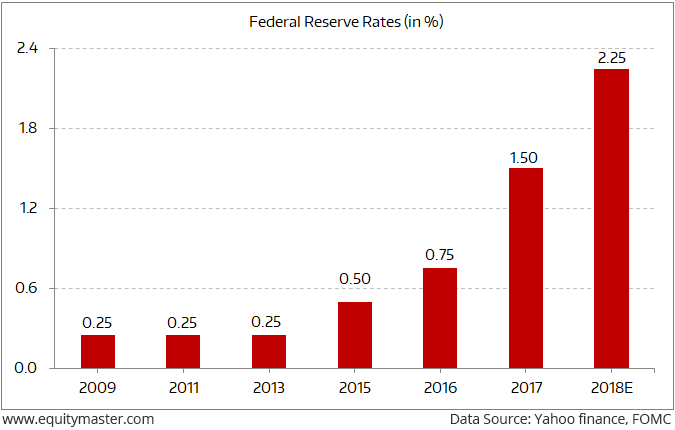
In its latest policy meeting, the US Federal Reserve left interest rates unchanged at 1.50-1.75% and signaled that the gradual path of rate hikes will stay.
Note that with the US economy chugging along for many months, the Fed is now gradually easing off the stimulus it provides to the economy by raising interest rates to more normal levels.
Federal Reserve Rate Hike in the Past 3 Years
How does a US interest rate hike affect Indian investors?
The instant effect is foreign money moving out of India's vaults. This means a slight correction in the share market in India, albeit temporarily.
While this might provide a good buying opportunity in long-term stocks, the main thing to look forward would be capex and earnings trends.
In the end, Indian investors are better off staying informed about the corporate earnings revival than Fed rate hikes.
It is also worthwhile to note that the Indian stock market has done relatively well during the last period of rate hikes by the US Fed.
Take 2003-2006 for example...
Between 2003 and 2006, the US Fed rate moved from 1% to 5.25%.
Despite this, the Sensex rose from 3,500 levels to more than 10,000 during the same period. This increase was supported by strong earnings growth.
So, in the long term, rate hikes (triggered by economic growth) have proved good for the Indian markets. In fact, earnings growth is at the heart of Tanushree's prediction of Sensex 100,000.
Comments
Log in or sign up to join the conversation.