

Asian share markets are lower today as Japanese and Hong Kong shares fall. The Nikkei 225 is off 0.5% while the Hang Seng is down 0.4%. The Shanghai Composite is trading down by 0.5%. US stocks rose sharply on Thursday after President Donald Trump clarified his position on a possible missile attack in Syria, while bank shares popped ahead of earnings.
Back home, India share markets opened the day on a firm note. The BSE Sensex is trading higher by 121 points while the NSE Nifty is trading higher by 36 points. The BSE Mid Cap index and BSE Small Cap index both opened the day up by 0.3%.
All sectoral indices have opened the day in green with metal stocks and bank stocks witnessing buying interest. The rupee is trading at 65.35 to the US$.
In the news from the economy. As per the data released on Thursday, retail inflation cooled to a five-month low of 4.28% in March following a decline in food prices including vegetables. The inflation based on Consumer Price Index (CPI) was 4.44% in February.
The inflation remained above the Reserve Bank of India's medium-term target, supporting views that monetary policy is likely to remain unchanged at the next review in early June.
The RBI, which has kept rates steady since a cut of 25 basis points in August, is widely expected to maintain rates at their current level in the next review due on 6 June.
Last week, the central bank lowered its April-September retail inflation projection to 4.7% to 5.1%, from a previous range of 5.1% to 5.6% released in February.
Notably, the retail inflation rate has been moderating since it hit a 17-month high of 5.2% in December. It had crossed the 12% mark in 2013 but has remained under control since, thanks to lower crude oil prices, tighter monetary policy and fiscal measures.
RBI Governor Urjit Patel said last week there were still uncertainties, such as a proposed hike in the minimum purchase prices of foodgrains, fiscal slippage worries and volatility in global crude prices.
Consumer food prices rose 2.81% in March, compared with 3.26% in February, as prices of pulses fell more than 13.4% from a year earlier.
Rising global crude oil prices and domestic health cost prices are contributing to India's inflation while prices of services, such as internet data prices, have fallen.
Further, fuel and light inflation stood at 5.73%, compared with 6.8% in February, while housing inflation stood at 8.31%, from 8.28% the previous month.
Separately, India's annual industrial output grew 7.1% in February.
However, we, at Equitymaster, do not attempt to predict how and when macroeconomic developments will unfold. Instead, we focus on the fundamentals and the underlying business strength of companies. The ValuePro team is always on the lookout for all-weather stocks whose fortunes are not tied to economic cycles.
Moving on to the news from the IPO space. Real estate firm Shriram Properties Pvt. Ltd is planning to raise around Rs 10 billion from an initial public offering (IPO) and enter the low-cost housing segment with homes in the Rs 1.5-2.5 million price range.
In 2017-18, a tough year for most developers, Shriram Properties sold 1,204 homes in Bengaluru, its core market, and 555 in Chennai. In 2018-19, it expects to sell almost double the number of units.
Further, Shriram Properties has four large investors at the company level-Walton Street Capital LLC, Starwood Capital Group, Tata Capital Ltd and TPG Capital.
Reportedly, the Shriram Properties IPO would generate liquidity for these investors as well as potential exits.
Mumbai's Lodha Group, which is expected to file for an IPO soon, will be a determining factor. If it fares well, it will be a huge confidence booster for the realty sector.
Moreover, Shriram Properties, which has a mid-income housing portfolio, plans to enter the low-income group (LIG) housing space and has a pipeline of projects of 6-7 million sq. ft across cities. All these projects will enjoy tax incentives and other benefits under the Pradhan Mantri Awas Yojana (PMAY).
Over the last year, Shriram Properties has raised significant capital from both domestic and foreign investors. Earlier this year, it raised around Rs 10 billion from ASK Group to invest in affordable and mid-income housing projects.
The last time real estate firms hit the primary market was in 2010. Pune-based Paranjape Schemes filed for an IPO in July, 2015 and the proposal was cleared in December, but eventually, the company didn't go ahead with it.
Since then, realty firms have brought institutional investors on board in joint ventures or through stake sales.
If you've been tracking the demand for IPOs, you would certainly think that 2017 was the year of IPOs. For one, IPO subscriptions were at sky-high levels. But if the performance of recently listed IPOs are anything to go by, they have flattered to deceive.
The IPO activity in FY17 is mainly driven by Offer for Sale (OFS) rather than fresh issues. An OFS is a route through which existing promoters and private equity investors offload their stake. Here, the money from the sale goes to the selling shareholder. Whereas, in a fresh issue, the money raised goes to the company who, normally, utilizes this money to repay debt, for capital expenditure, etc.
Also, the number of Private Equity (PE) investors exiting these companies raised a red flag. These PE investors had bought a stake in the IPO recently at a fraction of the listed price. Sensing the frenzy, they were able to offload their stake with multifold returns.
The only person left high-and-dry here was the retail investor. And, this is not a recent occurrence. The IPO euphoria is something similar to what was seen in 2007-08. More than 70% of the IPOs listed in 2007 and 2008 were in the red.
Poor IPO Returns Post Listing
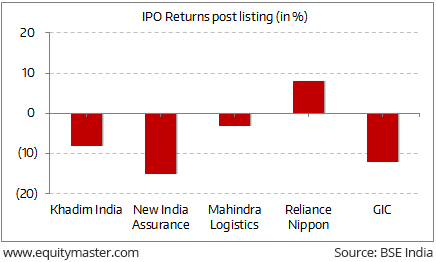
So, for the retail investor, it is very important to ignore the noise and focus on the fundamental and valuations on the table. And more often than not, this approach works much better than following the herd.



Comments
Log in or sign up to join the conversation.