

Majority of Asian stock markets are lower today as Chinese and Hong Kong shares fall. The Shanghai Composite is off 1.05% while the Hang Seng is down 0.08%. The Nikkei 225 is trading down by 0.08%. The Wall Street climbed on Friday as a surge in the tech sector and a rally in Amazon shares helped push the Nasdaq to its best day in nearly a year.
Back home, share markets in India have opened the day on a positive note. The BSE Sensex is trading higher by 118 points while the NSE Nifty is trading higher by 41 points. The BSE Mid Cap and BSE Small Cap index opened the day up by 0.8% & 0.7% respectively.
All sectoral indices have opened the day in green with automobiles sector and energy sector leading the pack of gainers. The rupee is trading at 65.09 to the US$.
Oil & gas stocks have opened the day on a mixed note with ONGC and Hindustan Oil Exploration being the most active stocks in this space. Oil and Natural Gas Corp (ONGC) on Saturday reported a 3.1% rise in its second quarter net profit as impressive gain from rising oil prices were taken away by fall in government mandated natural gas rates.
Net profit of Rs 51.3 billion in July-September was 3.1% higher than Rs 49.8 billion in the same period last year.
ONGC's September quarter earnings were in line with analysts' estimates. Its Ebitda of Rs 104.7 billion was close to estimates. That translates into an 8.5% year-on-year growth in ONGC's Ebitda for the September quarter, helped by a decline in other expenses and comes on the back of a 3% growth in revenue to Rs 189.7 billion.
Further, ONGC got US$51.2 for every barrel of crude oil it produced in the quarter, up 6.9% over US$47.9 per barrel realisation in September quarter of the last fiscal. For the fields operated jointly with private firms, the realisation was up 8.5% to US$45.9 per barrel.
Additionally, production numbers have been encouraging, especially on the gas front. For the half year to September, ONGC's total gas output increased 8.4% over a year ago and total crude oil production increased 1.2%. Sustaining and further improvement in these trends will augur well for the stock, the reports noted.
As per Livemint, given that recent reports suggest that the ONGC-HPCL deal may happen around HPCL's market price, it should augur well for ONGC shares post that. The news flow on the deal will be a crucial measure to follow for the stock.
So, what lies ahead for the merged entity? Richa Agarwal, our oil & gas sector analyst has shared her views in the recent edition of The 5 Minute WrapUp. Here's a snippet of what she wrote:
- "A fall in the oil prices has dented the profitability of oil exploration companies such as ONGC. The merger with a downstream company will help ONGC de-risk its business. ONGC will also benefit from the huge fuel retail network of HPCL."
Going forward, whether the move will be executed well or will lead to further complexities and integration issues instead of synergies will be the key thing to watch out for.
ONGC share price surged 2.7% in the early trade.
In another development, Foreign investors have pumped in close to US$ 3 billion in the Indian capital markets so far this month due to high nominal and real yields and stable macroeconomic conditions.
Interestingly, most of the funds have been infused in the debt markets.
According to the latest depository data, FPIs invested a net sum of Rs 28.1 billion in the stock markets and another Rs 151.3 billion in debt, taking the total to Rs 179.4 billion (US$ 2.8 billion) during 3-27 October.
This follows a net outflow of over Rs 100 billion from the capital markets last month. Prior to that, they had pumped in Rs 1.8 trillion in the preceding six months (February- August).
Reportedly, Indian bonds remain attractive on high nominal and real yields as well with the backdrop of macroeconomic stability and hence it continues to attract FPIs.
With regard to lower equity inflows, the same can be attributed to profit booking by FPIs amid high valuations.
One shall note that, Indian equities remain extremely overvalued even from a global emerging market perspective and hence witnessing lower inflows compared to bonds.
In fact, amongst all major indices, the Indian stock markets have given the best returns in 2017. Back in March 2016, we had predicted Sensex to touch 40,000 within a 3 to 4-year timeframe.
Global Index Returns in 2017
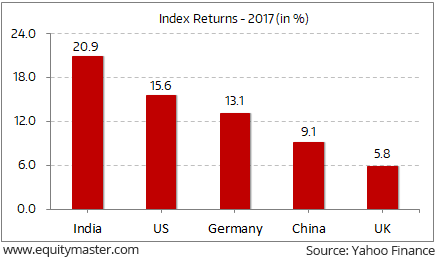
At this pace, it seems like Sensex might get there sooner rather than later. Which may not necessarily be a good thing. The current run seems to extrapolate all good news into the future and expects the ride to be smooth and consistent. But, history has shown that markets rarely work that way.
In such an environment, it makes sense for investors to be selective while buying stocks. Focus on value and the underlying fundamentals of the business. Then, they need not worry about the market.
So, what is key to identifying potential multibagger stocks? How does one pick them at the right time and ride them to their full potential? How many multibaggers do you really need to achieve the big riches that you desire?



Comments
Log in or sign up to join the conversation.